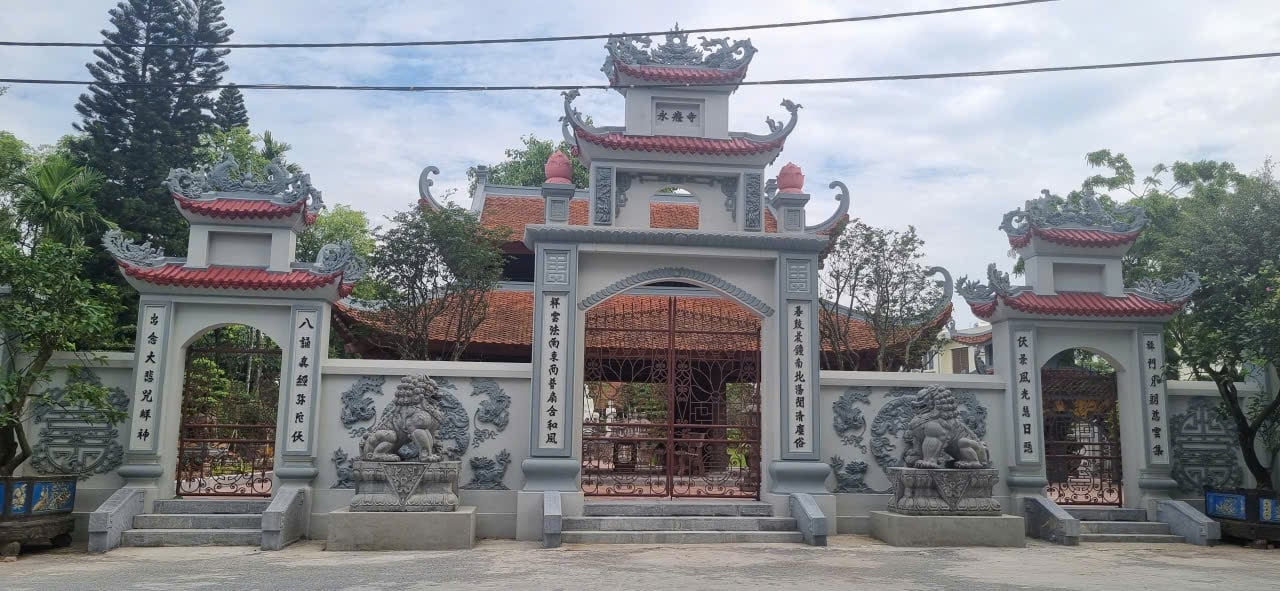
Phuong Bang Pagoda (Hung Long)
Introduction
HUNG LONG PAGODA
(PHUONG BANG PAGODA)

The pagoda
is located in Phuong Bang 1 village, Son Dong commune, Hanoi city.
Phuong Bang Pagoda (Hung Long Tu) is an ancient Buddhist pagoda with a long history, evidenced by the bas-relief stone carving of the infant Shakyamuni dated to the fourth year of Duc Long (1632). In the upper hall, the Mahayana Buddhist statue system is solemnly arranged in six tiers from top to bottom: at the top are three wooden Tam The statues seated on three-tiered lotus thrones; below are the statue of Shakyamuni preaching and the largest Amitabha statue in the pagoda, both made of lacquered and gilded wood, flanked by attendant Bodhisattvas; the fourth tier consists of the Jade Emperor statue in the center, with Manjushri Bodhisattva seated on a green lion and Samantabhadra Bodhisattva seated on a white elephant on either side; the fifth tier is an ancient Le dynasty statue of Thousand-Hand Thousand-Eye Guanyin with 16 arms, and at the bottom is a wooden infant Shakyamuni statue from the Nguyen dynasty. Outside, the two corridors display two rows of Ten Courts statues along with statues of Hau and Guanyin seated on a mountain, while the worship hall contains statues of the Holy Monk and the Earth God. The rich collection of ancient statues from the 17th century and this rare precious stone relief are important sources of documentation proving the pagoda's long existence.


Phuong Bang Pagoda (Long Hung Tu) is located on the left bank of the Day River, facing west, and is symmetrically and elaborately planned. The main pagoda has an interconnected Dinh-shaped structure, including the ancient Bai Duong hall (5 bays with 2 side wings, a four-pillar wooden frame with exquisite carvings combined with 6 arch doors featuring the four sacred creatures and four noble plants) and the Thuong Dien (3 longitudinal bays, smoothly planed and tightly joined). The system of stone steles records that the pagoda was once extensively restored by large clans in the 17th and 19th centuries.
Behind the main pagoda is a small vaulted bell tower hanging an ancient bell dated to the Canh Thinh era (1793). Next is the ancestral house with a Dinh-shaped structure, worshipping the Three Holy Mothers and deceased abbots, and serving as a place for monks and nuns' activities. The pagoda grounds also include a stupa garden, surrounding corridors, and old trees. Currently, the pagoda preserves many precious relics such as 40 wooden Buddha statues, a stone relief from 1632, 4 stone steles, 3 Le dynasty incense burners, 2 bronze bells, along with a bronze relic 0.78m high, ancient horizontal plaques and couplets.

Hung Long Pagoda was ranked as a historical, architectural, and artistic relic by the Ministry of Culture and Information in 1997.