
Bich Cau Dao Quan
Introduction
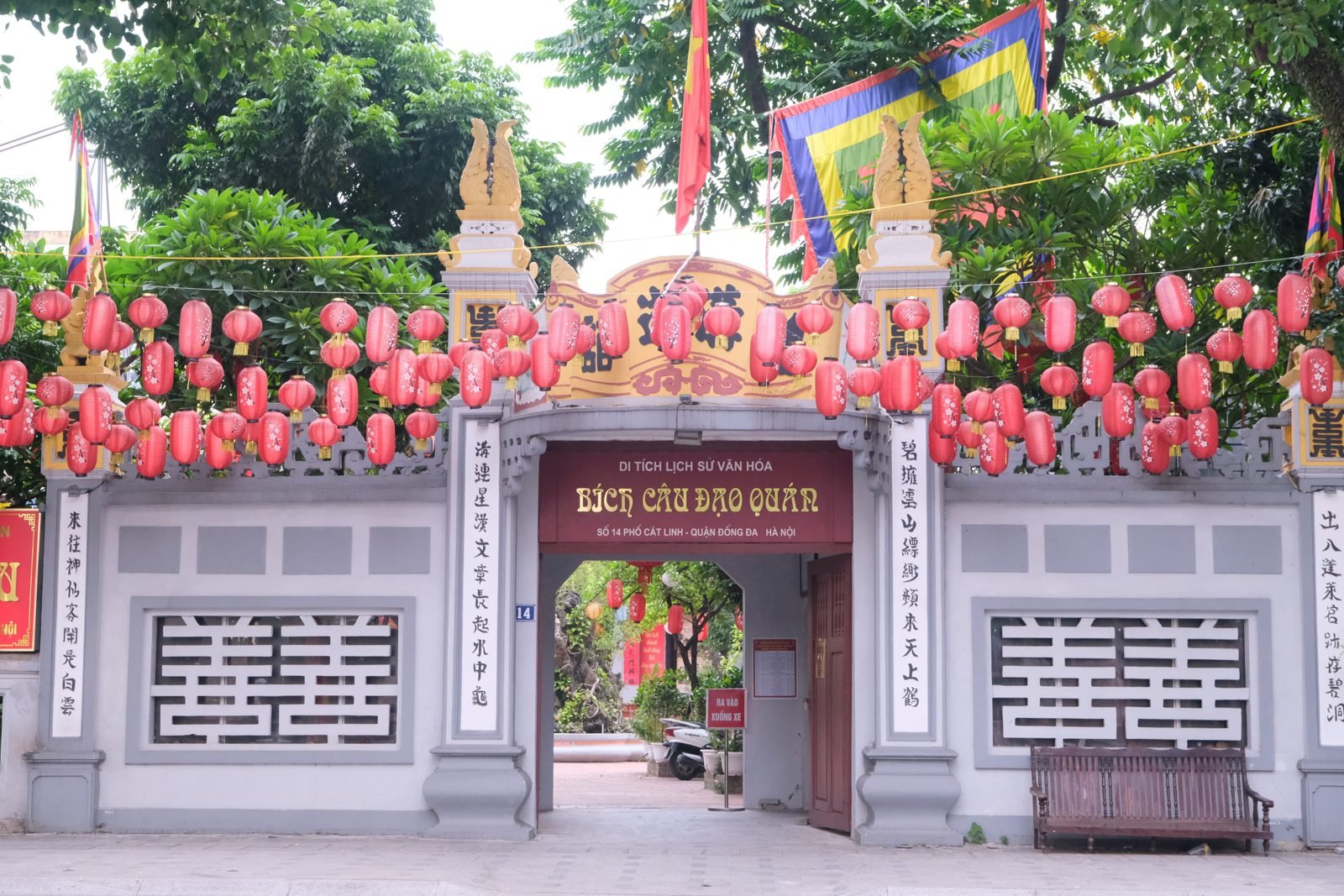
In the past, Taoist priests often came here to practice rituals and worship the immortal Tran Tu Uyen, a talented physician who helped King Le Thanh Tong defeat the enemy. Bich Cau Dao Quan was also a place where poets, writers, mandarins, and Confucian scholars from the Temple of Literature - Quoc Tu Giam gathered to offer and compose poetry. In the 17th century, Taoism declined, and many Taoist temples were converted into shrines and pagodas. Therefore, within the grounds of Bich Cau Dao Quan there are now both a pagoda and a Mother Goddess temple.
After being converted into Bich Cau communal house, the people of An Trach village continued to worship the village tutelary god Tran Tu Uyen. For a long time, Bich Cau Dao Quan fell into ruin and was burned by the French colonialists. In 1953, the people of An Trach village donated funds and restored the relic. The temple still stands on the former Quy Doi mound, with a dinh-shaped architectural layout, including: Nghi Mon, Tien Te, Hau Cung, Mother Goddess house, and guest house.
The Nghi Mon consists of four square-section pillars, decorated with stylized areca flower motifs on the tops, below are lantern panels embossed with the four sacred creatures and four noble plants. In the center is a scroll plaque bearing four characters: Bich Cau Dao Quan. The main gate is the only entrance. The two side gates are low walls decorated with seal-script patterns inlaid with ceramics and porcelain.
Passing through the Nghi Mon and stepping over the three-level steps is a large courtyard with a circular water basin in the center. The Tien Te is built with three bays and two wings, structured as a two-tier, eight-roofed overlapping-eave building. On the roof ridge is a sun motif; on the two gable ends are makara water monsters, sea monsters in Hindu mythology shaped like crocodiles, facing inward. Between the two roof tiers is a horizontal plaque bearing four Chinese characters: Than Kinh Tai Hoi, meaning that the immortals gather here. The Hau Cung is a three-bay longitudinal house built with closed gable walls. Inside is a high platform holding a wooden shrine with three statues: the immortal Tran Tu Uyen in the center, the immortal Lady Giang Kieu on the right, and the immortal child Chau Nhi on the left.
The Mother Goddess house and guest house are located to the right of the main structure. The Mother Goddess house has a dinh-shaped layout, including a front hall and rear sanctuary. The guest house is where the Thang Long ca tru guild performs. At Bich Cau Dao Quan, several precious relics are still preserved, such as three Taoist statues, an incense altar, a shrine, a horizontal plaque, a curtained doorway, couplets, and ceremonial weapons.
With these outstanding values, in 1990, Bich Cau Dao Quan was ranked as a National Historical and Cultural Relic.



