
An Định Pagoda
Introduction
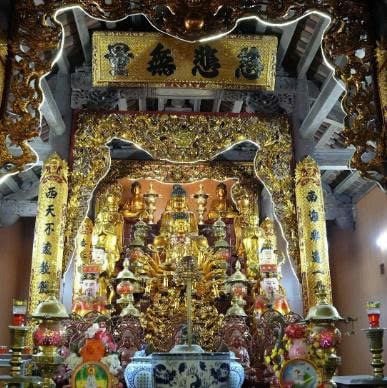
Nghĩa Lộ hamlet has two villages, also called areas: An Định village and Thọ Vực village. The village's historical and cultural relics, including the pagoda, are usually called by the village name: An Định Pagoda. The pagoda is also called Nghĩa Dưới Pagoda. Its Sino-Vietnamese name is Bảo An Tự.
An Định together with Thọ Vực are two areas of Nghĩa Lộ hamlet, Yên Nghĩa commune, Hoài Đức district, Hà Tây. This land belonged to Nghĩa Lộ commune, La Nội canton, Hoài Đức prefecture, Hà Đông before 1945. After the August Revolution, Do Lộ and Hòa Bình communes of Phú Lãm canton, Thanh Oai district, and Nghĩa Lộ and Yên Lộ of La Nội canton, Hoài Đức prefecture, were made into Yên Nghĩa commune, Hoài Đức district, Hà Đông province. From 1965, Hoài Đức belonged to Hà Tây province; in 1975 it belonged to Hà Sơn Bình. In 1979 it was transferred to Hà Nội, and in 1991 it again belonged to Hà Tây. Yên Nghĩa is one of the 22 communes of Hoài Đức district, located in the south of the district, bordering Thanh Oai district. In 1965, according to Decision No. 103/NQ-TVQH dated April 21, 1965, when Hà Đông and Sơn Tây provinces were merged into Hà Tây province, then An Định together with Thọ Vực belonged to Hà Tây province.
In 1976, when Hà Tây and Hòa Bình provinces were merged, An Định hamlet belonged to Hoài Đức district, Hà Sơn Bình province.
In 1991, when Hà Sơn Bình province was split into two provinces, Hà Tây and Hòa Bình, then An Định together with Thọ Vực are two villages again belonging to Hoài Đức district, former Hà Tây province, located in an ancient land long famous for many scenic spots and ancient relics; through many historical ups and downs, An Định hamlet has still preserved a communal house with beautiful artistic architecture. That communal house is called An Định Communal House; it has no other name.
On August 1, 2008, the entire Hà Tây province was merged with Hà Nội city, and Hà Đông city of Hà Tây province was incorporated into the capital Hà Nội. On May 8, 2009, the Government issued a resolution establishing Hà Đông district under the capital Hà Nội on the basis of the entire area and population of Hà Đông city, and establishing seven wards: Biên Giang, Đồng Mai, Dương Nội, Kiến Hưng, Phú Lãm, Phú Lương, and Yên Nghĩa on the basis of seven communes with corresponding names. Since then, Hà Đông has become the 10th urban district of the capital, comprising 17 subordinate wards.
On July 1, 2025, Hà Đông district was dissolved to implement a two-tier local government, with no district level. Đồng Mai ward was merged with Yên Nghĩa ward and named Yên Nghĩa ward.
On July 1, 2025, residential group 5-6 (An Định village) of the former Yên Nghĩa ward was named residential group 5-6, Yên Nghĩa ward.
On July 1, 2026, residential groups 5-6 of Yên Nghĩa ward (An Định village) were merged with the residential group including An Định residential group and named An Định Residential Group - Yên Nghĩa ward. The name An Định matches the former village name.
The An Định area has a history of formation and development dating back very far. Located along the ancient Hát Giang River, it was a settlement area where ancient Vietnamese people established villages from the earliest period of nation-building. Along with settlement, the traditional village religious architectural system was probably built early to meet the religious needs of the village community and preserve the nation's traditional cultural values.
The system of worship of village tutelary gods in An Định is similar to neighboring villages. The tutelary gods worshipped in this area are mostly deities from the early Hùng Vương period of nation-building and defense, and talented generals of the first-century uprising for national independence: the Hai Bà Trưng uprising.
Besides that, the system of pagodas worshipping Buddha was also built. Buddhism, with a history of appearing in India from the 5th century BC, was introduced to Vietnam very early, in the first years of the 1st millennium, and increasingly spread widely. The pagoda was established and existed with villages, serving as a place to entrust the spirituality of all community members always oriented toward goodness. At the same time, it also records the contributions of Buddhist men and women in the community to building and restoring the village pagoda. The pagoda is where religious ceremonies of An Định villagers are performed, and where, with the purpose of using Buddhist teachings and the compassionate Buddha's encouragement of goodness and punishment of evil, people are educated in humanity and righteousness: 'Love others as you love yourself.'
Based on the Hán-Nôm documents remaining in the relic and its material cultural documents, it can be said that Bảo An Pagoda was built long ago. During its existence, the pagoda has been restored and repaired many times. By the Nguyễn dynasty, its scale was almost the same as today. A major restoration of Bảo An Pagoda was carried out in 1930-1931 under King Bảo Đại. Since then until now, Bảo An Pagoda has always been repaired and maintained to preserve the relic for the long term.
Bảo An Pagoda in An Định area is a complete architectural complex within a large, enclosed grounds with dense ancient perennial trees: longan, mango, pomelo, persimmon, magnolia... Current items include: the three-entrance gate, main pagoda, Mother Goddess hall, ancestral house, and other auxiliary works.
Opposite the Mother Goddess hall, on the other side of the pagoda courtyard, is a five-bay longitudinal house. This is where the pagoda's patriarchs are worshipped. This house also has closed gable walls and decorative pillars shaped like throne arms. The ancestral house was recently restored and built, using new types of materials such as cement, iron and steel, and iron flower-grid doors.
Like many other village pagodas, Bảo An Pagoda in An Định area has architectural items oriented toward solidity, mostly smoothly planed and tightly joined. Sculptural decoration on the architecture is very rare. In some places on the trusses, stylized leaves and flowers are carved. At both ends of the beams of the main pagoda's porch columns, two dragon heads are carved in the sculptural style of the 19th century. The dragon heads have protruding foreheads, flared noses, bulging eyes, and hair fins projecting backward. The low walls and decorative pillars are coated and painted with decorative motifs in lime mortar.
Most artistic sculptures in the pagoda are concentrated in the system of round statues. The round statue system of Bảo An Pagoda, including Mother Goddess statues and Buddha statues, numbers more than 30 pieces with different creation sizes and dates. It can be said that the statues created earlier are smaller in scale. These include the Maitreya Buddha statue placed in the Mother Goddess hall. The Amitabha Trinity set dates from the 18th century, as do the three lotus pedestals in the Mother Goddess hall. Most of the remaining statues date from the 19th and early 20th centuries.
The Upper Hall is a three-bay longitudinal building connected to the front hall at the central bay. The Tam Bao roof trusses have a stacked-beam structure with secondary beams and lower braces similar to the front hall trusses. The row of porch columns has been replaced by a masonry wall. The main pagoda roof is covered with thin, pointed Ri tiles. The gable and ridge edges are built with mortar ridges. The gable ends of the ridge have marks.
Adjacent to the rear wall of the front hall and between the two rows of masonry columns of the Tam Bao, brick platforms were built rising gradually from the outside inward as seats for the Buddha statues in the Buddha hall.
The Mother Goddess hall of Bảo An Pagoda is located on the right side of the courtyard in front of the front hall. The Mother Goddess hall is a five-bay longitudinal building with closed gable walls and throne-arm-shaped pillars. The three central bays are the place of worship; the room on the right is connected to the kitchen, an auxiliary work hidden behind the gable end of the front hall. The outer room is used as a storage warehouse. Near the Mother Goddess hall, the structure is simple, of the rafter and crossbeam type. The porch columns are built round. The roof is covered with thin Ri tiles. The doors are rectangular with hinges. In the three central bays, a high brick platform was built as an altar.
Within the grounds of Bảo An Pagoda relic, besides the pagoda, there are also the Văn Chỉ relic and a memorial house for sons who sacrificed for their homeland An Định. The village Văn Chỉ is located right next to the village's ancient well. In previous centuries, the Văn Chỉ was built spaciously with curved roofs and stone steles inside. But now the Văn Chỉ is only an open-air worship stele together with a small stone stele. The stone stele clearly records three village worthies who passed the doctoral examination in the Lê dynasty, a period of revived and prosperous civilization.
From the village well and Văn Chỉ stele, looking to the right side of the village road, is an eight-bay memorial house commemorating from former worthies to the homeland's sons who rendered service to the country and sacrificed. This is a respect that has been preserved in the affection of An Định village.
Through many years from its appearance and existence to the present, with the purpose of encouraging goodness, punishing evil, compassion, and charity, Bảo An Pagoda is closely associated with the homeland scenery and village history through the periods. It is a center of belief and religious activities for local people, and also a center of cultural activities for the village community. It carries many features of national cultural tradition, contributes to preserving national cultural identity, and helps educate generations about the tradition of building and defending the country.
The system of round statues and other relics in the pagoda is not yet unique and high-quality, and the quantity is not large, but these are statues created meticulously and carefully, demonstrating the skillful talent of former artisans.
The statues were created in different periods of art history. Nevertheless, they remain unified in general outlines, supplementing and supporting one another to express a common purpose. At the same time, each statue has its own beauty and its own character for each figure.
Bảo An Pagoda relic is a place that preserves tradition, a place for traditional cultural exchange between villages, contributing to strengthening solidarity among the resident community, and a place to educate future generations about good things.



