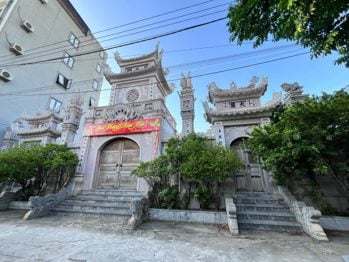
An Trai Pagoda (Ngoc Quang Pagoda)
Introduction
NGOC QUANG PAGODA (AN TRAI PAGODA)
Ngoc Quang Pagoda is located in An Trai village, Son Dong commune, Hanoi city.
The pagoda has a ding-shaped architectural layout, consisting of a five-bay Tien Duong (Front Hall) built with closed gable walls and a Thuong Dien (Upper Hall) connected at the rear. To enter the main pagoda, visitors pass through the Tam Quan (three-entrance gate) to the Tien Duong, which is notable for its roof ridge with three raised Han characters “Ngoc Quang Tu”; outside there is a pair of ornamental pillars decorated with four phoenixes in attendance and Han-character couplets. The pagoda’s porch preserves a stone incense post from the Le dynasty (1710) and a bronze bell from the Nguyen dynasty (1844); inside, the truss system “gia chieng chong ruong” is used on four rows of column bases. The pagoda’s decorative art focuses on the freestanding statue system in the Buddha hall: the Thuong Dien displays the Three Worlds Buddhas, the Amitabha Triad, and the Infant Shakyamuni along with two Bodhisattvas; the Tien Duong displays Dharma Protector statues, Holy Monk statues, the Ten Kings of Hell, rear statues, Mother Goddess statues, and five ancient stone steles (erected in 1699 and 1703).
An Trai Pagoda was formerly the merged site of two ancient pagodas, Ha Ngoc (Upper Pagoda) and Tuong (Lower Pagoda), after both were destroyed during the resistance war against the French. Local people gathered Buddha statues and relics to build a new pagoda named Ngoc Quang Tu. Every year, the pagoda holds many traditional ceremonies such as the Thuong Nguyen Festival, Buddha's Birthday, Vu Lan, especially the New Rice Festival on the 10th day of the 10th lunar month and the Patriarch's Death Anniversary on the 2nd day of the first lunar month.
An Trai Pagoda was ranked as an architectural and artistic relic by the Ministry of Culture and Information in 1990.