Continuing from the central bay of the front hall is the upper hall, a longitudinal building of three bays, built with closed gable walls, two sloping roofs covered with ri tiles, a plain unadorned ridge, decorative blocks at the ridge ends, and two-tiered sections at the ridge ends. Corresponding to the bays is a columnless truss system. The interior of the upper hall is where many artifacts of the pagoda are concentrated; here is the Buddha sanctuary arranged with the system of Buddha statues.
Arrangement of worship objects:
In the front hall: Three altars are arranged: the altar on the right is the Duc Ong altar, with a statue carved in a seated posture on a throne, depicted as a civil mandarin wearing a winged official hat, with a red face and a stern expression. The Duc Ong statue is originally Anathapindika (also called Sudatta), who was credited with buying the garden of Prince Jeta and building the Jetavana monastery in Sravasti, then inviting Shakyamuni Buddha and the sangha to come there to preach and guide sentient beings. He vowed to support the Dharma and protect pagodas, so whenever a pagoda is built anywhere, he is often carved and worshipped as a guardian deity of the pagoda. The altar on the left is the Holy Sangha statue, carved seated on a pedestal as a monk wearing a lotus hat, with the right hand forming the auspicious mudra or abhaya mudra, the left hand placed before the chest, and the legs pendant. The Holy Sage statue represents all the saints in Buddhism who have contributed to preserving and spreading the Dharma in general. The side wing on the left is the Earth Store altar, standing on a lotus pedestal, wearing a Vairocana hat, holding a khakkhara staff, symbolizing the desire to save all sentient beings in the six realms of samsara. In addition, on both sides are two guardian statues, carved in the form of warriors, looking very majestic, wearing helmets, armor, and sacred cords. The figure standing on the left is Ac Huu Thai Tu, also called Ong Ac - Trung Ac, actually the one who punishes evil, carved in a seated posture with a fierce face and holding a sword. The figure on the right is Thien Huu Thai Tu, also called Ong Thien - Khuyen Thien, carved in a seated posture with a gentle, fair face; both are deities protecting the Dharma.
- At the upper hall sanctuary: The upper hall is arranged with altars in ascending tiers from bottom to top. The first tier is the Nine Dragons throne - the infant Shakyamuni, depicting the birth scene of Shakyamuni Buddha. He appears in the world as a small child, with the figure of a boy pointing to the sky with his left hand and to the earth with his right hand.. The second tier is the Jade Emperor - Nam Tao - Bac Dau statue set; the Jade Emperor statue is carved in a seated posture in the center. In the conception of the Vietnamese people, the Jade Emperor, also called the Great Jade Emperor, is the supreme king of the sky and the lord of the heavenly court. He is the king of the heavenly court who governs the entire sky, earth, seas, and underworld. On both sides are the Nam Tao - Bac Dau statues, carved in seated postures, wearing hats, one holding a brush and one holding a register. The Bac Dau statue oversees death in the world, with a stern appearance and facing south. Nam Tao oversees birth in the world, with a gentle appearance and facing north.. The third tier is the Thousand-Hand Thousand-Eye Guanyin statue set (a thousand eyes and a thousand hands, meaning to perceive all the sufferings of sentient beings and to save them).. The fourth tier is the Amitabha statue carved in a seated posture on a lotus pedestal, with snail-shell curls, a high nose bridge, long earlobes, both hands placed palms up on the lap, and a two-layer robe. The Amitabha statue helps people escape the sea of suffering in life and sincerely turn toward the compassionate light of the Buddha. The fifth tier is the Three Worlds statue set, whose full name is the Three Worlds Ever-Abiding Wonderful Dharma Body, symbolizing “Three Worlds, Three Thousand Buddhas”, that is, three thousand Buddhas in three kalpas: the Past associated with the Solemn Great Kalpa; the Present associated with the Worthy Kalpa; and the Future associated with the Star Kalpa. Among the three Tam The statues here, the central Tam The of the Worthy Kalpa has a different form from the two Tam The statues beside it. The Tam The of the Worthy Kalpa is carved in a seated posture on a lotus throne with two layers of upward-facing petals in 19th-century artistic style; the Buddha statue is in a preaching posture with hands clasped together. The statue's robe has two layers, the inner layer tied in a knot before the belly, and the outer cloak carved with angular ridges. The snail-shell hair is joined in a high mass, the face is round and full, the eyes are half-closed, and the ears are large. The two Tam The statues on either side were made at the same time, also seated on a lotus platform with two layers of open petals and one layer of closed petals; the lotus petals are plain and carved in low relief.
The two side wings adjoining the left of the upper hall are arranged with a Child-giving Guanyin statue, carved in a seated posture on a pedestal, wearing a hat and holding a child on her lap. The side wing adjoining the right of the upper hall has a Longevity King statue lacquered red and gilded, wearing a hat, with long earlobes and both hands placed palms up on the lap, wearing a hat.
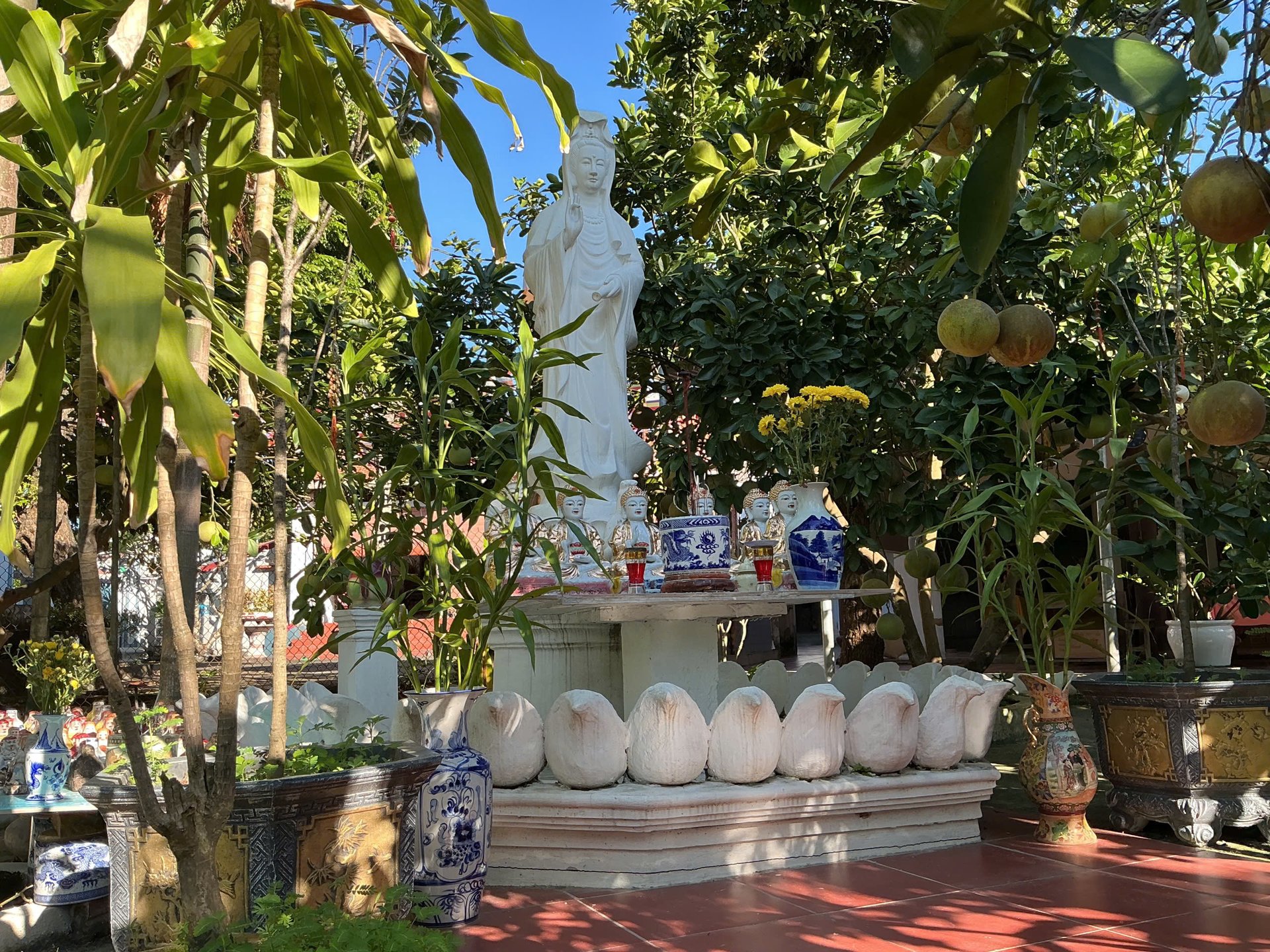
In the front hall and upper hall, worship objects such as incense burners, lamp stands, offering trays, and some other valuable worship objects are also arranged.
Cong So Pagoda “Linh Tam Tu” worships Buddha according to Mahayana Buddhism and is a cultural activity center of the residential community, a place preserving local traditional cultural values, and also a place of education guiding people toward good things in life. The presence of the pagoda is an indispensable symbol of every rural village, expressing the aspiration for a peaceful and serene life of every working person in the countryside.