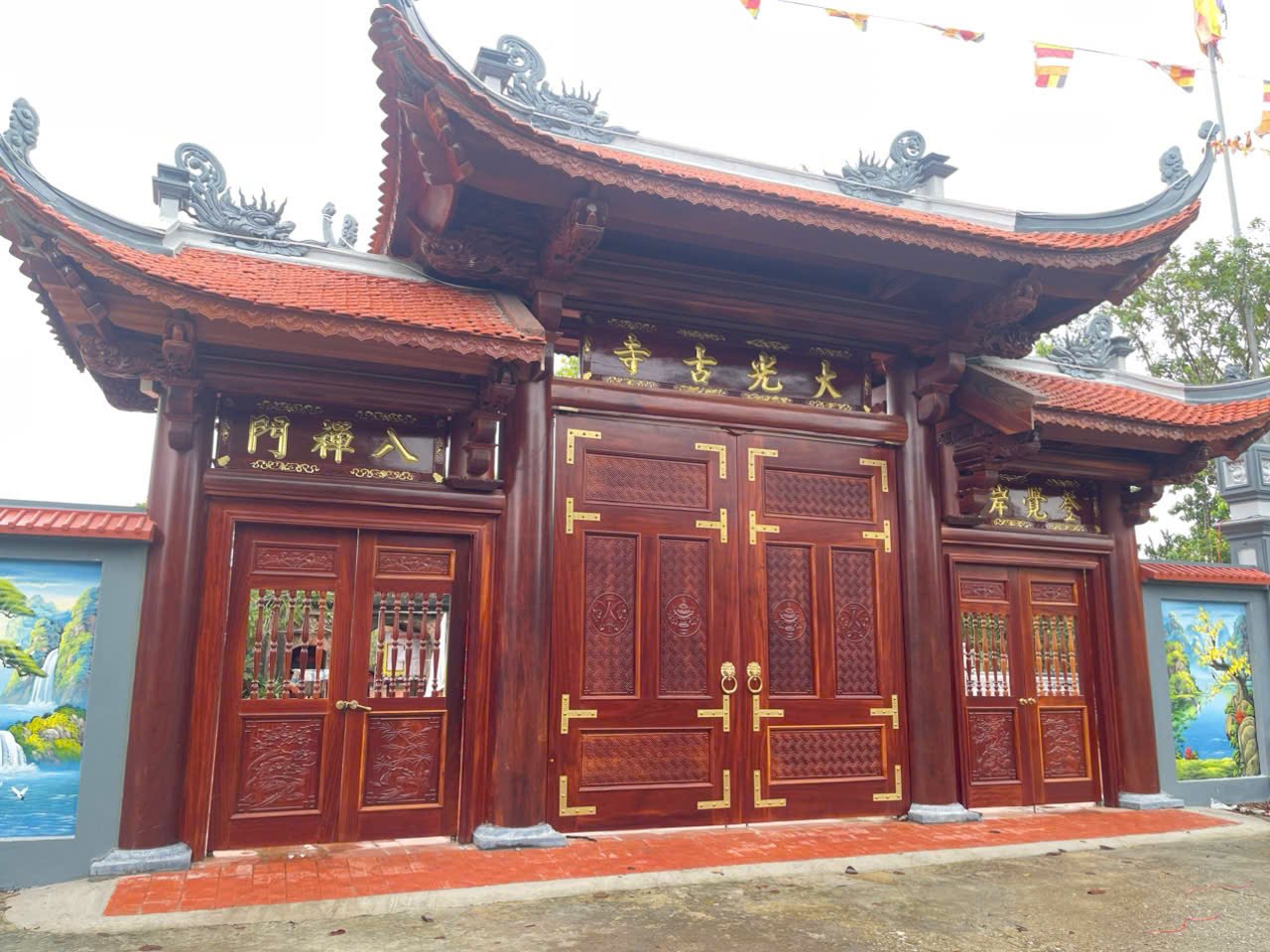
Đại Quang Pagoda, Văn La Village, Hòa Phú Commune, Hanoi City
Introduction
Đại Quang Pagoda, in Văn La Village, Hòa Phú Commune, Hanoi City, was recognized as an Artistic Relic under Decision No. 05/1999-QĐ-BVHTT dated February 12, 1999, by the Ministry of Culture and Information.
Đại Quang Pagoda has 36 Buddha statues from the Lê and Nguyễn dynasties; the Buddha statues are arranged centrally in the upper hall.
In Đại Quang Pagoda, the most prominent feature is a lotus stone pedestal, a sculptural artwork from the Trần dynasty. This is one of the most beautiful lotus stone pedestals still preserved in the former Hà Tây land. First, regarding the dimensions of the stone pedestal, its length is up to 2.3 m, its width is 1 m, and its height is 1 m; the stone pedestal is made of many joined slabs and carved with intricate and elaborate artistic patterns. The stone pedestal consists of an upper tier of large, plump lotus petals. The largest petals are up to 15 cm wide, and the smaller petal layer is 13 cm. On the lotus petals are carved coiled floral patterns representing clouds and eternal vitality. The lower body is divided into many decorative panels, with carvings inside of 'single dragon', 'dragon horse', li... Especially at the four corners of the body are carved four Garuda divine birds. The divine birds have bird faces and human bodies, modeled after Champa cultural artworks. The birds have bright eyes, long beaks, and plump arms, and are supporting a huge lotus pedestal. Finally, the base of the lotus pedestal is also decorated with swirling cloud patterns and hook motifs, and the four corners form the 'kneeling leg, fish belly' pose. In summary, the lotus stone pedestal at Đại Quang Pagoda is a unique, rare, and precious artistic work of Vietnamese culture.