
Dong But Pagoda
5.0Free
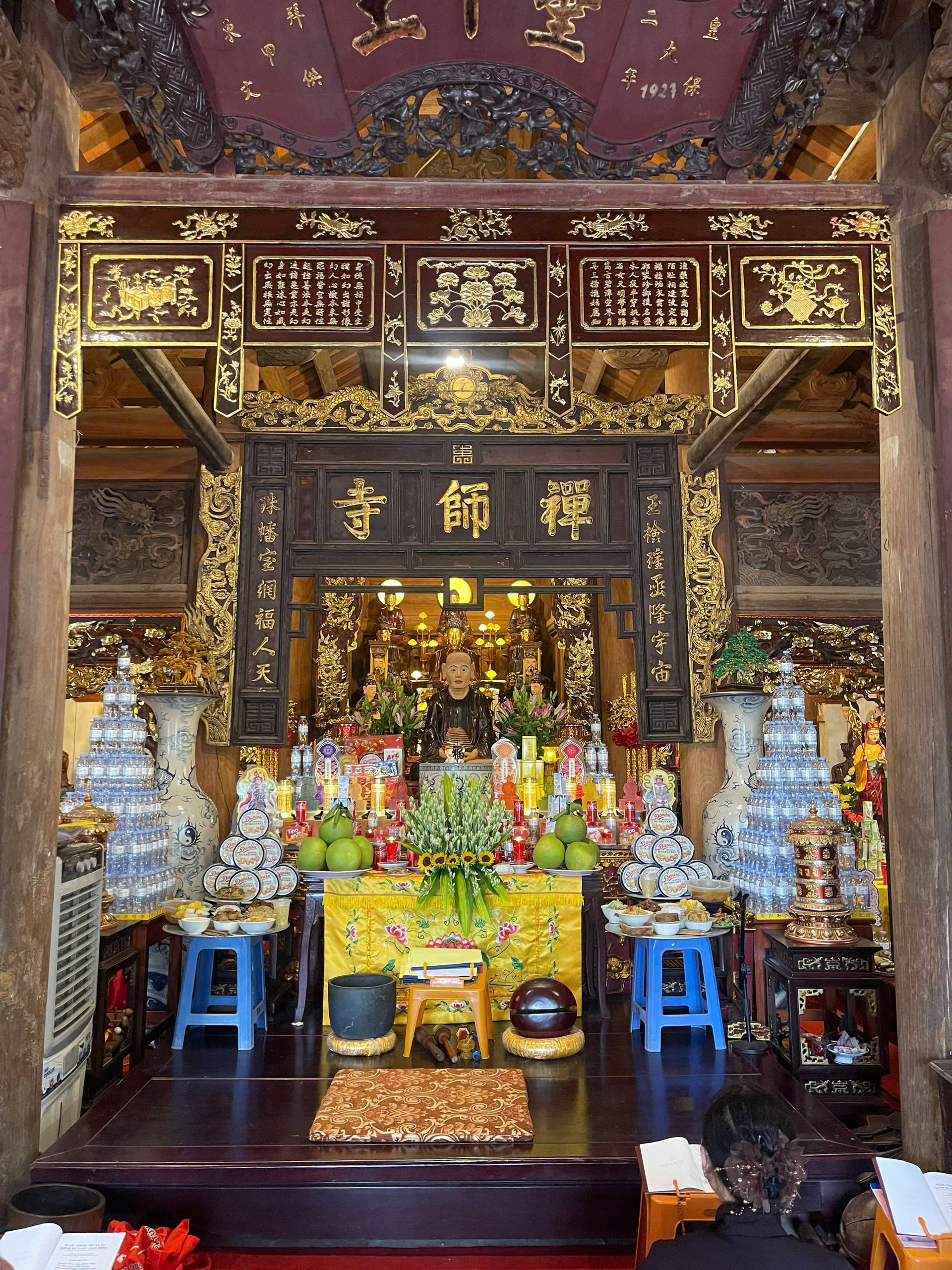
Dong But Pagoda was ranked at national level under Decision No. 1460-QD/VH dated June 28, 1996, by the Ministry of Culture and Information, now the Ministry of Culture, Sports and Tourism
Dong But Pagoda is also called Thien Su Pagoda. It is located in Trong Hamlet of Dong But Village, Ngoc Liep Commune, Quoc Oai District, Hanoi. This is considered the most beautiful location in Trong Hamlet and lies on the highest mound in the hamlet. Thien Su Pagoda faces southwest, with Lotus Pond in front. If measured along a straight line, Thien Su Pagoda looks directly toward Vuon No, about 1 km from Vuon No, which is said to be the birthplace of Zen Master Tu Dao Hanh; today Vuon No belongs to Ngoc Phuc Village, Ngoc Liep Commune, Quoc Oai District. In the past, adjacent to the right of Thien Su Pagoda was the village communal house, followed by Van Chi, but due to war, the communal house and Van Chi were destroyed. Behind and to the left of Thien Su Pagoda are the ancestor house and guest house, along with a number of other items added in recent times. It is also worth noting that to the left of Thien Su Pagoda there is a water well, symbolizing the dragon's eye and the village's feng shui vein; it is a water source that supplied daily domestic water to the villagers for many years. Thus, Thien Su Pagoda is situated in a space that is a complex of relics and spiritual sites of Dong But Village, including a communal house and Van Chi.
Thien Su Pagoda has a 工-shaped architecture, with a seven-bay front hall and a three-bay rear sanctuary. Connecting the front hall and rear sanctuary is Tam Bao (the front ritual hall). Outside Tam Bao and the front hall is the space for decoration and Buddha worship, while inside the rear sanctuary are worshipped Zen Master Tu Dao Hanh, the Holy Father, and the Holy Mother. This arrangement and manner of worship create a distinctive feature in the sacred space of Thien Su Pagoda: the worship style of “Buddha in front, Saints behind.”
In front of Thien Su Pagoda there is a corridor, then two courtyards at different heights, and finally the water space of Lotus Pond; this creates symmetry in the spatial layout and also provides open space for holding the annual festival.
To date, regarding the construction history of Thien Su Pagoda, we have not found any documentary source that specifically records the time of the pagoda’s first establishment. If based on the bell inscription cited above, Thien Su Pagoda was formed in the late 14th century, under King Tran Du Tong, in the 12th year of the Dai Tri era (1369). However, based on the architectural patterns of the wooden components at the pagoda, as well as the stele Inscription of the Dharma Master, erected on the 12th day of the 12th month, in the reign of King Le Huyen Tong, the 7th year of the Canh Tri era (1669), it is highly likely that this was the period when Thien Su Pagoda was built on a grand and large scale. Later, in the Nguyen era (the bell was cast in 1820, the stele Inscription of the Dharma Protector, erected in the first year of Minh Menh-1820), the pagoda was restored and continued to be jointly preserved by the people with united efforts and heart, resulting in its appearance today.
With the scale and architecture of Thien Su Pagoda, together with its long construction history and the restorations from ancient times to the present, this place has still been preserved and clearly affirms that it is the most sacred space of the villagers and the main, principal location for practicing and organizing the traditional festival of Dong But Village to commemorate Zen Master Tu Dao Hanh.



