Dong Tru Pagoda (Bao Thap Temple)
Story
01Dong Tru Pagoda (Quan Am Temple)
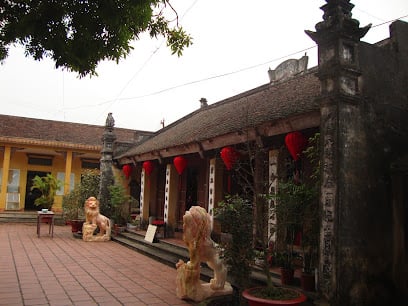
Dong Tru Pagoda, whose literary name is Bao Thap Temple, was built around the Later Le dynasty (1428-1789), at the same time as the village communal house. The pagoda was most recently restored in 1998. Based on artifacts and ritual objects preserved at the relic site, there are grounds to affirm that the pagoda was established quite early and has existed for several hundred years. The pagoda's artifacts, such as statues dating to the 18th century, the Canh Thinh bell, and especially the stone incense post from the Chinh Hoa period, show that the pagoda dates at least from the Later Le dynasty (1428-1789). In 2022-2023, the entire complex of Dong Tru Pagoda was restored while retaining its current architecture.
The pagoda's three-entrance gate is designed with two wooden tiers, four upturned corners, the roof ridge decorated with a water-monster finial, and the corner tips decorated with cloud clusters. The lower tier has three wide bays, open at the back, with gates fitted at the front, and a staircase inside leading to the second tier. The second tier has a balustrade system running around the eaves gallery, with the pagoda's large bell hung in the middle.
The main temple has a T-shaped floor plan; the incense chamber and upper sanctuary are combined into one. The front hall was built with five bays and two side bays, with closed gable ends, ngai-style handrails, and pillar markers; in the center of the pagoda roof, the pagoda's literary name is embossed on a rectangle, with leaf-scroll patterns on both sides. There are six roof truss frames in total; the central frames have complete four-column trusses in a four-row foot style. The pagoda's architectural structure follows the overlapping beam, ke chuyen, front ke, and rear bay style. The central bay has front and rear bracket supports depicting the four seasons. The front rafters form a wall resting on the row of veranda columns.
The upper sanctuary is connected to the central bay of the front hall, with a flat roof ridge and intersecting roof slopes at the junction. Inside the pagoda, brick platforms are built to arrange worship statues. The pagoda currently has six statues in two sets of Tam The that are relatively similar, bearing the artistic style of the late 18th and early 19th centuries. The pagoda has had two Tam The sets for a long time; the reason there are two sets is that the pagoda is inside the village and outside the village. The Amitabha statue dates to 18th-century art, is made of wood, lacquered and gilded, and depicts in detail the robe, snail-shell hair, face, hand position, and seated posture. The lotus pedestal alone was modified later. On either side are two Bodhisattva statues dating to the early 19th century, described differently in form and decoration, probably from two different pairs of statues. The Maitreya statue, expressing prosperity, abundance, and peace, is depicted quite distinctively: a wooden statue lacquered and gilded in 18th-century art. The Jade Emperor statue has elaborate floral patterns carved on his dragon robe, crown, and boots. The Nine Dragons throne and the infant Shakyamuni statue. The two bays of the front hall display statues of Duc Ong and the Holy Monk in lacquered and gilded wood. The two statues are described in detail in shape, sitting posture, and facial expression, especially the decorative patterns on the outer robes, which are very vivid and detailed. All were made in the 19th century.
To the right of the pagoda is a row of buildings including the Ancestor house, the soul house, and the guest house, with nine bays and two side bays, built with closed gables and ngai-style handrails, facing east toward the pagoda courtyard and front hall. There are three Ancestor statues made of lacquered and gilded wood from the late 19th century, commemorating the pagoda's monks who have passed away.
To the left of the pagoda is the Mother house with five bays, built with closed gable walls and ngai-style handrails with pillar markers, with a worship platform inside. At the Mother shrine, there is a distant worship of Lady Lieu Hanh; in a separate shrine brought here, statues of the Lady and attendant maids are carved. The statues are small and beautiful, bearing the artistic imprint of the 19th century.
Besides the statues, the pagoda also has a number of quite distinctive ritual objects, such as: a stone incense post made in the 18th year of Chinh Hoa (1697), with decorative patterns from the Later Le period carved quite beautifully. The incense post is erected in the center in front of the pagoda's three-entrance gate; it has an inscription recounting the merits of donors and contributions from people near and far for repairing and restoring the pagoda, including the making of the stone incense post. A large bell cast in the 8th year of Canh Thinh (1800) is a particularly noteworthy date. The bell is decorated with coiling dragons from the Tay Son period, and includes an inscription briefly recounting the pagoda's history; the pagoda previously had a bell that was lost, so efforts were made to cast another. Based on the historical content recorded on the incense post and bell, we can infer that the pagoda was built quite early and was large and beautiful. The 18 stone steles are mainly merit steles recording the names of people who made merit donations for repairing the pagoda. The steles date from the Later Le to Nguyen dynasties, through which we know that the pagoda was restored and embellished many times. Also in the rear house where the merit steles are placed, there is a commemorative statue of an overseas Chinese merchant who donated money and goods to the pagoda during the time he traveled and traded in the locality.
Dong Tru communal house and pagoda were ranked as a National historical and architectural-artistic relic under Decision No. 65/QD-BT dated January 16, 1995.