
Ha Quat Pagoda (Pha Coc Tu), Hop Tien Village, Hong Son Commune, Hanoi City
5.0Free
5.0Free
Introduction
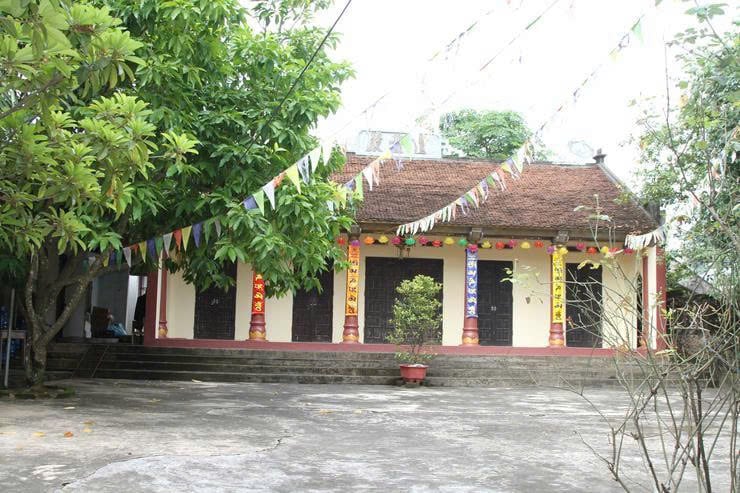
Ha Quat Pagoda (Pha Coc Tu) is a religious architectural work worshipping Buddha according to the Mahayana tradition, located in the center of Ha Quat Village, facing northeast, about 500 m from the village communal house. The relic includes: pagoda gate, Tam Bao Hall, Mother House, garden courtyard and funerary stupa. Since its construction, the pagoda has always been a place for local people's religious, cultural and spiritual activities, contributing to educating the tradition of doing good, preserving cultural identity and strengthening community cohesion. In addition to worshipping Buddha, the pagoda also worships the Mother Goddess, expressing the intersection between Buddhism and Vietnamese folk beliefs.
The exact time when the pagoda was founded is unknown; however, based on the bronze bell named 'Pha Coc Tu Chung' cast in the 12th year of Gia Long (1813), it can be determined that the pagoda existed from the early Nguyen period. Through war and many historical upheavals, the relic was severely damaged, and many items had to be rebuilt. The current Tam Bao Hall was restored in the 1990s with donations from the people; in 2012, the Mother House was built, and in 2023, the well and surrounding wall were repaired with socialized funding. The relic currently preserves a system of Buddha statues in the artistic style of the Nguyen period along with the bronze bell dated to the 12th year of Gia Long (1813), which are artifacts of historical, cultural and artistic value. With its outstanding historical, cultural and religious values, Ha Quat Pagoda (Pha Coc Tu) was ranked as a City-level Historical - Cultural Relic by the Hanoi People's Committee under Decision No. 4553/QD-UBND dated May 29, 2025.
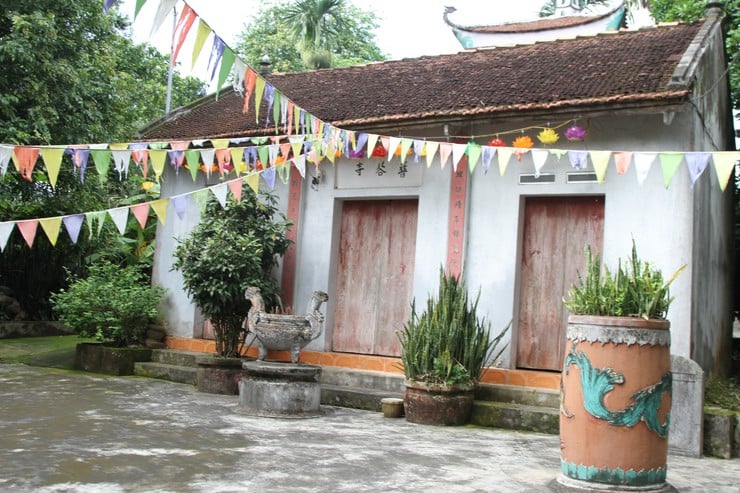
The Tam Bao Hall viewed from outside
The pagoda gate is simply made on the left side of the pagoda. The main orientation of the pagoda is a large pond. The gate is made of two brick pillars forming a passage, without other decorative plasterwork.
Tam Bao Hall of Pha Coc Pagoda has a floor plan in the shape of the Chinese character Dinh, with a Front Hall and an Upper Hall. The Front Hall consists of 3 bays, with two sloping roofs covered with shoe-nose tiles, the ridge decorated with earthenware tiles, and the two ends of the ridge decorated with two nail-shaped ornaments. Inside, corresponding to the 3 bays are 4 wooden trusses on 2 rows of hidden columns. The trusses are made in the style of a truss with a tie beam over the bay and hidden columns, with the trusses made of wood and the crossbeams made of concrete. The upper beam of the Front Hall has Chinese characters recording the year of restoration: Cong hoa xa hoi chu nghia Viet Nam, tue thu Mau Dan nien, ha thien tu nguyet nhi thap tam luong thoi thu tru thuong luong dai cat (Socialist Republic of Vietnam erected the columns and raised the roof on the 23rd day of the 4th lunar month in the summer of Mau Dan, greatly auspicious). The year Mau Dan here is presumed to be 1998.
The floor is paved with terrazzo tiles, a product of the recent restoration. Here, statues of Duc Ong, the Holy Sages, and Ksitigarbha Bodhisattva are arranged.
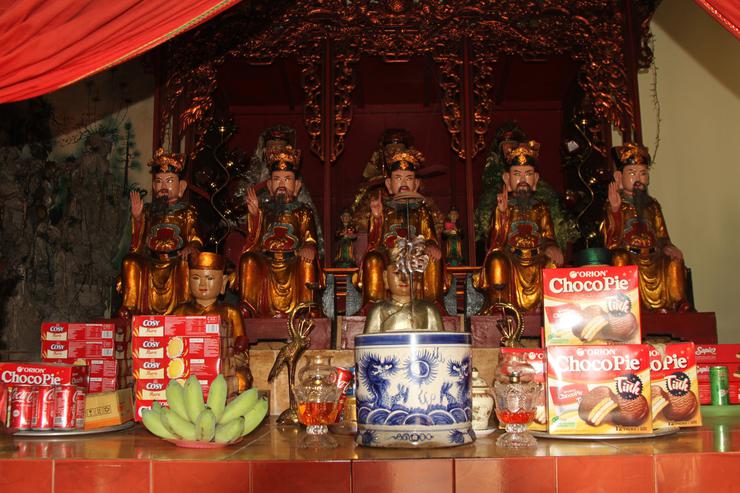
Altar in the Upper Hall
From the central bay of the Front Hall, a connection leads to the 3 longitudinal bays of the Upper Hall, whose floor is higher than that of the Front Hall. The roof system has 2 roof tiers; the interior trusses are made of concrete, in the form of a truss with a tie beam crossing over 2 rows of concrete columns. The Upper Hall is where the pagoda's main statue system is arranged. Here there are the Three Ages Buddha set, the Amitabha set, the Shakyamuni Holding a Flower set, the Cundi Guanyin set, the Jade Emperor set, and the Nam Tao Bac Dau set. The statue pedestal is paved with terrazzo tiles.
According to the research above, images of Buddha statues through the ages all carry human images. The Buddha statues at Pha Coc Pagoda are no exception to that rule. On the main hall, in the highest and deepest position are three statues of the Three Ages, whose full name is Tam The Thuong Tru Diu Phap Than, representing the 'Three Ages and Three Thousand Buddhas,' i.e., three thousand Buddhas in 3 kalpas: the Past associated with the Trang Nghiem Great Kalpa; the Present associated with the Hien Kalpa; and the Future associated with the Tinh Tu Kalpa. Each great kalpa is approximately 1,344,000,000 years. Among the three Three Ages statues here, the statue of the Three Ages of the Hien Kalpa in the middle has a different form from the two statues of the Trang Nghiem Three Ages and the Tinh Tu Three Ages.
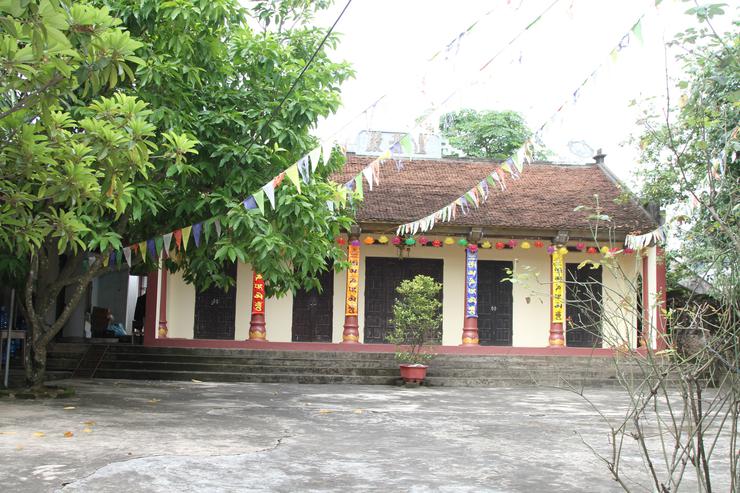
Ancestor House - Mother House
The Mother House is an integrated structure, built behind the Tam Bao Hall, separated by a spacious courtyard with a floor higher than that of the Tam Bao Hall. This structure has 5 bays. From the outside, the roof system includes 2 sloping roofs covered with shoe-nose tiles, the two ends of the ridge decorated with two nail-shaped ornaments, and in the middle of the ridge a raised Chinese inscription: Linh Dai Dien. From the courtyard, five steps lead to the building. Inside, corresponding to the 5 bays are 6 concrete trusses on 5 rows of concrete columns, including 2 rows of hidden columns and 1 row of wall-bearing columns. The trusses are made in the following forms: thuong gia chieng, chong ruong, ha chong ruong, ke, bay hien and thuong chong ruong ha con chong ruong, ke, bay hien.
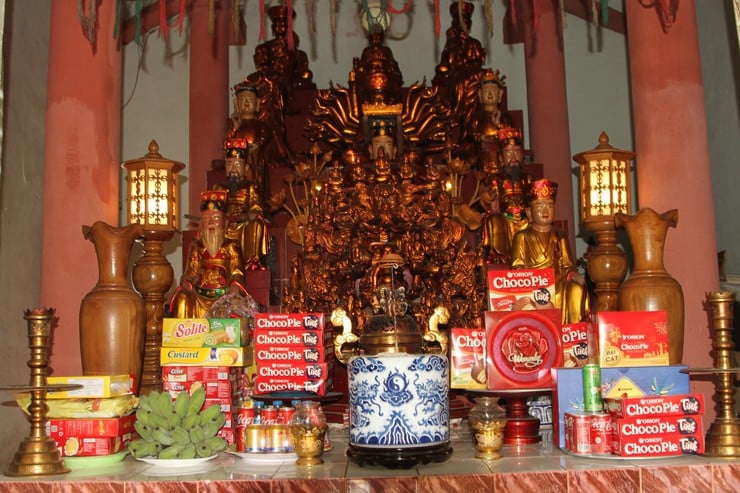
Altar in the Central Bay of the Ancestor House - Mother House
In the center of the building is the altar of the Three Holy Mothers; the left bay is the altar of Patriarch Bodhidharma and 2 patriarchs of the pagoda; the right bay is the altar of Mother Thuong Ngan.
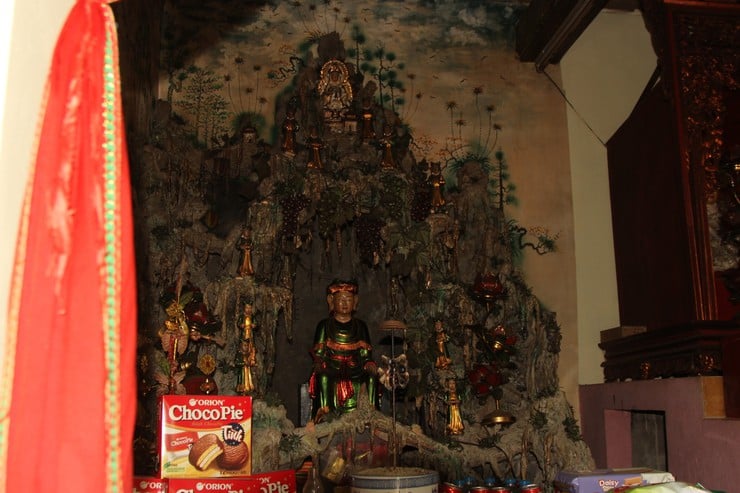
Altar of the Holy Mother
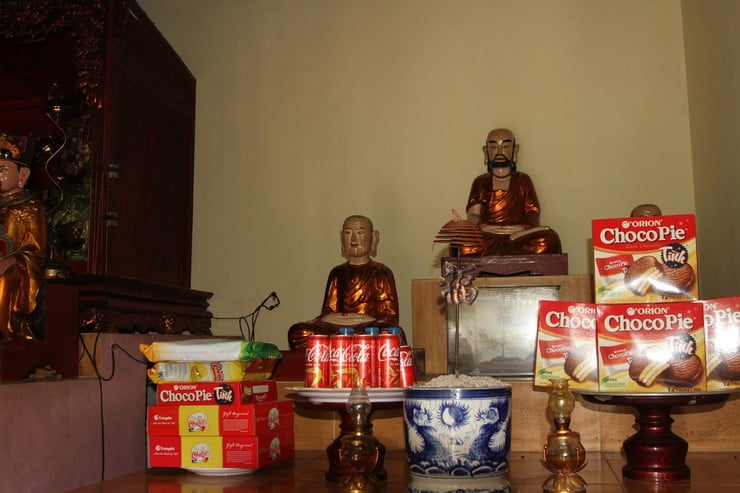
Patriarch Altar
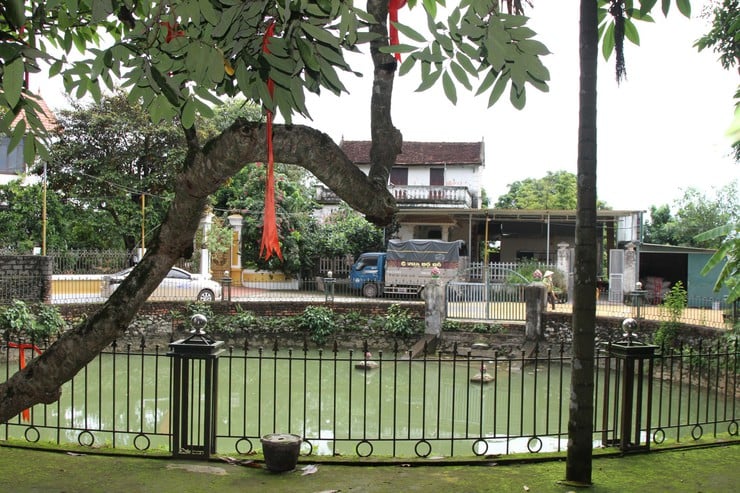
Well
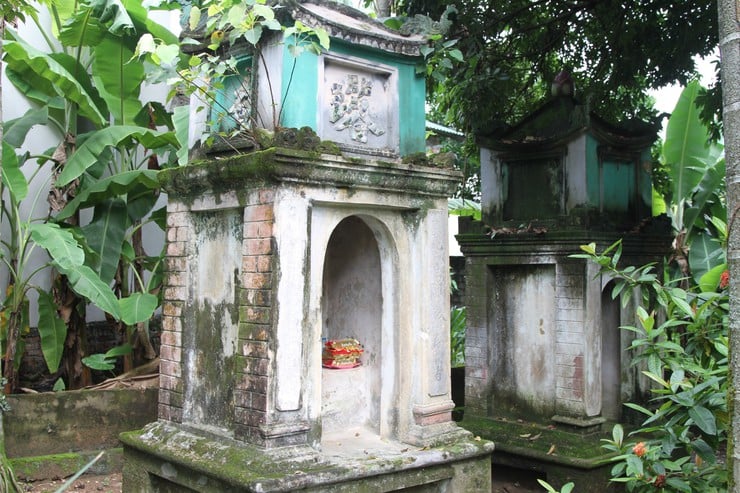
Funerary Stupa
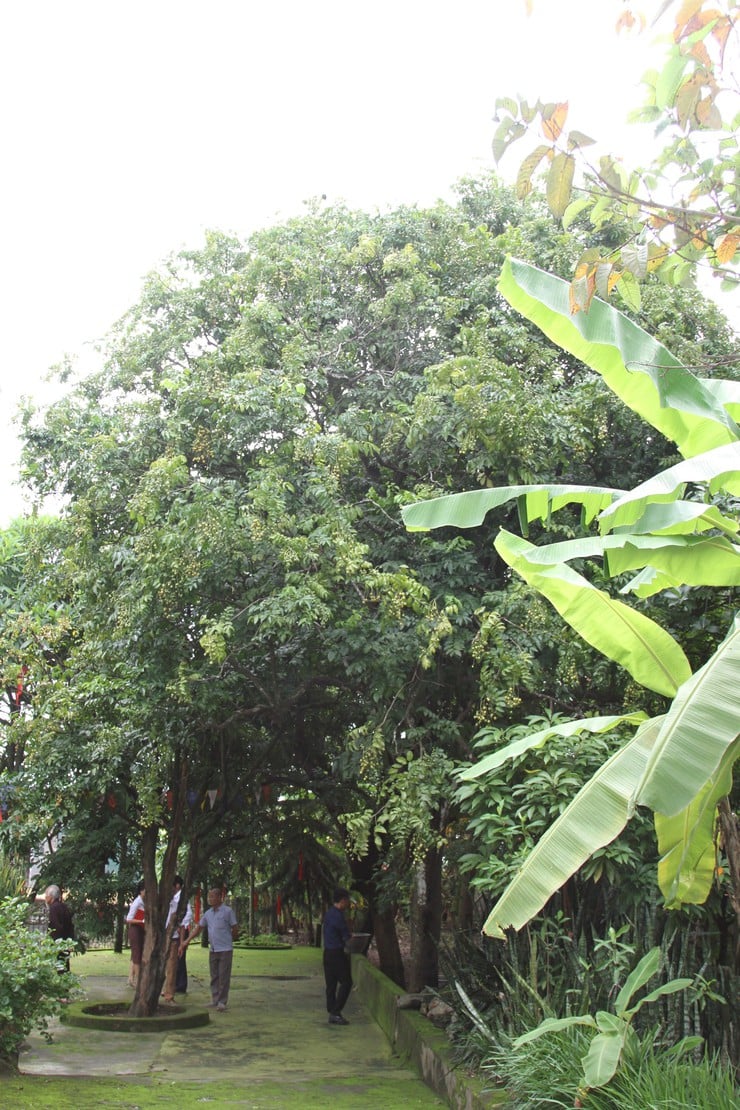
Pagoda Garden
Around the relic is a courtyard and garden. The front and back yards are concreted; in front of the front yard there is a large well, now surrounded by a revetment; from the back yard, a brick-paved path leads to the garden on the left of the pagoda. Here there are two monk stupas: the stupa of monk Thich Dam Ong and the stupa of monk Thich Dam Thu – those who once looked after and practiced at the pagoda. In the garden, fruit trees and perennial trees are planted, creating a cool green space for the relic. In particular, the pagoda also has 2 ancient persimmon trees that are hundreds of years old, like living witnesses to the ups and downs of the relic's existence.
Hạ Quất Pagoda currently preserves a number of relics, which are messages of history, thereby affirming the value of the pagoda to the community of Hạ Quất village in particular and Mỹ Đức district in general.
- 01 bronze bell from the Nguyễn period, Gia Long reign year 12 (1813)
- 01 stone stele from the Nguyễn period, now worn and faded
- A number of 20th-century Buddha statues bearing the artistic style of the Nguyễn period.
In addition, there are also ritual objects such as candle stands, water stands, and flower trays... dating from the 20th and 21st centuries. Besides the Gia Long-era bell and the stone stele worn by time, there are also many large stone blocks used as bases for the old pagoda’s columns, remaining with dimensions of about 50x50 cm. Overall, the artifacts at Hạ Quất Pagoda are moderate in number, arranged in a focused manner, and well preserved. These are valuable artifacts and evidence of the historical existence of the pagoda, most notably the bronze bell dated to the 12th year of Gia Long (1813).
Every year, the traditional festival is held on the 5th–7th days of the third lunar month (a grand festival is held once every three years). Hạ Quất village was formerly twinned with Cống Đặng village (Cống Đặng village festival takes place on the 2nd day of the second lunar month). During the festival, Hạ Quất village and Cống Đặng village (Hồng Sơn commune) formerly held a joint ceremony. On the 2nd day of the second lunar month, when going to Cống Đặng, it is similar—but with a special feature: the festival of this village is presided over by the host of the other village, and vice versa. This is quite special compared with many other villages. The village holding the festival prepares the reading of the ritual text. From Hạ Quất to Cống Đặng is about 5 km; in the past, the elders traveled on foot, and today, with cars and motorbikes available for festival visits, travel is easier. Both sides respect each other and call each other 'Anh'; since ancient times, there has been a custom that young men and women of the two villages may not marry each other because they regard each other as siblings, and this is still maintained today. The offerings presented when visiting each other’s festival are vegetarian offerings, incense, lamps, and cakes and fruit.
Outside the central area of the festival, which is Hạ Quất communal house, at Phả Cốc Pagoda, local people also respectfully offer incense, flowers, and fruit, praying that the Buddha will protect and bless them with a warm, peaceful life.
Important festivals at the pagoda include the Buddha’s Birthday celebration in the fourth lunar month every year. At Phả Cốc Pagoda, although the Buddha’s Birthday ceremony does not include a flower-float procession, it is still carefully prepared by Buddhists and local people, from cleaning the courtyard and garden and tidying the trees in the relic site to solemnly arranging the full ritual paraphernalia in the area worshipping the Buddha, with the participation of the commune’s departments and organizations, the village, and a large number of local people.
On seasonal ceremonial days of the year, such as the ceremonies for entering and leaving summer, Tết Nguyên Đán, Thượng Nguyên, the full moon of the seventh month, and the 3rd day of the third lunar month (the death anniversary of Holy Mother Liễu Hạnh)... the pagoda and local people all make offerings to the Buddha, praying for good things.
The relic site currently has an abbot, Venerable Thích Đạo Cương, so ceremonial work at the pagoda is maintained strictly. In the past, the pagoda had resident monks during many periods, but during some interrupted periods it was looked after by local people among the elders.
Over its long existence, Phả Cốc Pagoda is the Buddhist pagoda of the people of Hạ Quất village in former times. Hạ Quất Pagoda (Phả Cốc tự) is a relic of typical historical, cultural, and artistic value, closely associated with the formation and development of the Hạ Quất area and the religious life of local people. Since its founding, the pagoda has always been a center of religious activity, contributing to educating people toward truth, goodness, and beauty, preserving traditional cultural identity, and meeting the spiritual needs of the community. The relic currently preserves a system of Buddha statues in the Tam Bảo hall bearing the artistic style of the Nguyễn period and a bronze bell dated to the 12th year of Gia Long (1813); these are artifacts of historical and artistic value and important source materials for research on Buddhism and local beliefs. With these typical values, Hạ Quất Pagoda needs to continue to be preserved and promoted in order to safeguard cultural heritage for future generations.
Having gone through war and many ups and downs of history, the relic is currently deteriorating. The system of artifacts has been cleaned and basically conserved, so the elements of worship in the relic remain ensured.
At present, the relic still lacks a number of auxiliary items serving the protection and promotion of the relic’s value, and lacks some worship statues such as Dharma-protector statues... In the coming time, the local authorities need a plan to build an overall restoration plan and arrange appropriate construction items within the relic grounds in order to protect and promote the relic’s value and ensure worship is well maintained.
- Strengthen the management, preservation, and conservation of the relic’s ritual objects. Organizations and individuals assigned to manage the relic must not arbitrarily relocate, repair, or change the color or style of artifacts that are original elements constituting the relic, or receive and add artifacts to the relic and its grounds without the consent of the competent state management agency. Do not display or arrange symbols, products, sacred animals, and strange objects that are inconsistent with Vietnam’s fine customs and traditions.
- Pay attention to supplementing and decorating the system of artifacts, ritual objects, and interior furnishings of the relic in accordance with local beliefs, and seek opinions from specialized agencies and competent authorities. For ancient artifacts, pay attention to conservation and restoration.
- Pay attention to cleaning ritual objects and artifacts as well as implementing measures to conserve and preserve artifacts in accordance with regulations. Regularly look after the relic, carry out cleaning work, and ensure the relic’s landscape.
- Pay attention to fire prevention and fighting at the relic, and educate the people that when burning incense to worship the saints and burning votive paper, safety must be ensured.
- Encourage all voluntary contributions (money, property); receive, manage, and use them according to the principles of openness and transparency, spending for the right purposes and under the supervision and inspection of competent authorities according to management levels.
Hạ Quất Pagoda (Phả Cốc tự) is a typical relic with many historical, cultural, artistic, and religious values. The pagoda’s continuous existence, especially through periods of war and reconstruction, clearly reflects the subject role of the village community in preserving heritage. Not only a place of Buddhist worship, the pagoda is also a cultural institution that creates community cohesion, expressed through festival traditions, village twinning relationships, and the maintenance of charitable rituals. In the future, there should be an orientation for overall conservation, linking architectural restoration with the maintenance of living cultural space, so that Hạ Quất Pagoda continues to be a spiritual center and a symbol of community solidarity in contemporary life.



