
Khuong Ha Pagoda (Phung Loc Tu)
Introduction
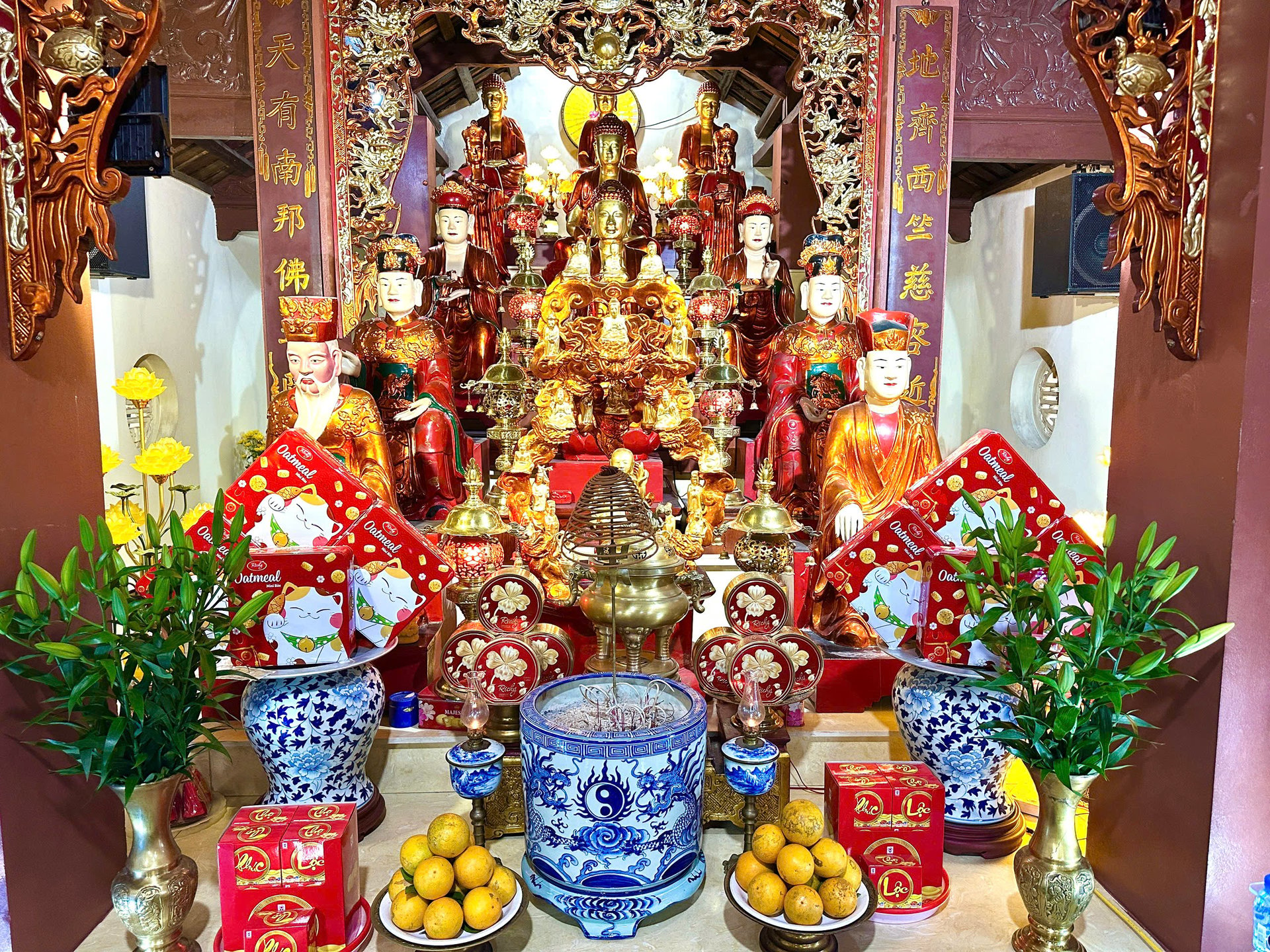
Khuong Ha Pagoda (Phung Loc Tu)
Khuong Ha Pagoda in Khuong Dinh Ward, Hanoi, is a Buddhist architectural work built during the Le Trung Hung period and has now passed through four centuries. The pagoda has been built, preserved, and restored by generations of residents of Khuong Ha Ward and has become a cultural and tourism address of Hanoi today.
Khuong Ha Pagoda is also called Khuong Dinh Pagoda (literal name: Phung Loc Tu). Formerly, the pagoda belonged to Khuong Ha village, Khuong Dinh canton, Thanh Tri district, Son Nam Thuong garrison (in 1831 it was Hanoi province, in 1889 it was Cau Do province, in 1904 renamed Ha Dong province); today it is Khuong Dinh Ward, Hanoi city.
The pagoda is located on fairly spacious and airy grounds, with luxuriant trees, a fresh and quiet atmosphere, near the left bank of the To Lich River, only about 200 m from Khuong Ha communal house to the north. Visitors can visit the pagoda by two different routes: one from Nga Tu So on Nguyen Trai Street, turn right and follow Vu Tong Phan Street for about 2 km south, then turn left into Khuong Ha Street; or go north and turn into Bui Xuong Trach Street. The main gate faces south, opening onto Alley 108 Bui Xuong Trach; the secondary gate faces west, opening onto Alley 29 Khuong Ha.
Khuong Ha Pagoda is designed in the typical architectural style of pagodas in the North. Overall, from the outside in, the pagoda's architectural system includes many layers: the three-entrance gate, the front hall, the rear sanctuary, the ancestor worship hall, the Mother Goddess worship hall, the guest house, and other architectural works arranged harmoniously in a spacious, airy space, with green trees casting shade in all four seasons, adding to the tranquil silence at the Buddhist gate. The pagoda's three-entrance gate faces south, built in the style of a double-eaved roof house, with two tiers and eight roofs in traditional architecture; above the main door are three Han characters Phung Loc Tu. Beyond the main gate is a large brick-paved courtyard; to the right and left in front of the front hall are areas planted with many shade trees, with stone benches for pilgrims to rest while visiting the pagoda.
The front hall is five bays wide, roofed with Vietnamese tiles, and connected to the rear sanctuary to form a 'chuoi vo' shape. The building frame has a simple structure and style, linked in the 'gia chieng, chong ruong' manner, but the entire frame is made of durable lim wood, with many finely carved panels in the artistic style of the early Nguyen period. The ancestor worship house is also five bays wide, connected to the rear sanctuary by a small door; the three central bays worship deceased abbots, and the two side bays are the monks' quarters. The guest house has two bays. Adjacent to the main pagoda area is the Mother Goddess worship hall, comprising three front bays and one rear bay, with statues of the Three Holy Mothers placed in the altar niche.
The Buddha statues in the rear sanctuary are quite rich, created in the artistic style of the late Le Trung Hung and early Nguyen periods. The first row holds the Three Times Buddhas; the second row has the Amitabha Trinity; the third row displays a large statue of Buddha Holding a Lotus; the fourth row includes statues of the Jade Emperor, Nam Tao, and Bac Dau; the fifth row has a Guanyin statue seated on a lotus throne; the last row holds the statue of the infant Shakyamuni. In the inner right corner is a child-giving Guanyin statue, and on the left is a mountain-seated Guanyin statue. The left bay of the front hall worships the statue of Duc Ong; on both sides of the incense-burning area are a pair of Dharmapala statues, Encouraging Goodness and Punishing Evil.
The main hall has two very beautiful sets of door curtains: the outer door is finely carved with images of dancing phoenixes and sacred fruits (peach, pomegranate, etc.); the inner door follows a similar theme but more skillfully, with two bands of kim tong on both sides.
At present, the pagoda still preserves a fairly rich collection of relics, including many relics of outstanding artistic value such as more than 20 gilded and lacquered Buddha statues, two bells cast in the 17th year of Tu Duc (1864) and the 15th year of Thanh Thai (1903), along with many other relics such as horizontal lacquered boards, scrolls with gilded lacquer, carvings of the four seasons and four sacred animals, incense burners, etc.
Legend has it that Khuong Ha Pagoda was built in the 17th century; through the ups and downs of time, the pagoda has undergone many repairs. Most recently, on May 20, 2016, the Hanoi People's Committee issued Document No. 2948/UBND-KGVX on adjusting the zoning of protected areas of the Khuong Ha communal house and pagoda relic in Khuong Dinh Ward, Thanh Xuan District, Hanoi. At present, a portion of land without original elements constituting the relic has been separated from the protected area of Khuong Ha Pagoda to build the clan meeting house of Residential Groups No. 1 and No. 7, facilitating better management and protection of the Khuong Ha Pagoda relic. Part of the restoration funding was contributed by local residents and granted by the Hanoi People's Committee. The pagoda is being repaired and made spacious within a large grounds with many shade trees and a surrounding wall.
Khuong Ha Pagoda is an artistic architectural work that should be respected and preserved. In order to honor the cultural and deeply religious values that Khuong Ha Pagoda has left to this day, the Khuong Ha Pagoda relic was ranked as a National Artistic Architectural Relic by the Ministry of Culture and Information (now the Ministry of Culture, Sports and Tourism) on March 16, 1993, and is currently directly managed by the Thanh Xuan District People's Committee under the decentralization of the Hanoi People's Committee.
With its system of teachings encouraging good and deterring evil, Khuong Ha Pagoda is a center of spiritual and cultural life for a community, a cultural address quite attractive in terms of historical content and the solemn beauty of antiquity, contributing to the thousand-year culture of Thang Long - Hanoi.



