
Kim Lien Pagoda
Introduction
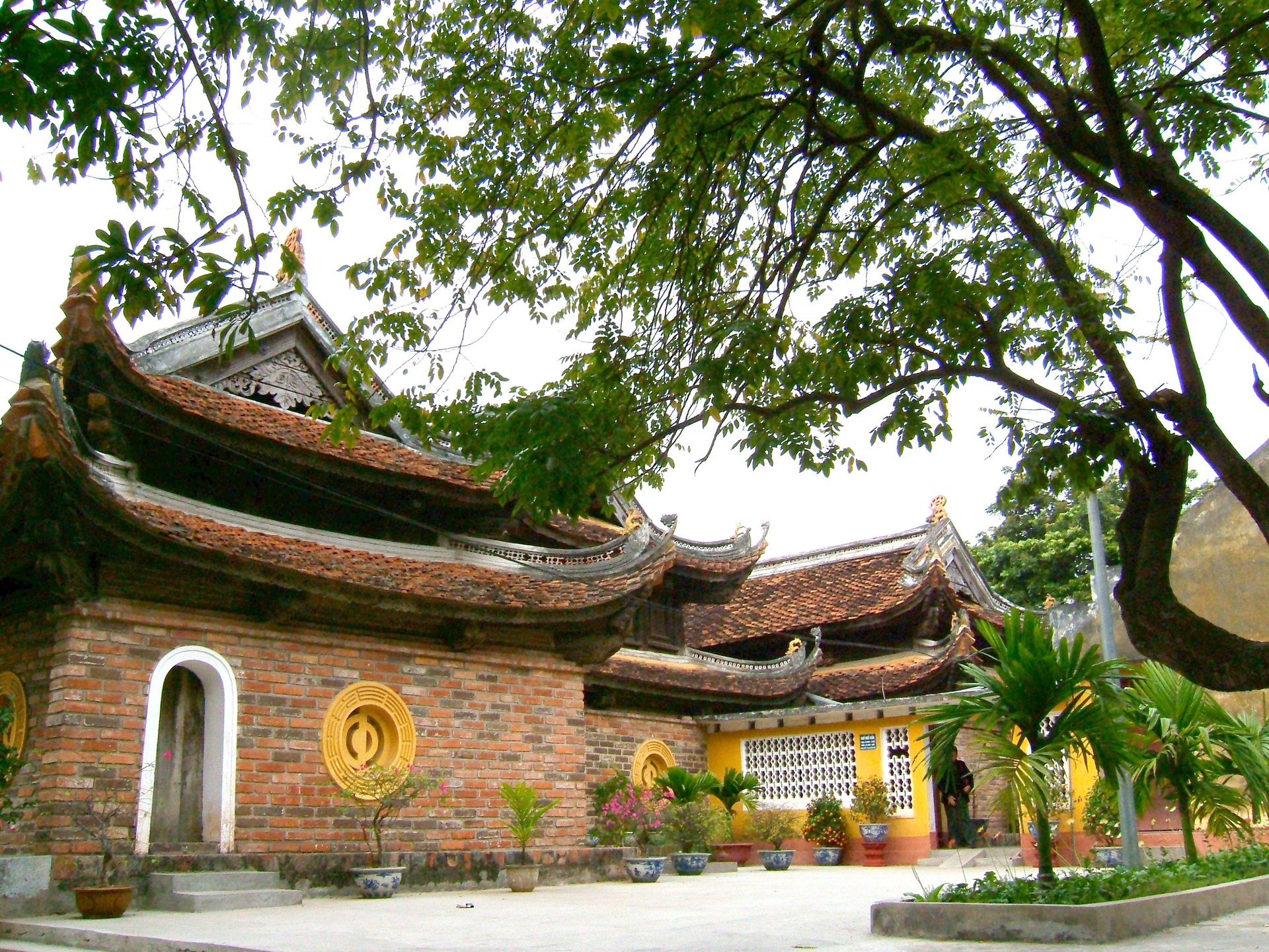
The pagoda is located on Ngu Dai bank, a high mound in Nghi Tam village, Tay Ho ward. People in Tay Ho still call this mound Hanh Cung or Cung mound. This historical name exists because Ly Thanh Tong had Quan Ngu Palace (for viewing fish) built here. Later, Princess Tu Hoa, daughter of King Ly Than Tong, asked to establish a mulberry field and silkworm-raising farm, which was renamed Tam Tang camp, and she founded Tu Hoa Palace on this land. In the Tran dynasty, Tam Tang camp was renamed Tich Ma camp, then Tich Ma ward. At the end of the Tran dynasty, on the old foundation of Tu Hoa Palace, local people built a pagoda called Dong Long Pagoda. In the Le dynasty, Tich Ma ward was renamed Nghi Tam ward. During this period the pagoda was also renamed Dai Bi Pagoda. In the 31st year of Canh Hung (1770), Trinh Sam restored the pagoda and renamed it Kim Lien Pagoda.
The special value of Kim Lien Pagoda is reflected in its distinctive and unique artistic architecture. The pagoda is built in the 'tam' character style, a traditional religious architectural style. In northern Vietnam, only two pagodas are built in that style: Kim Lien Pagoda and Tay Phuong Pagoda.
The pagoda has overlapping eaves, two tiers and eight roofs, covered with old 'mui hai' tiles; its walls are built of unplastered brick, and the wall ends all have round windows following the Buddhist phrase 'sac sac, khong khong' (form and emptiness). In particular, the decorative motifs on the architecture are expressed with rich and diverse themes such as old bamboo, dragons and phoenixes, cloud patterns, parasol trees, and drum-shaped motifs; most prominent and concentrated is the image of a lotus flower blooming on the water surface, rendered very exquisitely and vividly, with carving technique reaching a masterful level. The pagoda still preserves the only Tam Quan gate in northern Vietnam built in the 'Tam Son - Tu Tru' style. This is the inheritance and promotion of architectural art from previous dynasties, used and placed appropriately. The artistic architecture of the pagoda belongs to the complete art of the Le-Trinh period, reflecting the historical development of national art.
Viewed from afar, Kim Lien Pagoda has an architecture of three buildings on a horizontal axis, symbolizing the harmony of Heaven, Earth, and Man. With brick-building and paving techniques, plus the Dharma-wheel door rings of 'Form - Emptiness' and the soaring overlapping-eave roof corners, Kim Lien Pagoda evokes the simple wondrous meaning of Zen doctrine and universal salvation of sentient beings.
Kim Lien Pagoda has a distinctive beauty and is famous as one of the most beautiful pagodas in Hanoi. An ancient pagoda hidden in the mist and smoke of Tay Ho, comparable to Tay Phuong Pagoda built on a high mountain and bathed in golden morning sunlight—one by water, one by mountain—but in terms of structure and artistic decoration they differ only slightly in size and are otherwise exactly alike. The entire exterior landscape, the unique interior architecture, and the stone steles and highly artistic statues have increased the pagoda's value and have long been an object of study and visitation for historians, architectural art scholars, and those knowledgeable about historical relics in Vietnam and abroad.



