
Mỗ Xá Pagoda, Mỗ Xá Village, Hòa Phú Commune, Hanoi City
Good to know
- It is advisable to arrive early for a spacious experience
- Free
- Convenient to travel by taxi or bus.
Introduction
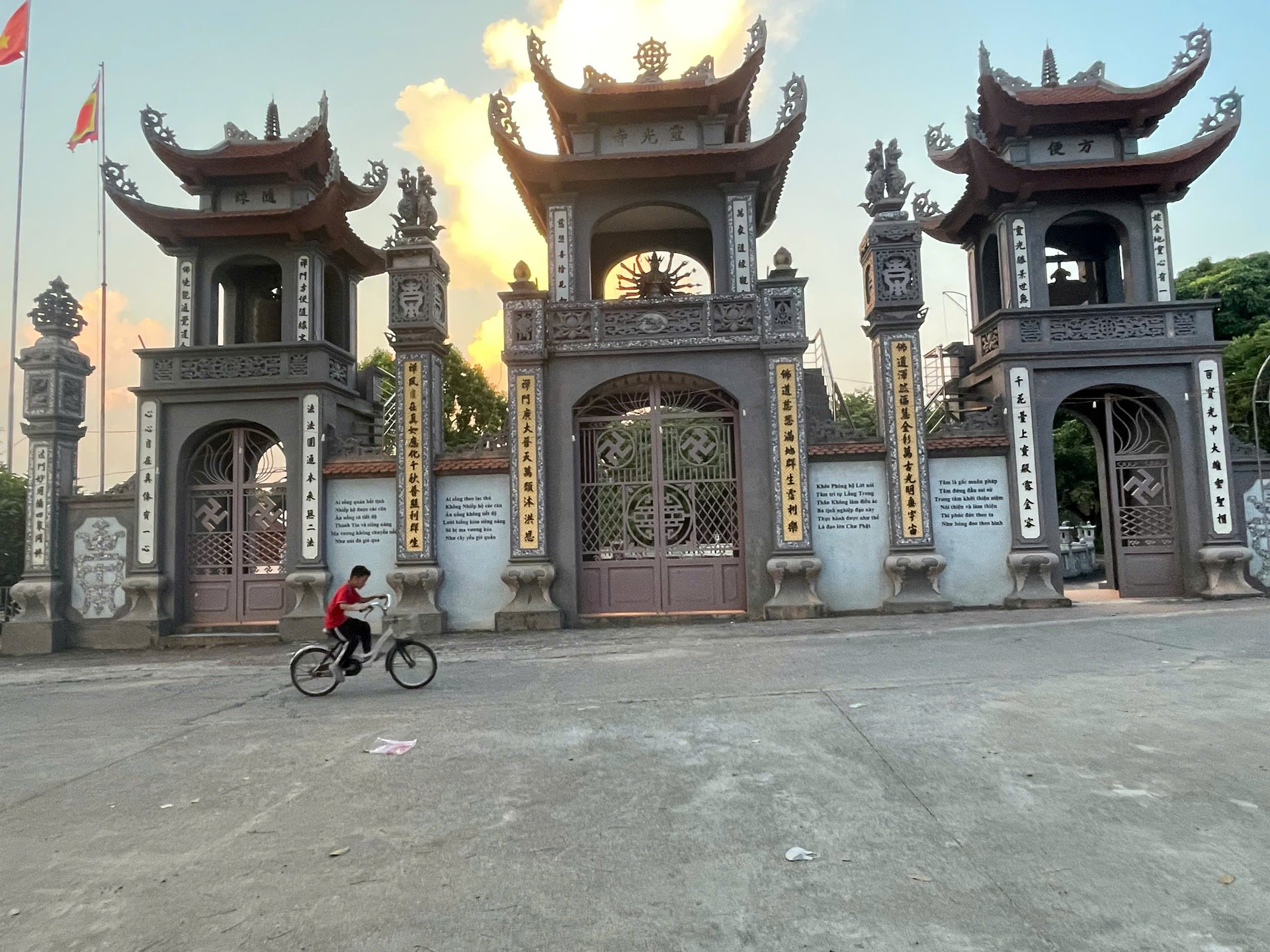
Mỗ Xá Pagoda is a Mahayana Buddhist architectural work, belonging to the artistic architectural relic type of Pagoda.
Mỗ Xá Pagoda includes the following items: the main pagoda, the Mother House, the Ancestor House, and other auxiliary structures.
The main pagoda has a Dinh-shaped layout, consisting of the Front Hall in front and the Tam Bao (Three Jewels) Hall connected in the chuoi vo style at the rear. The Front Hall has 5 bays built with masonry walls, closed gables, tay ngai, and two pitched roofs covered with ri tiles. The roof ridge and eave edges are finished with bo dinh ridges, and in the middle of the roof ridge is a "Two dragons flanking the moon" motif made of lime mortar with colored ceramic appliqué.
The decoration on the Front Hall architecture is relatively elaborate, following themes commonly found in traditional wooden architecture of the Nguyen dynasty, namely stylized clouds in the form of lotus flowers, flipped leaves, tiger-face motifs, and seal-script characters.
The Tam Bao Hall is a three-bay longitudinal building connected from the central bay of the Front Hall. The Mother House is built behind the Tam Bao Hall, also facing west, with three bays and a rear chuoi vo, built with walls on three sides, closed gables, and two pitched roofs covered with tiles. The Ancestor House is aligned with the Mother House but shifted to the north, adjacent to the communal house yard.
The wooden architectural components of Mỗ Xá Pagoda are mostly smoothly planed and tightly joined, with decorative patterns concentrated mainly in the Front Hall. Therefore, the sculpture art in the pagoda is concentrated in the system of freestanding statues in the Buddha hall.
The statues of Linh Quang Pagoda were once very rich, but due to the effects of time and war, the pagoda currently preserves 20 Buddha statues, some Mother Goddess statues, and a statue of Saint Tran. The freestanding statue system is made of wood and fired clay, with dates ranging from the 18th century to the present.
The artistic sculpture in the pagoda is concentrated in the carved panels on the Front Hall, the artifacts, and especially the system of freestanding statues in the Buddha hall. The statues of Mỗ Xá Pagoda are of medium size, but the statues were crafted elaborately and meticulously, so they all have complete aesthetic value in the 17th-18th and 19th centuries.
More Other places
- Other placesVerified
Gioi Duc Pagoda (Hong An Temple)
Ung Hoa Commune
5.0Free  Other placesVerified
Hai Giac Pagoda
O Dien Commune
5.0Free Other placesVerified
Phuong Bang Pagoda (Hung Long)
Son Dong Commune
5.0Free Other placesVerified
Sung An Pagoda, also known as Sung Khang Pagoda (Dong Ba Pagoda)
Thượng Cát Ward
5.0Free
