
Nen Pagoda
Introduction
Nen Pagoda, with the literary name “Dan Co Tu” or “Co Son Tu”, is located at No. 17, Alley 1160 Lang Street, Lang Ward, Hanoi City.
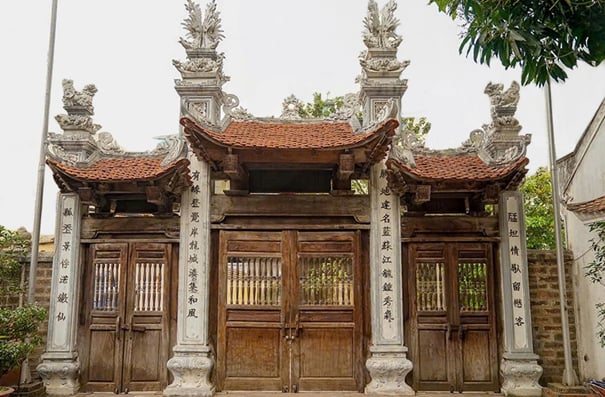
According to legend, Nen Pagoda originated from the old house of the parents of Zen Master Tu Dao Hanh, the place where the Saint was born, hence the name Dan Co. When the two passed away, this place became a shrine. When Tu Dao Hanh became a famous monk during the Ly dynasty, the shrine was Buddhistized and became a pagoda. This story is reflected in the content of the ancient couplet still preserved in the pagoda.
Long Do descended as a deity, extending over the universe.
Tu Co revealed the Saint, comparable to heaven and earth.
(Meaning:
The Dragon lineage - the country sent down a deity who covered the universe
From the house of the Tu family emerged a Saint whose merits can be compared with heaven and earth.)
Thus, Dan Co Pagoda is a place to worship the Buddha and the father and mother of Zen Master Tu Dao Hanh.
According to the book “Linh Nam Chich Quai” by Vu Quynh and Kieu Phu, Tu Dao Hanh's father was Tu Vinh - a monk skilled in magic who held the post of Tang Quan Do Sat in the Ly dynasty, often visited An Lang village, married the daughter of the Lo family named Loan, and therefore stayed there. Shortly after Tu Dao Hanh passed the Bach Lien examination, because he displeased Dien Thanh Hau, Tu Vinh was struck dead by Zen Master Dai Dien using magic, and his body was thrown into the To Lich River. The body floated to An Quyet bridge, in front of Dien Thanh Hau's house, where it stood upright for a whole day without floating away. Dien Thanh Hau, frightened, spoke to Dai Dien and shouted: “A monk is not allowed to be angry for more than a day”; as soon as he finished speaking, the body fell down and floated away.
After his father passed away, Tu Dao Hanh went to seek a teacher to learn the Way in order to avenge his father. His mother went to practice at Hoa Lang Pagoda (Dich Vong). Later, to commemorate the parents of Zen Master Tu Dao Hanh, the feudal court bestowed upon them the title of Phuc Than and allowed the people to establish a shrine for worship. Every year on the main festival day of Lang Pagoda (7/3), the villagers often organize a solemn procession to bring Zen Master Tu Dao Hanh to pay respects to his Father and Mother. After that, they reenact the “deity battle” between Tu Dao Hanh and Dai Dien to avenge his father.
The above records show that Dan Co Pagoda was formed during the Ly dynasty (11th century) and has existed continuously to the present day. Physical traces from the Le Trung Hung period remain through the ancient cabinet housing the statues of the Holy Father and Holy Mother and a relief carving of a pair of dragons facing each other. In the early Nguyen period, the villagers of An Lang and the abbot carved new statues of Buddha, the Holy Mother – Holy Father, and the abbots of the pagoda who had passed away. In the Mau Tuat year, under King Thanh Thai (1898), the bell “Dan Co Tu Chung” and the gong “Dan Thanh Co” were cast. In the 9th year of Bao Dai (1934), Dan Co Pagoda was again restored and extensively repaired; this restoration created the imposing architectural scale of the ancient pagoda.
In early 2005, the Ancestor Hall, Mother Hall, Guest House, Stupa Garden, and several other items were extensively restored and embellished. In particular, the restoration of the Three Jewels Hall was inaugurated on the occasion of the grand celebration of the 1000th anniversary of Thang Long – Hanoi in 2010.
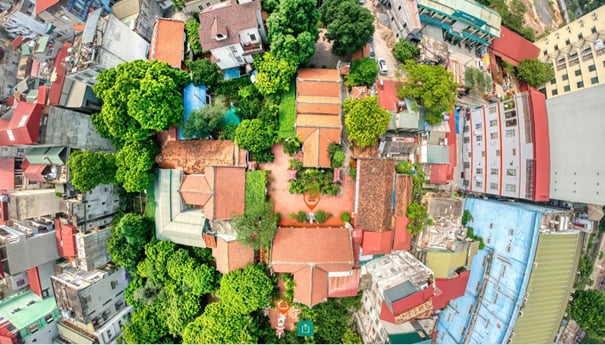
Nen Pagoda is built facing south with many architectural units. The architectural items are arranged along the depth of the relic, including: Tam Quan (three-entrance gate), Left and Right Corridors, Front Hall, Upper Hall, Holy Palace, Ancestor Hall, Mother Hall, Memorial Hall, Tinh Xa area, and auxiliary works. Surrounding the architectural complex is a large green garden that creates a separate and tranquil space for the Zen gate.
The Tam Quan gate of Nen Pagoda is similar to the outer Tam Quan of Lang Pagoda, taking the form of a four-pillar Nghi Mon gate. On top of the two main pillars are stylized Danh fruits, and on the two side pillars are standing guardian lion-like creatures. Connecting the pillars is a system of curved tiled roofs creating a graceful and elegant feeling. The roof tops are decorated with sun shapes, and the roof corners are attached with stylized dragon leaves.
Beyond the Tam Quan gate is a three-bay structure with gable walls, covered with traditional tiles, and a red brick floor; the two gables of this structure are two rear gates leading to the back of the pagoda.
The pagoda courtyard is very large with many old trees, making the relic more serene and tranquil. On both sides of the courtyard are the Left and Right Corridors, roofed with traditional tiles.
The main pagoda consists of a Front Hall with 5 bays and 2 side wings, an Upper Hall with 2 bays in a longitudinal house, and a Holy Palace behind worshiping the Holy Father and Holy Mother, giving the architecture a ground plan in the shape of the Chinese character “Cong”. The Front Hall and Upper Hall are built with gable walls, roofed with traditional tiles; in the middle of the roof ridge is a horizontal plaque bearing three Chinese characters “Dan Co Tu”, the two roof gables are decorated with stylized dragon leaves, and in front of the pagoda courtyard stands a white stone statue of Guanyin symbolizing salvation from suffering and calamity for sentient beings.
The load-bearing frame system consists of wooden roof trusses in the style of “upper gong frame and stacked beams, lower continuous purlins”, decorated with scroll patterns, curled leaves, and spiral clouds on the tie beams and eave brackets, bearing the artistic style of the Nguyen period.
The Holy Palace is structured in the shape of the Chinese character “Nhi”, consisting of the Front Sacrificial Hall and the Rear Palace, each with 3 bays and 2 side wings. The frame is made of precious hardwood in the style of “upper stacked beams and lower seated brackets with eave support” on four rows of columns. In front of the Front Sacrificial Hall is a wooden door system of the “upper lattice, lower panel” type; in the two gable bays, a bell and a gong are hung. In the central bay hangs a screen door “Ngo Hoa Ton Than” (meaning that after meeting here, one becomes a deity in this place).
The Rear Palace is parallel to the Front Sacrificial Hall and is the place of worship for the Holy Father and Holy Mother of Tu Dao Hanh. In the central bay, there remains a screen door bearing the name of the ancient pagoda “Co Son Tu”. The screen door is carved in high relief, pierced, and openwork with dragons in nests, dragon horses, and the four sacred creatures. The dragon bodies are made thick and plump, with raised scales, and thick, plump whiskers flying out from the dragons' eyes. This is a rather beautiful screen door remaining in the relic, dating to the artistic period of the late 18th to early 19th century.
In the central bay are statues of the Holy Father and Holy Mother of Tu Dao Hanh seated in a large cabinet; the right bay worships Duc Ong and two assistants; the left bay worships Thanh Hien along with Diem Nhien – Dai Sy.
In addition to the main architecture, Nen Pagoda also has many architectural works such as the Ancestor Hall, Mother Hall, Memorial Hall, Tinh Xa area, and auxiliary works... These works are all built in traditional style, in harmony with the overall planning of the relic, creating an imposing and spacious appearance for the ancient pagoda.
Through many ups and downs and historical changes, Nen Pagoda to this day still preserves a large number of unique and rare relics reflecting the religious content of the site, such as: bronze bells, bronze gongs, stone steles, royal edicts, along with many horizontal plaques and couplets praising the beauty of the relic, the land, and the merits of the deities worshiped in the pagoda. Among them, noteworthy are the two statues of the Holy Father and Holy Mother in the Holy Palace. The statues sit in a large cabinet with a rounded top in the lotus position, with their hands placed on their laps. Because they were Buddhistized, the two statues are rendered according to Buddhist sculptural rules: eyes half-closed looking down, straight nose, large ears extending down to the shoulders... the statues date to the artistic period of the 19th century.
The pagoda's system of Buddha statues includes: Buddha statues, Ancestor statues, and Mother statues, beautifully and meticulously crafted, strongly bearing the sculptural art style of the 19th century. There are high-value statues, such as: the Tam The set, Amitabha, Maitreya, the Four Bodhisattvas, the Four Heavenly Kings... Overall, the statues in Dan Co Pagoda are of medium size, and their dates of origin are mainly in the 19th century.
Nen Pagoda, together with the system of relics related to Saint Lang such as Lang Pagoda, Hoa Lang Pagoda, Tam Huyen Pagoda, Thay Pagoda... forms a unique relic complex in the western land of the Thang Long capital. It is evidence of the harmony between indigenous beliefs and Buddhism, and of the unique imprint of pagodas of the type “Buddha in front, Saint in back” in the history of Vietnamese Buddhism under the Ly dynasty. With the values of the relic, Nen Pagoda was ranked as a National-level relic in 1992.



