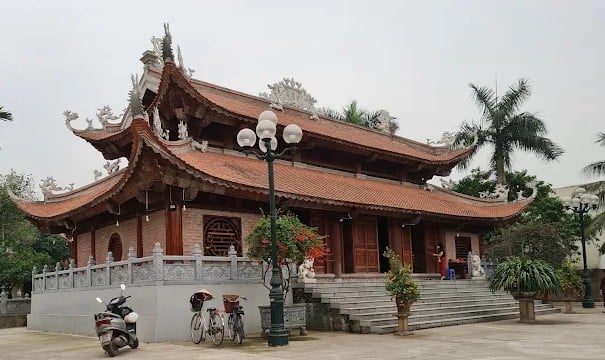
Nha Pagoda
Introduction
The historical and cultural relic complex of Nha Communal House - Pagoda formerly belonged to Nha Village, Co Linh Commune, Thuan An Prefecture, Kinh Bac Region. In the Nguyen Dynasty it was in Bac Ninh Province; today it belongs to Nha 2 Residential Group, Long Bien Ward and Cu Dong Residential Group, Long Bien Ward, Hanoi City.
Nha Pagoda has the Sino-Vietnamese name “Co Linh Tu” and the vernacular name Dong Lim Pagoda. According to folk legend: The pagoda was built together with the construction of Co Bi royal palace; in one night, along with the construction of a stone bridge, 95 mounds, and the palace at Co Bi, the fairies also hurriedly built the pagoda. While the work was underway, the local deity prevented construction by imitating a rooster's crow so that the fairies thought dawn had come and flew back to heaven. In the morning, people in the area saw four large lim columns erected and a large raft of lim wood in the Nghia Tru River. Villagers competed to pull the wood but could not move it; only the people of Nha Village could pull it and continue building the pagoda, hence the name Dong Lim Pagoda.
Dong Lim Pagoda was built in the Le Dynasty and most recently restored in the Nguyen Dynasty, including structures such as: the Three Jewels Hall with a Dinh-shaped layout, comprising a 5-bay front hall and upper sanctuary; behind it is the Ancestor House with 10 bays, the Mother House with 5 bays, and auxiliary works such as the gate, yard, garden, and ancient tomb stupa.
Dong Lim Pagoda is a place of Buddhist worship and a cultural, religious, and belief activity site for the people of Nha and Buddhist devotees to this day. Currently, in the upper sanctuary of the pagoda there are a set of Buddhas of the Three Times, Amitabha Buddha, and Shakyamuni Buddha dating from the 18th century, a bronze bell from the 19th century, and some horizontal lacquered boards and hangings dating from the early 20th century.
On September 28, 1990, Nha Communal House - Pagoda was ranked as a National-level historical and cultural relic.