
Phu Dien Pagoda
5.0Free
5.0Free
Introduction
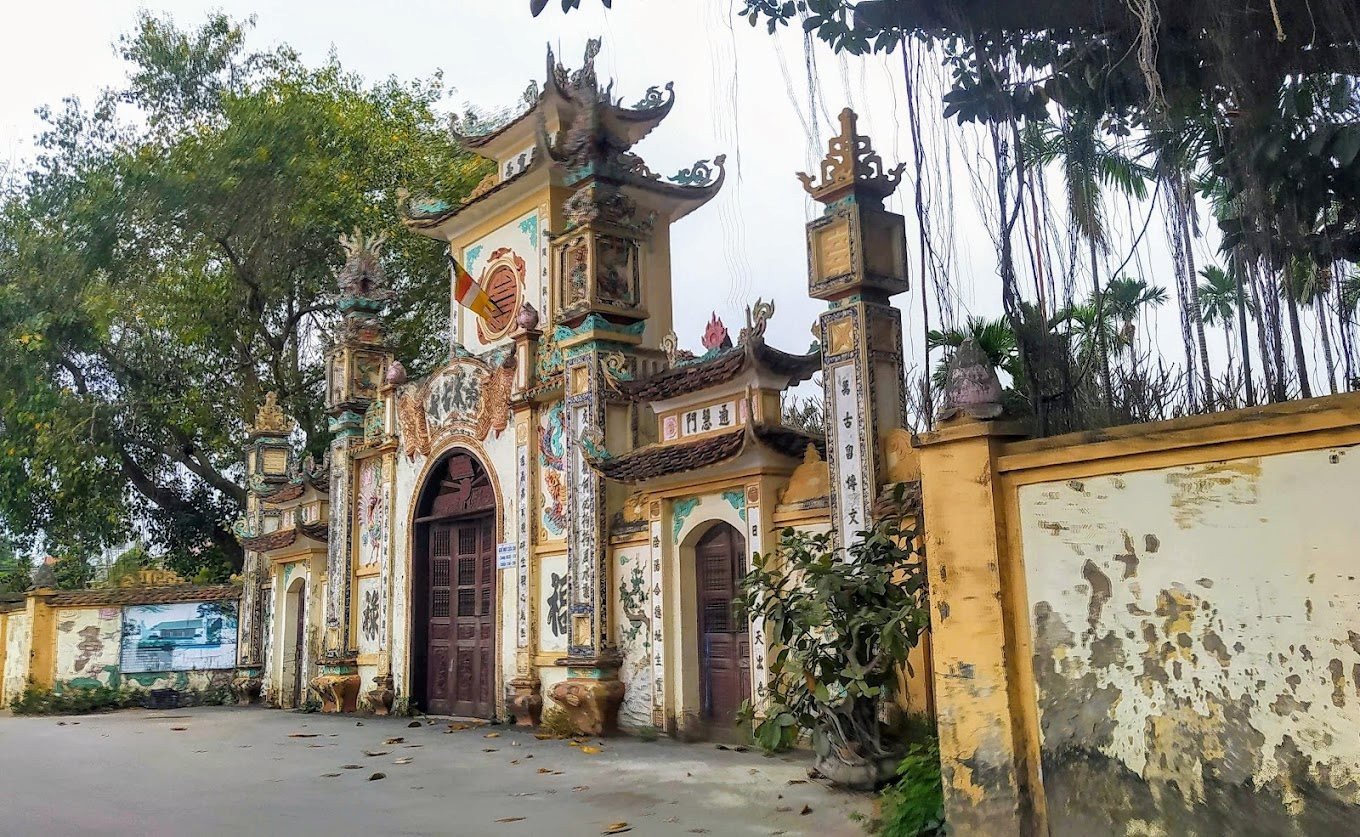
Lying peacefully beside the gently flowing Nhue River in the west of the capital, the ancient land of Phu Dien (now in Phu Dien Ward, Hanoi City) has long been famous not only for the sweet taste of its specialty Dien pomelo but also for its rich treasury of spiritual cultural heritage. Today, we invite you to quiet your heart and step into the serene space of Phu Dien Pagoda, also known by its very sacred and familiar Sino-Vietnamese name: But Moc Tu.
Phu Dien Pagoda is located on a high, spacious plot of land on the edge of the ancient village of Phu Dien, Phu Dien Ward, Hanoi City.
Phu Dien Pagoda does not stand alone but lies within a cultural-historical space with a history spanning thousands of years. In 1985, archaeologists discovered the Ngoa Long archaeological site right near Phu Dien Pagoda, establishing that humans have lived in this area for more than 1,000 years. Legend has it that from the Hung Vuong era, the deity Bach Hac Tam Giang once stopped and built a temporary palace here.
Phu Dien is famous as a land of illustrious scholarship with many high-ranking scholars such as: Doctor Le Tao (passed the Ky Suu examination in 1529), Doctor Duong Van An (passed the Dinh Mui examination in 1547 - author of the famous geographical work O Chau Can Luc), Doctor Hoang Hiep Tam (passed the Tan Suu examination in 1661), and the renowned physician - National Master Nguyen Dao An. The family line of the renowned physician Nguyen Dao An later donated much money to restore the pagoda and erect the Hau Phat stele.
As early as the Ly dynasty (12th century), Ly-Tran poetry and prose records noted that the monk Kieu Ban Tich – a native of Phu Dien – was the author of many profound Buddhist poems.
During the pre-uprising period to seize power in August 1945 and the years of resistance against the French, Phu Dien Pagoda was a contact point and secret meeting place for Viet Minh cadres and a training site for local guerrilla militia. During the resistance against the Americans, the pagoda continued to be a safe stationing place for local troops.
Based on the extant Han-Nom documentary system at the relic site (stone steles, an ancient bell, horizontal plaques, and couplets), Phu Dien Pagoda is believed to have been founded around the late Le dynasty (18th century). Over a long period of vicissitudes, the pagoda has undergone several major restorations:
· Year 15 of Gia Long (1816): The people cast a large bell But Moc Tu Chung and carved additional Buddha statues.
· First year of Minh Menh (1820): The Nguyen Dao family donated money to repair the entire pagoda and erect the Hau Phat stele.
· Year of Dinh Suu (1936): A major restoration of the pagoda was carried out.
· 1990 & 2000: Local people re-tiled the Tam Bao hall to prevent leaks, repaired the Patriarch's house and the Mother Goddess house, and restored the three-entrance gate with bell tower and the stele house.
The entire architectural complex of Phu Dien Pagoda nestles under the shade of ancient trees and lush Dien pomelo gardens, facing southeast toward vast green rice fields – the direction of wisdom and coolness according to feng shui concepts.
The gate is built of brick and mortar in the style of a double-eaved roof imitating tubular tiles. The lower level has 3 arched doorways. On both sides, the gable ends have pillar structures in a lantern style; atop the pillars are four phoenixes with their tails joined together in relief, forming a stylized fruit shape. The second level is an elegant bell tower, with roofs decorated with soft, curling dragon-tail motifs.
· Front Hall (5 bays with 2 side wings): Built in the style of a gable wall with blocked ends and armchair-shaped supports, roofed with old-style fish-scale tiles. The sturdy wooden frame consists of 6 rows of columns in the upper thu - lower thach style set on blue stone blocks.
· Upper Hall (5 bays): Runs lengthwise toward the rear, connecting to the central bay of the Front Hall. The roof truss is made in the upper rường - lower kẻ style, and the rafter panels are decorated with solemn tiger talisman motifs.
On the rafter panels and eave brackets of the Front Hall, visitors can admire the extraordinarily exquisite relief and openwork carvings of 19th-20th century folk artisans with themes such as Old bamboo transforming into a dragon, Old apricot transforming into a dragon, Dragon roundel and Tiger talisman.
Behind the Tam Bao hall is a cluster of ancestral and Mother Goddess worship houses with a simple Dinh-shaped structure. In front of the Mother Goddess house is the stele house with a four-sided double-eaved roof, along with an ancient stupa garden containing the tombs of monks who once served as abbots of the pagoda.
Phu Dien Pagoda currently preserves an extremely rich collection of cultural artifacts of high artistic value. The statues bear the distinctive artistic style of the 18th and 19th centuries and are lavishly lacquered and gilded:
1. Set of Three Worlds Buddhas: Seated in meditation on three-tiered lotus thrones with plump petals, refined oval faces, elongated ears, expressing the compassion and equanimity of 18th-century Buddhism.
2. Amitabha Buddha statue: 1.3 m high, with a serene countenance and hands in meditation mudra.
3. Jade Emperor statue: Wearing an imperial robe, a flat-top crown on the head, and holding a tablet before the chest with both hands, full of majesty.
4. Buddha Shakyamuni Holding a Flower & Nine Dragons Throne: The Nine Dragons Throne, lacquered and gilded, depicts nine dragons spraying water to bathe the infant Shakyamuni Buddha when he had just been born.
· But Moc Tu Chung bronze bell: Cast in the 15th year of Gia Long (1816), with Han characters inscribed on four sides and relief carvings of the Four Sacred Creatures.
· Minh Menh first-year (1820) stone stele: Records the Nguyen family's donation for the restoration of the pagoda.
· Horizontal inscribed board - Couplets: A system of ancient couplets praising the elegant beauty of the pagoda:
Auspicious clouds gather at the blessed pagoda
The Diễn stream flows, welcoming the sacred light
(Meaning: Auspicious clouds gather at Phú Diễn Pagoda / Villagers welcome the sacred light).
Phú Diễn Pagoda (Bụt Mọc Tự) is not only an ancient artistic architectural work imbued with the identity of the Northern Vietnamese countryside, but also a spiritual landmark, a place that preserves the "soul" and historical traditions of the people of Phú Diễn through many generations.
Away from the hustle and bustle and noise of the city, stepping into Phú Diễn Pagoda is stepping into a peaceful world, where the resounding pagoda bell blends with the rich fragrance of pomelo flowers, helping our souls become more serene and inclined toward goodness.



