
Thach Cau Bay Pagoda
Introduction
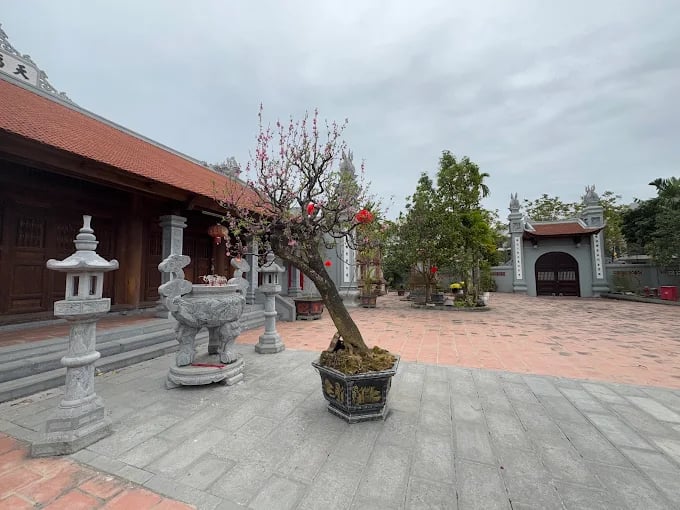
According to the stele still kept at the pagoda, Thach Ban was formerly named Thach Kieu (meaning Stone Bridge); later the sound “Kieu” changed to “Cau,” also meaning bridge. It was called Thach Cau because, according to the stele erected in the 4th Vinh Huu year (1738) and still kept at the communal house, which records the repair of the stone bridge and the renovation of Nghia Tru River: Nghia Tru River flows through the east of the village and is a branch of the Red River in the areas of Bat Trang, Kim Lan (Gia Lam), Van Giang, and Xuan Quan (Van Giang - Hai Hung). In 1958 the river section was renovated into the Bac Hung Hai irrigation project. Nghia Tru River flows through Kieu Ky and Da Ton communes; one branch separates and flows through Duong Xa and Duong Quang and joins Thien Duc River. The section through Thach Ban was later called Cau Bay River. The name Cau Bay or Thach Cau Bay distinguishes it from Cau Doi village or Thach Cau Doi village in Long Bien commune (now Long Bien Ward).
Like many ancient pagodas in the Northern Delta, Phuc Tru Pagoda was built to meet the local people's need for Buddhist worship. Thach Cau Bay Pagoda was built early in the village's overall architectural planning. According to the inscription engraved on the stele “Tu tao Phuc Tru tu bi” in the 10th Hoang Dinh era (1609), the beauty of the ancient pagoda was praised:
“The land of Viet in the South, its boundaries already divided, a good and auspicious area, a famous village where sacred energy gathers, the renowned Tru Pagoda, a beautiful branch of Nghia Tru River, enclosing the bright hall, the winding canal like Huyen Vu, curving and flowing, sacred land and beautiful village, such good karmic conditions, doing good will surely succeed, the scale is fresh and beautiful, a new order is opened, lasting and majestic, the tower and hall are splendid, the Three Jewels are glorious, truly like a fairy garden, the people there are clear...”
Buddhism was introduced into our country from the early years of the Common Era; because its content suited the psychology of the Vietnamese people and its rituals were simple, Buddhism developed strongly and at times became the orthodox ideology of the Dai Viet feudal state. This is a religious architectural work within the Mahayana Buddhist system, closely linked to the spiritual life of the local people. The pagoda is both a trace of Buddhist architecture and an expression of the people's faith and aspirations for a peaceful and prosperous life, and it educates people in compassion and benevolence.
Thach Cau Bay Pagoda was also a base for local revolutionary activities. During the resistance war against the French from 1945 to 1954, the pagoda was a secret operational base for local soldiers and guerrillas. In the pagoda's upper hall there were two secret tunnels leading out to the fields; when the French came to sweep the area, soldiers and guerrillas could escape through these two tunnels. In particular, on December 13, 1946, local guerrillas here were ordered by their superiors to destroy Cau Bay Bridge spanning Nghia Tru River to block the French army's advance from Hai Phong to Hanoi. Because their route was blocked, the French swept into Cau Bay village, burned the communal house and nearly 100 houses, and killed elderly people and children. Local soldiers and guerrillas fought back heroically; thanks to the secret tunnel inside the pagoda, soldiers and guerrillas withdrew to Thuong Hoi village secretly and safely. It was precisely because secret tunnels were dug inside the pagoda that its foundation later cracked. During this period, the pagoda had two abbots, Thich Dam Hieu and Thich Dam Nghia, along with four novices who looked after it. During the years of secret operations at the pagoda, local soldiers and guerrillas were regularly cared for, protected, and wholeheartedly helped by the two monks and the pagoda's novices. Novice Thich Van Ky directly participated in local guerrilla activities for a time, was later recruited into the army, and died. Novice Thich Van Ky was recognized by the State as a martyr against the French. By 1954, Cau Bay Pagoda was recognized by the State as a resistance pagoda and was awarded the Third Class Independence Medal.
During the resistance war against the United States for national salvation, Thach Cau Bay Pagoda voluntarily donated three compartments of the rear hall and five compartments of the corridor to the cooperative. In 1974, the monk Thich Dam Hieu passed away. On the occasion of summarizing the resistance war against the United States, the monk was posthumously conferred by the State the title Vietnamese Heroic Mother.
With those values, Thach Cau Bay Pagoda was ranked as a historical and artistic relic by the Hanoi City People's Committee in Decision No. 1526/QD-UBND dated April 20, 2026, and had a revolutionary resistance relic plaque installed under Decision No. 5013/QD-UBND dated December 15, 2007.



