
Thị Cấm Pagoda (Linh Ứng Temple)
Introduction
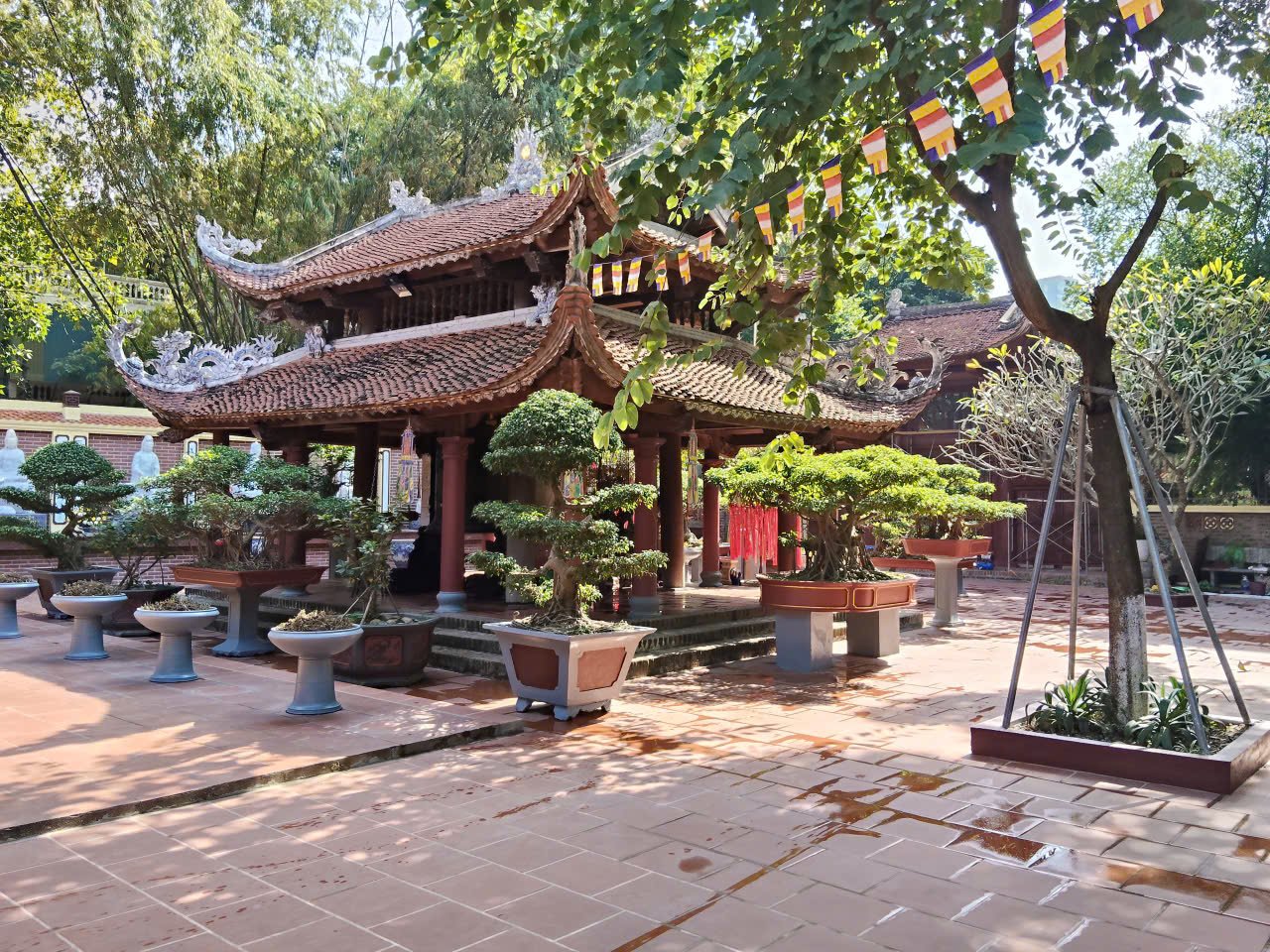

Linh Ứng Pagoda (Thị Cấm) - Xuân Phương Ward
Thị Cấm Pagoda is in Thị Cấm Hamlet, Xuân Phương Commune, Từ Liêm District - Hà Nội, now belonging to Xuân Phương Ward, Hà Nội City; its Sino-Vietnamese name is 'Linh Ứng tự'. It lies in the west of Hà Nội capital, about 12 km from the city center. Before 1945, Thị Cấm was a hamlet of Phương Canh Commune, Phương Canh Canton, Hoài Đức Prefecture. Later it belonged to Xuân Thủy Commune, and in 1959 it was made Xuân Phương Commune. Thị Cấm is also called Canh. This is an ancient village; the village's historical depth is evidenced by its historical-cultural relics, folk legends, customs, practices, and old traditions. Located along the west bank of the Nhuệ River, amid a rich countryside, Linh Ứng Pagoda is quite large and surrounded by thick bamboo ramparts. Local folk legend says that Linh Ứng Pagoda was built in the Trần dynasty. The pagoda's date under the Lê dynasty is also firmly confirmed. At the end of the 17th century, Mrs. Nguyễn Thị Bảo and her husband in the village donated their wealth to repair the upper sanctuary, the bell tower, and to cast a bell. A century later, due to historical changes, the old bell was no longer there; the villagers raised funds and mobilized donations from people near and far to cast the bronze bell 'Linh Ứng tự chung'. The inscription on the bell, composed by the official Diên Đức Nam of the Ministry of Personnel, states that the bell was cast in the second year of Cảnh Thịnh (1795). This casting also left two precious relics: the stele 'Hậu Phật bi ký', erected on March 22, 1795, recording the merits of Mr. Bùi Đình Chi, whose title was Pháp Cải, and the stele 'Hậu Phật bị ký', engraved by the famous Tây Sơn-era figure Trần Bá Lãm, a Hanlin Academy scholar known for filial piety. In the Nguyễn dynasty, written records about the relic's existence and restoration events became richer. Steles and inscriptions on the bronze bell show that the pagoda underwent major repairs in the Đinh Tỵ year of Emperor Tự Đức's reign (1857); in the Quý Mão year of the Thành Thái era (1903), the villagers again cast a new bell, 'Linh Ứng tự chung'. In the 12th year of Bảo Đại (1937), the pagoda was once again extensively restored; since then, after many repairs, it has the grounds it has today. The surviving architecture includes: the main pagoda's three-entrance gate in the shape of the character 'Công', the Mother Goddess house, and the guest house. The front of Thị Cấm Pagoda; Linh Ứng Pagoda's three-entrance gate was recently rebuilt and consists of one large gate and two side gates. The lower part is brick, and the upper part is covered with old tiles. The central roof is made in an eight-roof style, with curved roof corners, ending in folded leaf shapes along the roof edges; the forecourt inscription bears three Chinese characters 'Linh Ứng tự' (Linh Ứng Pagoda). Beyond the gate is a small garden leading to the pagoda courtyard. The main pagoda is an ancient structure in the shape of the character 'Công', consisting of the front hall, the incense-burning house, and the upper sanctuary. The pagoda faces east, with its front looking out to the Nhuệ River. The front hall has three bays and two wings, covered with local tiles; the roof ridge is built in an inverted T shape. In the center is a fiery sun above a tiger symbol; at the two gable ends are two dragon heads facing inward. The building has four roofs, and the corners form soft curved upswings. At the end of each upswing is a dragon head facing the roof ridge; in the middle of the roof edge is a large blue ceramic nghê. Supporting the roof are four simple truss sets of the 'thượng kẻ cầu, hạ kẻ' type on four rows of feet. The incense-burning house consists of two longitudinal bays connecting the front hall and the upper sanctuary. The two roof-supporting truss sets are made in two different forms. The outer truss is of the 'thượng kẻ câu, hạ kẻ' type like the front hall; the inner truss is made in the 'thượng chồng rường giá chiêng, hạ kẻ' form. The upper sanctuary is a three-bay building with a local-tile roof in four-roof form. The roof corners are made into curved upswings, and the tips have slender phoenix heads turning toward the roof ridge. The ridge of the upper sanctuary is built in a nail-edge form; in the center is a raised rectangular section containing three Chinese characters 'Linh Ứng tự'. At the outermost ends are two dragon heads looking toward the middle of the roof. Currently, the tam bảo of Linh Ứng Pagoda is built as brick platforms rising gradually from the incense-burning house to the upper sanctuary, serving as places to arrange worship statues. The pagoda currently has 55 round statues, including 30 large statues and 25 small statues on the Maitreya and Snow Mountain grottoes. Among these, 7 large statues date to the Lê Trung Hưng period, and the rest belong to the Nguyễn period. The pagoda has a precious relic, the bell 'Linh Ứng tự chung', cast in the second year of Cảnh Thịnh (1795); there are also a pair of 19th-century stone elephants, 2 ceremonial doors, 2 canopy doors, 7 horizontal plaques, 4 pairs of gilded and lacquered parallel sentences made under the Nguyễn dynasty, and 13 stone steles from various periods. During the two resistance wars against foreign invaders to protect the country, the abbots of Linh Ứng Pagoda contributed much to society. In 1947 the pagoda was a place that received and treated many wounded soldiers of the western Hà Nội front. The abbot, Venerable Chân Thường, was a person who fulfilled religious duties and was deeply attached to worldly life. He joined the National Salvation Buddhist Association, served as adviser to the Central Vietnam Buddhist Association, and was chairman of the Từ Liêm District Buddhist Association. He passed away in 1982 amid the grief of the villagers and Buddhists. As a traditional relic, Linh Ứng Pagoda has multifaceted value for the life of Thị Cấm people in particular and for everyone's spiritual life in general. The relic's significance lies in its historical and architectural values and in the historical and artistic relics that remain today. For this reason, the pagoda was ranked as a national relic by the Ministry of Culture and Information in 1990.



