
Tho Khoi Pagoda
Introduction
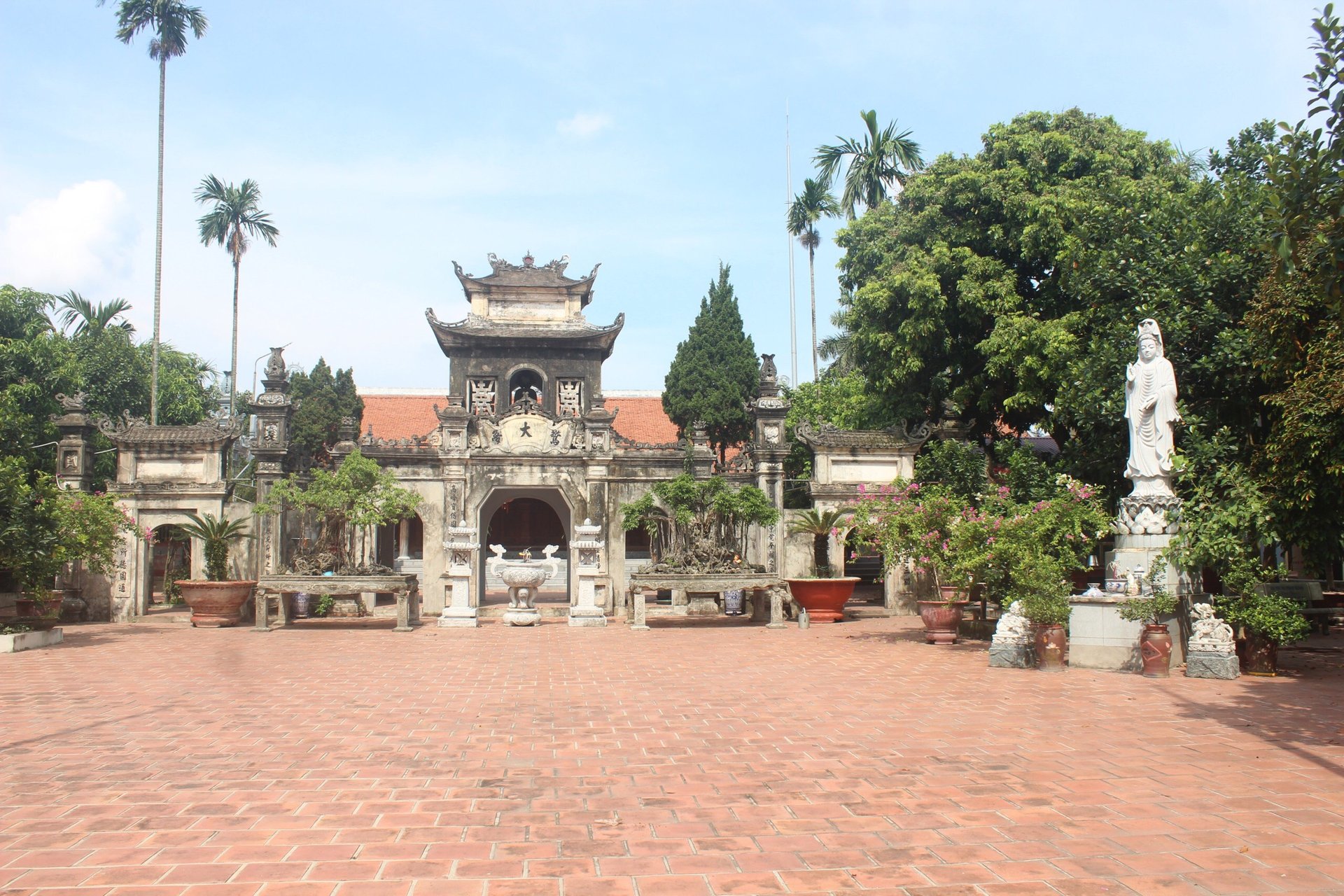
Tho Khoi Pagoda, whose literary name is Sung Phuc, is located on a large plot of land in Tho Khoi 1 residential group, Long Bien Ward. The pagoda lies outside the foot of the Red River dyke, about 7.5 km from Chuong Duong Bridge. The pagoda has a moss-covered, ancient two-tier bell tower housing the Great Bell, so that when it rings it will save all sentient beings still bound by worldly karma.
Tho Khoi Pagoda stands on high ground and faces west. People often think of the West as the Pure Land, where Amitabha Buddha resides, the realm of no birth and no death. In particular, the west is a direction that harmonizes yin and yang. This is because the west carries the yin element; the front of the saint is yang, the back of the saint is yin and faces east, which is yang; the north is yin, corresponding to the saint’s right hand, which is yang; the south is yang, corresponding to the saint’s left hand, which is yin. All directions express the interplay of yin and yang so that things may multiply and develop.
Currently there is no documentation about the founding of Tho Khoi Pagoda. According to researchers, the name Sung Phuc appeared quite early. In the past, Tho Khoi had five high mounds such as Go Cat, Cau Cao, Dong Son, Dong De, and Dong Hot. These five mounds are regarded as the five sacred peaks and also represent the Five Elements in mutual generation, creating a prosperous village. A pair of couplets on the pillar of the front hall records:
Five peaks uphold the Dharma realm; jade dew is fragrant, golden fruits enjoy the scene and look up to the lofty standard
Two waters nourish the mind of wisdom; auspicious clouds cover it; the sun of wisdom turns its light around the precious throne
Rough translation:
Five peaks like the Dharma realm, a jade vase scatters fragrance, bears fruit, and looks up in reverence to the heights
The Nhi River, that is, the mind of wisdom—how auspicious! The sun of wisdom turns its rays toward the lotus throne
Legend has it that during the Le dynasty, a man surnamed Dao from Tho Khoi village, Tong Son district, Thanh Hoa prefecture (Thanh Hoa), came to this alluvial area to make a living. He had the merit of helping King Le escape danger, and afterward the court allowed him to control boats passing through here. If the dyke broke or floods occurred, he was permitted to request reinforcements for rescue from the Thai Binh Governor's Office to Tuyen Quang. After he died, the villagers worshipped him as the Village Tutelary God, and the court bestowed a title on him.
Thus Tho Khoi is a village along the Red River, and it is possible that at first the pagoda only worshipped Quan Am Nam Hai (Avalokiteshvara of the Southern Sea).
Over the years, Tho Khoi Pagoda suffered subsidence and erosion. According to the Hau Phat stele dated the 7th day of the 4th month of the 14th Minh Menh year (1833) at the pagoda, it states: 'In the 13th Minh Menh year (1832), our commune's pagoda suffered subsidence and erosion; moved by this, Mrs. Dao Thi Viet donated 20 quan from her family property to begin restoration and embellishment.'
After that, Tho Khoi Pagoda continued to restore the Tam Bao hall. The Hau Phat stele dated the 28th day of the 10th month of the 7th Tu Duc year (1854) records: 'The village elders, district chief, village chief, and the sacrificial association together with Tho Khoi commune, Gia Lam district, Thuan An prefecture, built and repaired the Tam Bao. Every family contributed some merit. Mrs. Le Thi Han, daughter of Le Van Nhai, donated 42 quan in money.'
Also during this period, Tho Khoi Pagoda cast a bell and a khanh. The inscription on the bronze khanh cast in the Quy Ty year, the 14th Minh Menh year (1833), is still preserved.
From the 19th century, when the Lam Te sect was transmitted from Ba Da Pagoda to Dao Xuyen Pagoda (Da Ton), Tho Khoi Pagoda became a branch of the Dao Xuyen ancestral line. Every year, on the death anniversary of the Dao Xuyen patriarch, the Lam Te-line pagodas in the surrounding area, including Tho Khoi Pagoda, go to Dao Xuyen Pagoda to worship the Buddha and invoke the patriarch.
Architecturally, the Tam Bao hall has a ding-shaped structure. The upper sanctuary houses the system of Buddha statues. Unlike other pagodas, here the two side walls of the main hall have arched niches for worshipping the Ten Courts of Hell, and at the very back of the upper sanctuary there is still a passage for the ritual of circumambulating the Buddha (running the altar).
In addition to the system of bells, khanh, and stone steles, the pagoda also preserves many ancient artifacts such as horizontal lacquered boards and couplets describing the scenery here. Among them is a pair of couplets inscribed:
Our hometown is favorable; Gia Lam is at hand; the first path resounds with the clear sound of flowers
The Zen gate opens up the land; Tho Khoi appears vast, widening everyone's view
Translation:
Gia Lam, the hometown, gathers in prosperity; flowers and trees grow well
The Zen gate opens up the land and opens a vast realm beyond the range of vision
In addition to worshipping the Buddha, Tho Khoi Pagoda also worships the Mother Goddess. The Mother Goddess building is located on the left side of the Tam Bao hall and was rebuilt at the same time as the bell tower. Here are worshipped the Three Holy Mothers, the Four Palaces Lady mediums, the Four Palaces mandarin princes, the spirits (girls and boys), the Son Trang cave, and Saint Tran.
Tho Khoi Pagoda has been ranked as a historical and cultural relic by the Ministry of Culture and Information, now the Ministry of Culture, Sports and Tourism. Although the pagoda is of moderate scale, it has left the people of Tho Khoi, even when far from home, with the image of their homeland and the tranquil pagoda with its bells summoning and welcoming morning and evening. Along the Red River or following the dyke down to Bat Trang, Tho Khoi Pagoda has been and remains a stop for visitors.



