
Thuong Village Pagoda, Thuong Phung Xa Hamlet, Hong Son Commune
Introduction
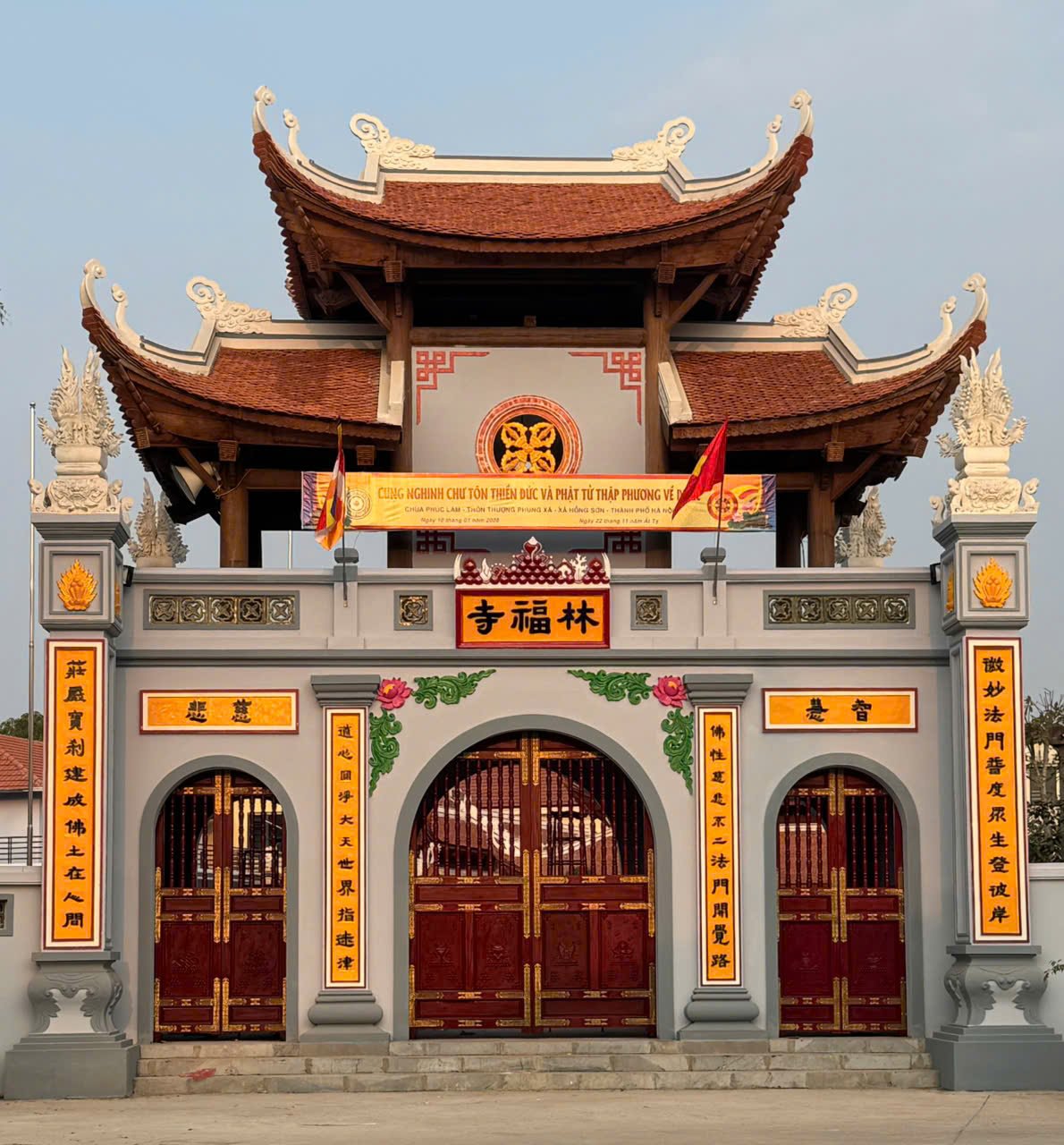
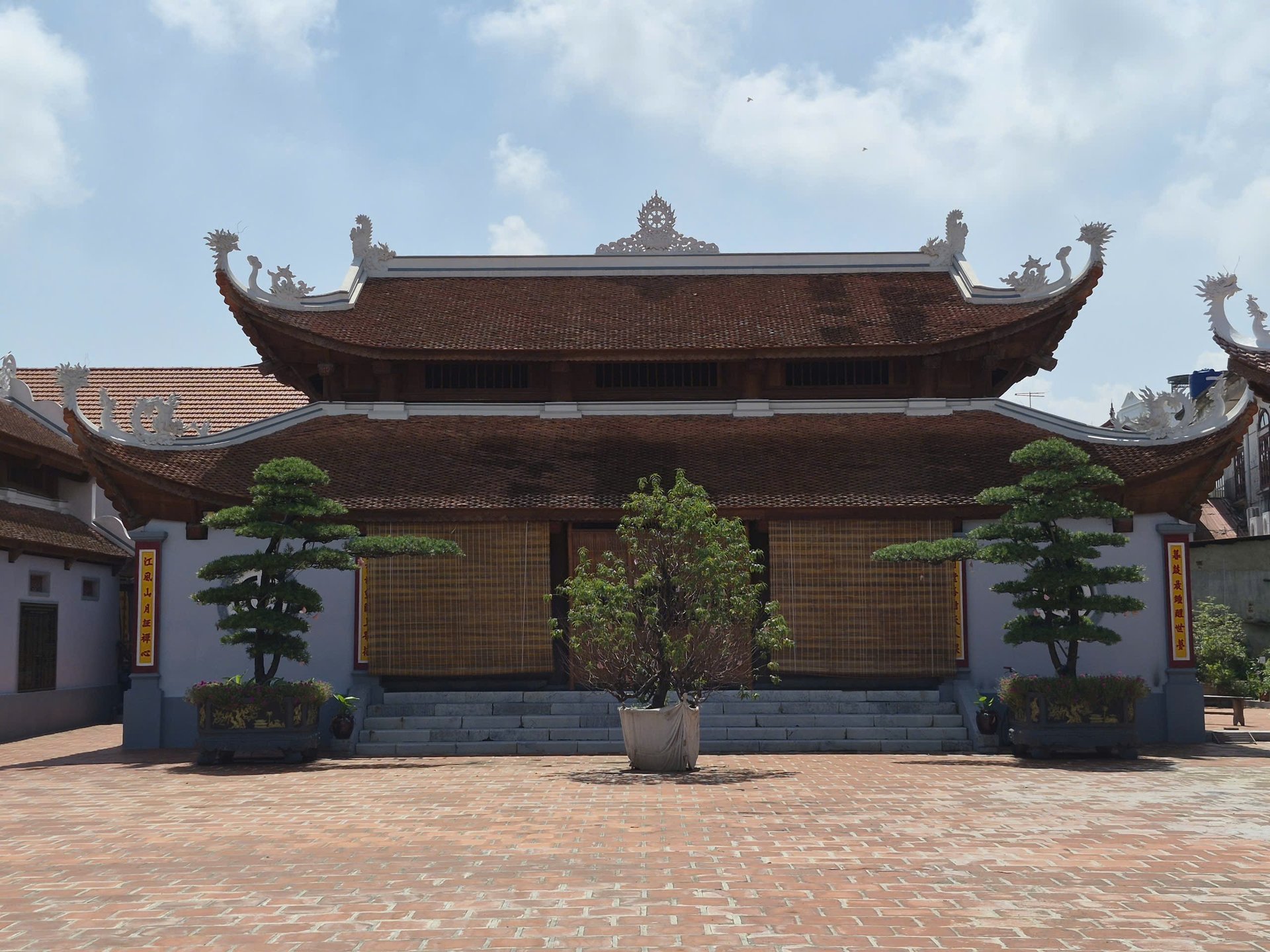
Thuong Village Pagoda belongs to Thuong Phung Xa Hamlet, Hong Son Commune, Hanoi City.
Thuong Village Pagoda was ranked as a city-level historical and cultural relic under Decision No. 651/QD-UBND dated May 21, 2002, of the Hanoi City People's Committee.
Thuong Village Pagoda (Phuc Lam Tu) was built to meet the religious and spiritual needs of the Thuong village community. It is a Buddhist architectural work worshipping Buddha according to the Mahayana tradition. Therefore, Thuong Village Pagoda is classified as a pagoda-type architectural relic.
Thuong Village Pagoda is located on a high, open and beautiful plot of land facing west. At present, the main pagoda has a Dinh-character (J) layout with a Front Hall and a Three Jewels Hall. In front there is a three-entrance gate and a brick-paved yard. The pagoda has a fence system surrounding the fruit garden and the land of the relic area.
From the three-entrance gate along the main path, across a yard, one reaches the Front Hall of Thuong Village Pagoda. The Front Hall consists of three bays built in a two-tier, four-roof overlapping-eave style and was restored in the 11th year of Bao Dai (1936). The whole pagoda was restored, embellished, completed and put into use in early 2026.
Inside, the roof-supporting trusses are made uniformly in the style of upper stacked beams and lower flank beams. In these trusses, connecting the two main columns is a small tie beam, slightly tapered at both ends; the tie beam supports three straight beams placed one above another through three thin square bearing blocks with tapered bases; the topmost beam supports the upper ridge beam through a boat-shaped block; the fifth beam close to the tie beam has its middle section cut away and transformed into a con nhi detail, giving lightness to the roof-supporting truss. The side beam connects from the body of the main column to the brick wall; one end of each side beam is mortised into the body of the main column, and the other end supports the roof purlins. The trusses are also linked to one another by upper and lower beams running lengthwise through the building. In the central bay of the entire worship hall, between the two beams, a system of wooden lathe-turned ornaments is decorated, creating aesthetic beauty for the relic.
The decoration on the architecture of the Front Hall is simple, mainly smooth planing and close fitting, with moulded edges. Architectural details such as beams, purlins and crossbeams are planed and moulded with raised edges.
The Three Jewels Hall consists of three longitudinal bays connected to the central bay of the Front Hall in a tail-shaped plan, with brick gable walls with throne-arm motifs and two sloping roofs covered with ri tiles. Inside, the main columns are built of brick, with lathe-turned balusters above to provide ventilation and light; the Buddha statue system is arranged on a brick platform rising gradually. The Three Jewels Hall was restored in the 26th year of Tu Duc (1875) and in 1996, and was embellished and restored in 2025. Its artistic architecture is simple and tends toward solidity.
Behind the Three Jewels Hall is the Ancestor and Mother Goddess house, five bays with brick walls and gable ends. The two end bays are partitioned by walls as accommodation for the abbot, while the three central bays are used for ancestor worship; however, the pagoda currently has only one Ancestor altar in the central bay.
The wooden architectural components of Thuong Village Pagoda are mainly smooth-planed and close-fitted; decorative patterns are concentrated mainly in the Three Jewels Hall. Therefore, the carving art in the pagoda is concentrated in the free-standing statue system on the Buddha altar. At present, the pagoda still preserves 25 Buddha statues, one Nine Dragons stand, and a number of Mother Goddess statues. The free-standing statues are made of wood and molded earth. In the Three Jewels Hall, the first tier, at the top, is the three Tam The statues. The set consists of three statues, fully called 'Tam The Thuong Tru Dieu Phap Nhan' (the eternally abiding Dharma Body of the Three Worlds). The three statues are similarly posed and equal in size. The statues measure 83 cm in height and 59 cm across the knees; they are carved in a meditative sitting posture with hands forming the meditation mudra, palms upturned in the lap. The skulls are broad, the faces full, round and short, and the ears large and pendulous. The ushnisha is clearly raised on the top of the head; the hair is arranged in thick coils with small beads. The necks have three lines. The robes are tied in a knot before the abdomen, the chests are bare, and the robes are wide. The statues have a somewhat short stature.
The lotus base of this statue tier consists of three layers of petals opening according to the seated posture. The lotus petals are thick with pointed tips, and the carved lines are somewhat coarse.
The second tier is the Amitabha Trinity. The set includes the Amitabha statue and two statues, Avalokitesvara Bodhisattva and Mahasthamaprapta Bodhisattva. The Amitabha statue is 90 cm high and 60 cm across the thighs. The statue is in a seated position compactly within the base, in the yin-yang sitting posture. The hands form the meditation mudra in the lap. The skull is broad and round, the ushnisha rises high, and the ushnisha is made into a pointed top on the head. The ears are thick and pendulous, the neck is low with three lines. The statue's robe has three layers.
The statue sits on a lotus base 25 cm high; the base is carved with petals opening according to the seated posture and consists of three layers of upturned petals.
The Avalokitesvara Bodhisattva and Mahasthamaprapta Bodhisattva statues are carved standing on lotus thrones, of similar height, 125 cm, with symmetrical hand positions. The heads have hair coiled upward; outside they wear scarves with two ear bands, and split hair bags hang down to the ears. The robes have two layers falling loosely, with the outer layer made in a pointed, flattened raised style.
The statues have lotus bases consisting of two layers of upturned petals and two layers of downturned petals.
The third tier is the Cundi Avalokitesvara statue, with the attendants Golden Boy and Jade Girl. The Cundi Avalokitesvara statue has two pairs of hands. The main pair forms the Cundi mudra, while the other pair forms the meditation mudra placed in the lap. The face is oval, the head wears a crown with two long ribbons behind. The front is carved with raised scroll patterns, and chrysanthemum flowers are decorated close to the hairline. The statue sits on a lotus throne with four layers of petals, supported by the demon Upananda Dragon King. The wrists are slender and round and wear bracelets; the hands have cloth bands. The statue is 105 cm high (excluding the lotus base). This is the most beautiful statue in the pagoda.
The Golden Boy statue wears a helmet-shaped hat and court robes with a belt and rank badge; the robe folds fall softly, and the feet wear boots.
The Jade Girl statue has hair coiled upward and tied with a scarf outside. The robe is a pullover garment falling inside the skirt, with a belt before the abdomen, and the scarf folds fall softly. The statue's feet wear shoes.
The two statues Golden Boy and Jade Girl have symmetrical hand positions, holding Buddhist treasures. Both statues are 1.20 m high.
The fourth tier: the Jade Emperor statue is in the center, flanked by the Nam Tao and Bac Dau statues. Nam Tao and Bac Dau wear court robes with belts and rank badges and sit on bases. Their heads wear winged hats. Nam Tao holds a red scroll in his right hand. Bac Dau holds a register in his left hand and a brush in his right hand. The Jade Emperor statue is carved in a seated posture, 1.20 m high, wearing a Binh Thien crown, holding a command tablet with both hands, wearing boots, and dressed in a dragon robe.
The fifth tier, outermost, is the Nine Dragons stand flattened into a circular shape; in the center is the infant Shakyamuni statue standing on a lotus throne, with the left hand pointing to heaven and the right hand pointing to earth according to Buddhist legend.
On the two sides of the gable ends of the Three Jewels Hall, statues are arranged: Child-giving Guanyin on the right and the Holy Sage on the left. The Child-giving Guanyin statue depicts female figures with gentle faces, sitting on a base, with the right leg drawn up and the left leg extended in a seated posture.
Outside the Front Hall, on the two sides of the end bays, are the two Dharma Protector statues, Encouraging Good and Punishing Evil, holding swords, with long backs and stern faces; the Encouraging Good statue holds a bright pearl representing the light of the Buddha Dharma.
The two statues measure 185 cm overall and are 82 cm thick. The statue bases are 67 cm high and built of square bricks. The lion is 110 cm long.
At the two ends of the gable of the Front Hall are altars: the Earth God and Kitchen Supervisor altar on the right, and the Ksitigarbha statue altar on the left.
* Traditional festival and activities in the relic:
Thuong Village Pagoda (Phuc Lam Tu) came into being to satisfy the cultural and spiritual needs of the majority of Thuong village residents. People come to the pagoda to pray for good things for human health and for favorable crops and lush trees. Together with the communal house, the organization of the traditional festival in the homeland at the pagoda takes place as follows:
Every year, on the 14th day of the first lunar month, the birthday of Lady Phat Cac, and on the 28th day of the sixth lunar month, the village anniversary, a festival is held to gather descendants back to their roots, show gratitude for merits, and pray for blessings for the villagers. Each giáp prepares offerings including incense, flowers, banh day, and che kho to place on the altar. The offerings are products from four sao of village rice fields assigned for cultivation to prepare the ceremony.
On the days of Tet Nguyen Dan, Thuong Nguyen (the 15th day of the first lunar month), Buddha's Birthday (the 15th day of the fourth lunar month), the full moon and the first day of the month, more people come to the pagoda than usual. Offerings presented to the Buddha include incense, flowers, oan cakes and fruits, and agricultural products according to each season, with sincere incense offered.
* Scientific, historical, cultural and artistic values
Thuong Village Pagoda (Phuc Lam Tu) came into being to meet the spiritual, religious and belief needs of a village community, specifically Thuong village. As a village pagoda with values in many aspects of traditional Buddhist architecture, it gives Thuong village pagoda a significant position in the cultural heritage treasure of the homeland.
The artistic architecture in the pagoda is concentrated and expressed in special relics, especially through the free-standing statue system on the Buddha altar. The Buddha statues at Thuong Village Pagoda are carved elaborately and meticulously, so they all have high aesthetic value. Each statue carries its own beauty and its own characteristic general features, typical of each specific figure.
Throughout its existence, Thuong Village Pagoda has contributed significantly to preserving the traditional cultural values of the nation and nurturing compassion and love for the homeland and country among local people. The pagoda was also a revolutionary base during the resistance period.



