
Thuong Pagoda (Linh Nhac Tu), Thuong Noi Village, Hong Son Commune, Hanoi City
5.0Free
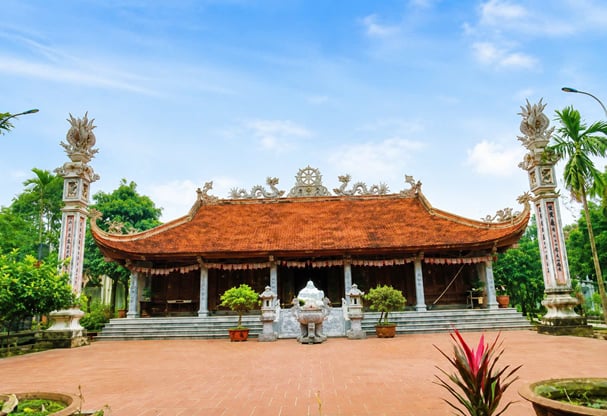
Thuong Pagoda (Linh Nhac Tu), Thuong Noi Village, Hong Son Commune is evidence of the flow of Mahayana Buddhism. The pagoda is located on a high, spacious plot of more than 4,000 m2, with trees lush all year round. About 10 m behind the pagoda is the Day River; in front are a large pond, an ancient banyan tree, and village fields. Because it is not in the middle of a residential area, the pagoda still retains a pure, peaceful, and quiet space, creating a harmonious landscape between religious architecture and nature. With typical historical, cultural, artistic architectural, and belief values, Thuong Pagoda (Linh Nhac Tu) was recognized by the Hanoi City People's Committee as a city-level historical-cultural relic under Decision No. 4553/QD-UBND dated September 2, 2024. This is the State's recognition of the relic's outstanding values and an important basis for preserving, restoring, and promoting the pagoda's values in the cultural and spiritual life of the local community.
1. Historical events and figures, characteristics of the relic
Buddhism is a major religion formed in India in the 6th century BC and introduced into our country very early. Many studies suggest that Buddhism was introduced into our country in the early years of the Common Era. Buddhism has two main schools: Mahayana and Theravada. Northern Vietnam was heavily influenced by Mahayana Buddhism, while Southern Vietnam was influenced by Theravada Buddhism.
Surveys of the architecture, statue system, and worship rituals at Thuong Pagoda show that the pagoda has the characteristics of a Northern Vietnamese pagoda worshipping Buddha according to the Mahayana school. On the Buddha hall of Thuong Pagoda are statues of: the Three Ages, Amitabha, Shakyamuni holding a flower, Avalokiteshvara Bodhisattva, Mahasthamaprapta Bodhisattva, Manjushri Bodhisattva, Samantabhadra Bodhisattva, Cundi Avalokiteshvara, the Nine Dragons Cradle of the infant Shakyamuni, Earth Deity, and Dragon God. Besides the historical Buddhist figures mentioned above, the Front Hall also has altars to the Holy Sangha, Duc Ong, and the Dharma Protectors Khuyen Thien and Trung Ac. The side chamber adjacent to the corridor has an altar to Ksitigarbha Bodhisattva.
Behind the Three Jewels is the Ancestor House, with an altar to Patriarch Bodhidharma and the pagoda's ancestral masters. The first patriarch was the monk Thich Thong Cat, who died on the 25th day of the 6th lunar month; the second was Thich Thanh Nhan, who died on the 10th day of the 2nd lunar month; the third was Thich Dam Hoi, who died on the 16th day of the 6th lunar month; the fourth was Thich Dam Hoan, who died on the 11th day of the 7th lunar month; and the fifth was Thich Dam Nghiem, who died on the 22nd day of the 11th lunar month.
To the right of the Three Jewels is the Mother Goddess House, dedicated to the Mother Goddess belief combined with the belief in Saint Tran of the Tran dynasty in the relic. Mother Goddess worship is a distinct Vietnamese belief honoring Saints and Holy Mothers—who are deified humans or natural deities, real historical figures, and sometimes figures born of the people's imagination. Mother Goddess worship meets the spiritual element of the Vietnamese people's age-old needs and aspirations for a warm, happy life, favorable weather, and abundant harvests...
Currently, Thuong Pagoda still preserves a bell inscribed "Linh Nhac Tu ancient bell inscription, reign of Hoang Trieu Thieu Tri, ten thousand years, made on a good day in the 12th month of the Nham Dan year, Thieu Tri reign (1842)". The bell's content tells of the people of Xuy Xa Commune contributing money and property to cast the bell... Through many ups and downs and changes in the nation's history, the village pagoda remains a familiar symbol of every Vietnamese village. People and Buddhists come to the pagoda to study the Buddha's teachings of compassion and equanimity, and also to entrust their faith and aspirations for a life of sufficiency and peace.
2. Belief activities related to the relic
Thuong Pagoda is a village pagoda in the Northern Delta, worshipping Buddha according to the Mahayana school. Therefore, Thuong Pagoda also maintains cultural and spiritual belief activities with reverence and solemnity like relics in the surrounding area: on festival days and Buddhist ceremonies such as the Thuong Nguyen Festival (full moon of the first lunar month), the summer-entry ceremony (the 1st day of the 4th lunar month), Buddha's Birthday (the 8th day of the 4th lunar month), the summer-exit ceremony (the 1st day of the 7th lunar month), and the Vu Lan Festival (full moon of the 7th lunar month). On these days, the pagoda still maintains and ensures cultural, spiritual, and belief activities, serving and meeting the religious needs of the people. Offerings to the Buddha include glutinous rice and oan cakes, sweets, bananas, fruit, betel and areca, and pure water. Among these festivals, Buddha's Birthday in the fourth lunar month is held on a large scale each year. Buddha's Birthday is considered an important festival of Buddhism, attracting participation not only from Buddhists but also from local people. This ritual is carefully prepared by the people, from decorating the Infant Buddha to the rituals of bathing the Buddha and chanting sutras, attracting a large number of people to come and worship...
Important festivals at the pagoda include Buddha's Birthday in the fourth lunar month each year, commemorating the birth of the Buddha, the founder of Buddhism. According to Buddhist history, the Buddha, as a child, was Prince Siddhartha, born in Lumbini Garden on the full moon day of the Vesak month (the spiritual month in ancient Indian conception) in 624 BC. Buddha's Birthday is considered an important festival of Buddhism, attracting participation not only from Buddhists but also from local people. This ritual is carefully prepared by the people, from decorating the Infant Buddha to the rituals of bathing the Buddha and chanting sutras, attracting a large number of people to come and worship...
Following Buddha's Birthday is the Ancestor Memorial Ceremony at the pagoda, organized on a large scale by the locality. Currently, Thuong Pagoda has five ancestral masters: the first patriarch was the monk Thich Thong Cat, who died on the 25th day of the 6th lunar month; the second was Thich Thanh Nhan, who died on the 10th day of the 2nd lunar month; the third was Thich Dam Hoi, who died on the 16th day of the 6th lunar month; the fourth was Thich Dam Hoan, who died on the 11th day of the 7th lunar month; and the fifth was Thich Dam Nghiem, who died on the 22nd day of the 11th lunar month. Every year, the locality chooses to hold the main memorial ceremony on the death anniversary of one ancestral master (on a rotating basis) as the main ceremony to commemorate the merits of the ancestral masters, expressing the moral principles of "respecting teachers and honoring the Way" and "remembering the source when drinking water." Offerings to the Buddhas and ancestral masters include incense and lamps, oan cakes and fruit, and vegetarian rice. On this occasion, local people prepare about 50 trays of vegetarian rice for all people to receive blessings.
3. Current status of the relic
Thuong Pagoda "Linh Nhac Tu" faces west. In front are fields and a large pond, creating a picturesque feng shui position. Behind the pagoda is the Day River. According to the Thuong Village Relic Management Board, the pagoda was originally small and simple. In 1948, Thuong Communal House was set on fire by the French, and the fire spread to the pagoda. In 1994–1995, local people repaired and restored the Three Jewels of the pagoda. Ten years later, in 2014, the local government and people resolved to contribute labor and money to repair and restore the Three Jewels at a new location—the current location—and the old Three Jewels became the Mother Goddess House. The current overall layout of Thuong Pagoda includes: Gate, Three Jewels, Ancestor House, Mother Goddess House, Guest House, Water Pond–Quan Am Pavilion, Stupa Garden, courtyard and garden, kitchen, and restrooms.
* Pagoda gate
The pagoda gate is built in front to the right of the Three Jewels, made of brick and tile, with a two-tier overlapping roof structure; the upper tier bears the Chinese characters "Linh Nhac Tu"; the gate body forms pillars on both sides, with an arched passage in the middle and iron gates. From the two gate pillars, low walls connect to both sides and continue to two ornamental pillars. The tops of the pillars are decorated with nghê creatures; below are lantern panels; the pillar bodies bear couplets; the pillar bases are in a tied gourd shape. From the main gate, a concrete path leads into the main structures of the relic. To the left of the path is a pond with the Quan Am Pavilion, followed by the Mother Goddess House; to the right are the Three Jewels, the Stupa Garden, etc.
* Three Jewels:
The Three Jewels are located on high ground, on a fairly large and spacious scale. The courtyard in front of the Three Jewels is quite wide and paved with bat bricks. On both sides of the Three Jewels are two large ornamental pillars structured as follows: the tops are decorated with four phoenixes facing inward; below are lantern panels decorated with the four sacred creatures and four precious plants; the pillar bodies have ceramic and porcelain inlays, with Chinese characters inlaid inside; the pillar bases are in a tied gourd shape. The Three Jewels are structured in the shape of the character ding, including the Front Hall and the Upper Hall. The Front Hall has three bays and two lean-tos, with four curved corner roofs. The pagoda roof is covered with traditional tiles; the ridge is decorated with a lime-flower border; in the center of the ridge is a depiction of the wheel of reincarnation; at both ends of the ridge are dragons holding the ridge; the roof edges are decorated with unicorns holding cloud ribbons; the corner tips are decorated with dragon heads curving toward the Three Jewels. The front of the Front Hall has folding doors (the two side bays have solid panels with longevity-character openings); above, a longevity character is decorated in an oval panel to provide ventilation; below is solid paneling.
From the courtyard, ascending five steps to the porch of the Front Hall, through the threshold, the folding door system leads inside the relic. The floor is paved with bat-tile. The main load-bearing frame of the Front Hall is made of wood; the trusses are structured in the style of upper stacked trusses and lower half-stacked trusses, with seven eaves and four rows of columns (the eave columns are stone). The upper truss is connected as follows: a large tie beam with a flat back mortised through the top of the main columns. Resting on the back of the tie beam through bottom-tapered bearing blocks are two short truss struts, creating openness for the truss. Continuing above are two short truss struts stacked through bottom-tapered bearing blocks, jointly supporting the upper ridge beam through a boat-shaped bearing block carved with lotus patterns. The tie beam and truss struts are carved in relief with leaf patterns and the character for longevity. Below the tie beam are two beam-end carvings depicting dragon heads. The lower truss is the eave truss of the Front Hall, structured with stacked trusses including a longitudinal beam with one end mortised into the main column and the other into a hidden wooden column atop a stone column; resting above are a short truss strut and long truss struts stacked through bearing blocks. The eave bracket is a wooden component with one end mortised into the hidden column and the other extending out to support the roof edge through a board.
Connected to the central bay of the Front Hall is the Upper Hall. The Upper Hall is structured like a longitudinal house connected to the rear of the central bay of the Front Hall, forming a Dinh-shaped layout. The rear roof of the Upper Hall has a curved blade roof and lemon-flower frieze similar to the Front Hall architecture; on the gable wall is a tiger-face relief. The Upper Hall consists of three longitudinal bays; the outer truss is structured in the style of upper stacked trusses and lower stacked trusses on two rows of wooden columns. The wooden components of the truss, such as the tie beam, side beams, and columns, are connected by mortises at the column heads and bodies. On the truss components are carved leaf patterns and the character for longevity similar to the Front Hall truss. The wall section adjoining the Upper Hall and Front Hall has a side door so the abbot can conveniently offer incense morning and evening.
It can be said that the Three Jewels Hall of the pagoda has rather elaborate architecture, with curved roofs rising like a great boat carrying Buddhism to the world. The roof-supporting frame is made of lim wood; the components are large, quite sturdy, and firm.
* Ancestor House
The Ancestor House is located behind and slightly to the right of the Three Jewels Hall. The Ancestor House has a Dinh-shaped structure; the front ceremonial building has 7 bays, but only 5 bays on the left are used for worship, and 2 bays on the right are auxiliary rooms. The doors are hinged; the floor is paved with ceramic tiles. The roof is covered with local tiles; wooden purlins and rafters support the roof. The roof-supporting frame is concrete, built in the style of upper trusses, lower beams, and beams continuous with the eave brackets. Connected to the rear of the central bay of the 5 worship bays is the Rear Sanctuary, with a concrete vaulted structure and a small area.
* Mother Goddess House
The Mother Goddess House is located to the right of the Ancestor House. Before the pagoda burned down, the Mother Goddess House was the pagoda's Three Jewels Hall. The current architecture of the Mother Goddess House is mainly the result of restoration and embellishment in 1995. The Mother Goddess House is built on high ground, with a Dinh-shaped structure comprising a Front Ceremonial Building and a Rear Sanctuary. The Front Ceremonial Building has three bays; outside, two tiers of overlapping roofs are built, imitating tubular tiles with lime mortar, and the roof ridge is decorated with two dragons. Below is a vaulted passage and hinged doors; the floor is paved with ceramic tiles. Through the door inside is the worship space. The roof is covered with local tiles and structured as a single roof tier. The truss of the Mother Goddess House is structured as a truss resting on two rows of hidden wooden columns atop concrete columns. The wooden components of the truss are small and made of miscellaneous wood. Connected to the central bay is the Rear Sanctuary, structured with two roof tiers and a closed gable wall. The vaulted truss and columns are made of concrete.
* Auxiliary items: Guest house, water pond – Quan Am Pavilion, stupa garden, courtyard and garden...
The Guest House is to the left of the Ancestor House, with a concrete ceiling structure, old architecture, simple in the style of a residential house. In front of the Mother Goddess House is a small incense tower worshipping the Mother Goddess of Heaven, followed by a water pond, in the middle of which is the Quan Am Pavilion. To the left of the Three Jewels Hall is the Stupa Garden, including a white Quan Am statue, a 9-story Buddha Stupa, and monks' stupa tombs. The stupa garden area is enclosed by a stone balustrade and planted with flowers and ornamental plants to create a landscape.
The pagoda garden is large, with many green trees such as longan, sau, jackfruit, pomelo, etc., contributing to a fresh and green atmosphere for the relic.
* Artifacts in the pagoda
There are quite many artifacts at the relic, mainly a system of wooden statues and artifacts of other materials, among which wooden artifacts account for the largest proportion. The artifacts at Thuong Pagoda are arranged at the altars in the Front Hall, Upper Hall, Ancestor House, and Mother Goddess House basically in the traditional style of a Northern Vietnamese pagoda. Although the ancient architectural marks of the pagoda are almost gone, some artifacts bearing 19th-century art are still preserved, such as the Amitabha statue, the set of Three Worlds statues, Earth Deity, Dragon God, Duc Ong, Saint Sage, Jade Emperor, Nam Tao, Bac Dau, the infant Shakyamuni (standing in the Nine Dragons shrine), and some artifacts: a Tho Ha incense bowl and a bronze bell hung in the Mother Goddess House.
4. Historical, scientific, and aesthetic values of the relic
Through the years of historical changes, the ancient pagoda architecture is no longer as before; the pagoda's architectural appearance bears strong marks of restorations and embellishments in the 20th–21st centuries. The statue layers of the pagoda are created and arranged according to the traditional Northern Vietnamese pagoda form of Mahayana Buddhist worship. Currently, Thuong Pagoda still preserves a number of statues, worship objects, and artifacts bearing 19th-century art, such as the Amitabha statue, the set of Three Worlds statues, Earth Deity, Dragon God, Duc Ong, Saint Sage, Jade Emperor, Nam Tao, Bac Dau, the infant Shakyamuni (standing in the Nine Dragons shrine), a Tho Ha ceramic incense bowl, and a bronze bell dated to the Thieu Tri era...
For the community of Thuong village, Thuong Pagoda is a place of religious and belief activities closely tied to the people's life. Therefore, it can be said that Thuong Pagoda is a place where many tangible and intangible cultural values converge, including religious and belief culture, scientific, aesthetic, and folk cultural values, etc. Thus, protecting and promoting the value of Thuong Pagoda contributes to preserving the cultural values of Hong Son area in particular and the whole country in general.
Currently, the relic is carefully looked after and protected by local authorities and people. At the pagoda, there is an abbot responsible for regularly caring for and preserving the relic and maintaining cultural, religious, and belief activities related to the relic.
5. Orientation for protecting and promoting the value of Thuong Pagoda relic
- Strengthen the management, preservation, and conservation of the relic's worship objects. Organizations and individuals assigned to manage the relic must not arbitrarily relocate, repair, or change the color or style of artifacts that are original elements constituting the relic, or receive and add artifacts to the relic and its grounds without the consent of the competent state management agency. Do not display or arrange symbols, products, mascots, or strange objects inconsistent with Vietnamese fine customs and traditions.
- Pay attention to supplementing and decorating the relic's system of artifacts, worship objects, and interior furnishings in accordance with local beliefs and seek opinions from specialized and competent agencies. For ancient artifacts, pay attention to conservation and repair. Artifacts bearing Han-Nom characters should be transcribed and translated by agencies or individuals specialized in Han-Nom studies to add documentary sources for understanding the relic's values.
- Pay attention to cleaning worship objects and artifacts as well as implementing measures to preserve and maintain artifacts according to regulations. Regularly care for the relic, carry out cleaning, and ensure the relic's landscape.
- Pay attention to fire and explosion prevention and fighting at the relic; propagate to the people that when offering incense to saints and burning votive paper, safety must be ensured.
- Encourage all voluntary contributions (money, property); receive, manage, and use them according to the principles of openness and transparency, spending for the right purposes and under the supervision and inspection of competent agencies according to management decentralization.
6. Plan for using and promoting the relic's value:
- After the relic is ranked, the Relic Protection Subcommittee and the person directly managing the relic must be responsible for being ready to welcome visitors for sightseeing, research, study, and performance of belief activities reasonably and conveniently.
- Cultural, religious, and belief activities organized at Thuong Pagoda must comply with legal regulations on cultural heritage, environmental protection, and other relevant legal regulations. Worship rituals must be consistent with the nature and historical characteristics of the relic, fine customs and traditions, and the local socio-economic situation.
- Pay attention to propaganda on local mass media so that collectives and individuals are responsible for protecting and preventing acts harmful to the relic and worship objects; maintaining hygiene, environmental landscape, and fire prevention and fighting; ensuring security and order; implementing civilized conduct at the relic; making offerings, placing offering money and oil money, burning incense, burning petitions, and disposing of waste in designated places.
- Build an introduction board about the relic or make leaflets and brochures distributed at the relic.
- Encourage organizations and individuals to participate in social mobilization in activities to protect and promote the relic's value.
Through many ups and downs of history, Thuong Pagoda (Linh Nhac Tu) has still retained precious historical, cultural, architectural, artistic, and belief values, becoming a spiritual support and a place preserving the fine traditional values of the local community. Its recognition as a city-level historical-cultural relic is a worthy acknowledgment of the pagoda's outstanding values, and also affirms the relic's role in the flow of Mahayana Buddhism and in the cultural life of the people. Today, Thuong Pagoda is not only a place of belief activities for monks, nuns, Buddhists, and the people but also an address for traditional education, contributing to preserving national cultural identity and promoting cultural heritage values in the cause of building and developing the homeland of Hong Son to be increasingly rich, beautiful, and civilized.



