
Y Son Pagoda (Bao Phuc Tu)
Introduction
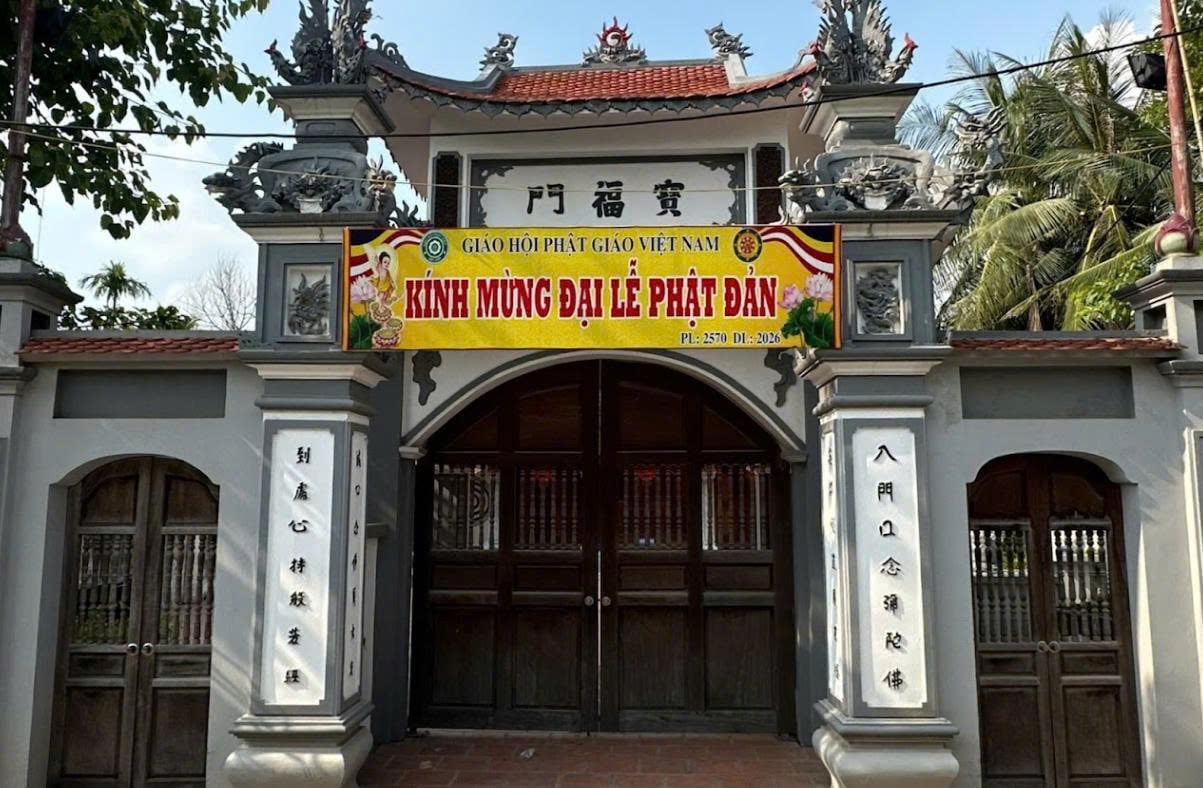
Nui Y Son Village, Dong Mai Commune, Thanh Oai District, former Ha Tay Province, now residential groups 28, 29, and 30 of Yen Nghia Ward – Hanoi City, has a relic built long ago; this is the community cultural activity place of all the people of Nui Y Son Village. Y Son Hamlet, Dong Mai Commune, Thanh Oai District, Ha Tay Province has an ancient relic built long ago; this is the community cultural activity place of all the people of Y Son Village. The relic is named after the hamlet, Y Son Pagoda. The pagoda also has the Sino-Vietnamese name Bao Phuc Tu.
Y Son is an ancient Vietnamese village, formerly named Nui Village, located in the Red River delta and surrounded by dikes of the Day River. Y Son is one of nine hamlets of the former Dong Mai Commune, including Co Ban, Nhan Hue, Nhan Dao, Tong Cong, Phuc Mau, Dong Hoang, Bai Dong Hoang, and Y Son.
Under King Tu Duc, Y Son belonged to Mai Linh Commune, Thanh Oai District, Hanoi Province. At the end of the 19th century, Y Son belonged to Mai Linh Commune, Thanh Oai District, Ha Dong Province. After 1954, Y Son Hamlet belonged to Dong Mai Commune, Thanh Oai District, Ha Tay Province.
In 1965, Ha Dong and Son Tay provinces were merged into Ha Tay Province.
In 1975, Ha Tay Province merged with Hoa Binh Province to form Ha Son Binh Province.
From September 1991, Ha Tay and Hoa Binh provinces were separated, and Thanh Oai District again belonged to Ha Tay Province as before.
On August 1, 2008, the entire Ha Tay Province was merged with Hanoi City; Ha Dong City of Ha Tay Province was incorporated into the capital Hanoi. On May 8, 2009, the Government issued a resolution establishing Ha Dong District under the capital Hanoi based on the entire area and population of Ha Dong City and establishing 7 wards: Bien Giang, Dong Mai, Duong Noi, Kien Hung, Phu Lam, Phu Luong, and Yen Nghia based on 7 communes of corresponding names. Since then, Ha Dong has become the 10th urban district of the capital, comprising 17 subordinate wards.
On July 1, 2025, Ha Dong District was dissolved to implement a two-level local government, with no district level. Dong Mai Ward was merged with Yen Nghia Ward under the name Yen Nghia Ward. The Y Son Communal House relic is located in Yen Nghia Ward, Hanoi City.
Y Son is an ancient Vietnamese village dating from ancient times; along with settlement and village establishment, a religious system was also built early to meet the religious and belief needs of the village community and to preserve the traditional cultural values of the nation.
Buddhism arose in the 6th century BC (more than 2,500 years ago) in a small state in India; its founder was Prince Siddhartha. He voluntarily left a life of privilege to become an ascetic hermit but did not achieve peace of mind and did not realize the truth. After six years, he abandoned ascetic practice and turned to intellectual contemplation. Finally, after 49 days of meditation under the Bodhi tree, immersed in profound contemplation, he reached the truth and was titled Shakyamuni.
Gradually afterward, Buddhism spread to many places and became one of the three major religions of the world. The root of Buddhism is an atheistic philosophical system with deep insight into all things; it highly values wisdom for enlightenment and liberation, emphasizes a bright way of life, downplays rituals, and rejects caste discrimination. Buddhism advocates equality among people, upholds compassion, and states that human destiny is self-created and one must bear responsibility for it, not predetermined or decided by gods.
After Shakyamuni entered Nirvana, Buddhism became a religion in the 2nd century BC and split into two schools: Mahayana (the great vehicle that can carry many people far, that is, to the realm of great enlightenment) and Hinayana (the small vehicle; whoever practices receives the corresponding blessings, without the issue of saving others and enlightening others...). Gradually, from around the 8th century onward, Buddhism declined in India but increasingly developed in other countries around the world.
Buddhism entered Vietnam very early (in the 3rd century BC). Later, along trade and missionary routes, in the first centuries AD, Buddhism was propagated more strongly into Vietnam. Buddhism was strongly believed by the Vietnamese people and gradually became a dominant ideology, contributing to rallying forces against foreign invaders. In the middle of the 6th century, a man surnamed Ly took the title of Buddha's son to seize power and became king of Van Xuan (Ly Phat Tu - 571). Also during this time, Buddhism strongly blended with indigenous beliefs to suit the Vietnamese. However, by the Ly dynasty (11th century), because of its otherworldly and compassionate, joyful, and equanimous nature, Buddhism could not actively participate in politics amid the strong development trend of history while preserving national cultural identity; therefore, Thao Duong and Truc Lam were born. Yet before the development trend of Confucianism and the actual changes in society, it declined in the 15th century.
By around the middle of the 16th century, Buddhism was almost revived to gradually develop strongly in the 17th century and then declined again at the end of that century; however, it had penetrated deeply into the hearts of the masses and could not be destroyed. In the 1930s, Buddhism was revived again, like a call back to the roots, contributing to resistance against Western culture.
For more than 2,000 years, Buddhism has coexisted with the ups and downs of Vietnamese history and has always created balance for society's anxieties. Therefore, pagodas worshiping Buddha were also built and developed. Y Son Pagoda, like many other village pagodas, was established for the purpose of using Buddhist teachings and the Buddha's compassion to encourage good and punish evil and to educate people in humanity and righteousness. This is also a place that introduces and promotes the creative labor tradition of ancestors to present and future generations.
Y Son Pagoda exists to meet the religious and belief activity needs of the Y Son village community. This is a Buddhist architectural work worshiping Buddha according to the Mahayana school. In terms of outstanding value, Y Son Pagoda belongs to the architectural and artistic relic type of pagoda.
Y Son village pagoda is located on a beautiful plot of land facing south. In front of the pagoda is an area where residents gather; around it is a pagoda garden planted with flowers, ornamental plants, and fruit trees, and a vast field stretching as far as the eye can see. According to Buddhism, south is a cool direction, the realm of wisdom (eliminating ignorance), and also the direction of good karma.
According to the stories of the village elders, Y Son Pagoda was formerly a massive structure of the Thanh Oai area, but through wars the ancient pagoda could not retain its original appearance at its founding. To preserve the historical relic according to the tradition of remembering the source when drinking water, the people of Y Son Village restored the pagoda as spacious and beautiful as it is today.
At present, Y Son Pagoda includes the following works: the main pagoda, the Ancestor hall, the Mother hall, a system of courtyards and gardens, fruit trees, and a protective wall around it.
From the gate, through a yard paved with Bat Trang bricks, one reaches the main pagoda. The main pagoda is structured in the shape of the Chinese character Dinh (丁) consisting of the Front Hall and the Upper Hall.
Y Son Pagoda was established to satisfy the cultural and spiritual activity needs of the vast majority of people in Y Son Village. People come to the pagoda to pray to Buddha and worship, usually on the first and fifteenth days of the lunar month. On major holidays such as Lunar New Year, Thuong Nguyen, Buddha's Birthday, Vu Lan, etc., the number of people coming to the pagoda is very large.
In addition, during village festivals and anniversaries of the birth and death of village tutelary gods, the pagoda also opens its doors to welcome villagers and visitors from everywhere. There is no superstition in the pagoda; the caretaking and worship are handled by the abbot and elderly lay women who are very devout and united.



