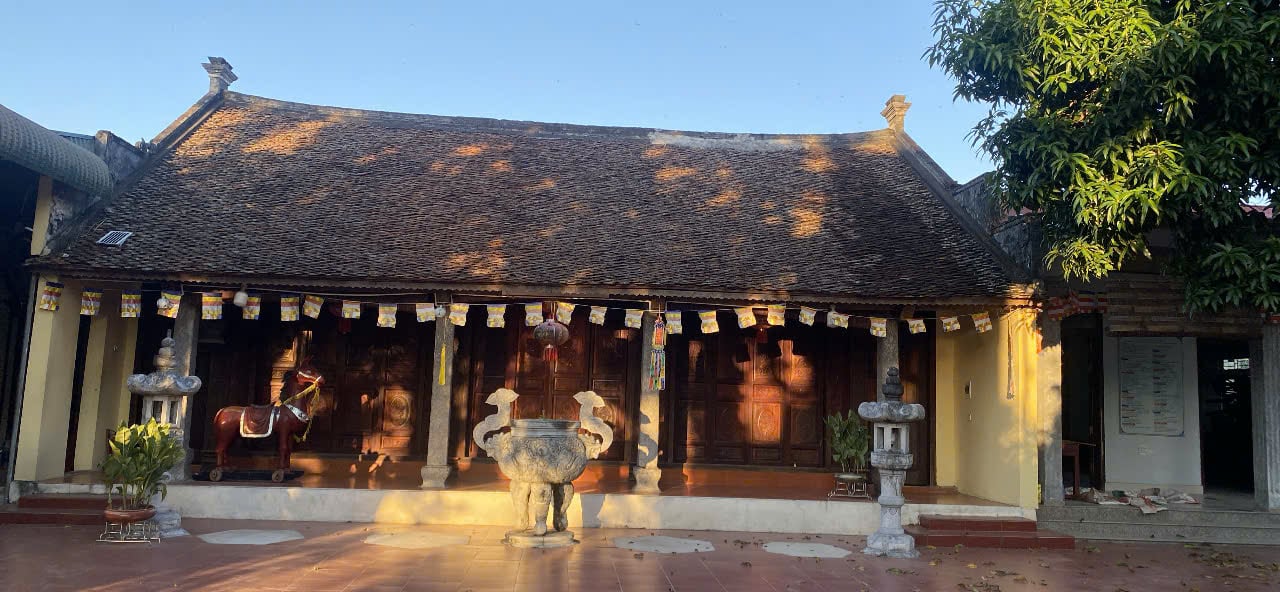
Yen Coc Pagoda, Hong Phong Hamlet, Hoa Phu Commune, Hanoi City
Introduction
According to elderly villagers' accounts of the pagoda's origin, it is praised as a long-standing Buddhist architectural work. For hundreds of years, the round statues and stone pillars have still been preserved to this day. Over time and through war, the pagoda was damaged and had to be repaired, but it has retained its ancient appearance.
The main pagoda has a Dinh-shaped structure and faces southwest, including the Front Hall and the Upper Hall. This entire architectural complex is built on a high foundation, surrounded by the Mother Goddess Shrine, the Ancestor Hall in side-house style, a guest house, a garden system, and monks' tomb stupas.
The pagoda's Front Hall has three bays and two wings, with closed gable walls and two sloping roofs covered with ri tiles.
The Upper Hall is a longitudinal building in the "tien dao hau doc" style, consisting of two bays and one subsidiary bay. Its truss is similar to that of the Front Hall; the structure of the pagoda's Front Hall and Upper Hall is primarily solid, with intricate techniques mainly concentrated in the system of round statues.
The statue system here is extremely rich and diverse, crafted elaborately and meticulously.
In the Three Jewels Hall, the highest position is occupied by the Three Worlds Buddhas, 90 cm tall, 30 cm across the shoulders, with a 59 cm lotus pedestal carved with two layers of upward-facing single petals.
The second layer is the Amitabha Trinity, also called the Buddha of Infinite Life or the Buddha of Infinite Light, the Buddha whose lifespan equals heaven and earth and who radiates the light of Buddhist teachings to save sentient beings.
The next layer is the Thousand-Hand, Thousand-Eye Guanyin statue, 80 cm high including the base, 24 cm across the shoulders, 34 cm across the thighs, and 85 cm at the widest span between the arms, carved seated in a yin-yang posture on a lotus pedestal.
The next layer is the Shakyamuni Holding a Flower statue, flanked by Maitreya and Tuyet Son.
The Jade Emperor statue is carved in a seated posture, 120 cm tall, 36 cm across the shoulders, and 49 cm across the thighs.
Outermost in the Upper Hall is the Nine Dragons shrine, carved in an arch style, 108 cm high, 68 cm wide, and 54 cm deep. At the center of the Nine Dragons shrine is the infant Shakyamuni standing on a lotus pedestal, bare-chested, with his left hand pointing to the sky and his right hand pointing to the earth according to Buddhist legend.
Next are the two statues Giam Trai and Tho Dia.
On the two sides outside the Front Hall are the altars of Duc Ong and the Holy Sages.
The pagoda's statues are mostly made of clay and date from the 19th century to the present.