
Phu Doi Village Communal House and Pagoda Relic Complex, Phuong Duc Commune
5.0Free
5.0Free
Introduction
PHU DOI COMMUNAL HOUSE – PAGODA
PHU DOI COMMUNAL HOUSE – PAGODA
Located in Phu Doi village, Phuong Duc commune, Hanoi city, the relic complex Phu Doi Communal House – Pagoda is an important trace of an ancient Vietnamese village in the Northern Delta. Phu Doi was formerly named Dong Nhuyen trang, popularly called Nhon village, under Luong Xa canton, Phu Van district, Son Nam trấn. Through many changes in administrative boundaries, the communal house and pagoda remain the cultural and religious center, connecting generations of Phu Doi residents with the history of their homeland. The relic complex was ranked as a national-level relic according to Decision No. 141-QD/VH dated 23/01/1997 of the Ministry of Culture – Information.
Phu Doi Communal House worships Nam Giang Dai Vuong as the village tutelary deity. According to the legend preserved and passed down locally, Nam Giang Dai Vuong is said to be the 41st child of Lac Long Quan and Au Co, entrusted with guarding the Nam Giang region. When he came to the land of Dong Nhuyen, he found the terrain favorable, helped the people open up land, divide fields, and establish settlements. Therefore, in the consciousness of the Phu Doi community, the tutelary deity is not only a protective god but also symbolizes the merit of opening land, founding the village, caring for life, and fostering the community's prosperity. This is the content of the legend and folk belief, which should be understood within the traditional cultural space of the village.
Traces of this belief are also reflected in Sino-Nom sources. The catalogue of deity edicts of the Institute of Sino-Nom Studies records that Phu Doi commune has edicts bestowed upon Nam Giang Dai Vuong and the Long Than (Dragon Deity) during several reign titles of Canh Hung, Chieu Thong, and Canh Thinh. This is a valuable source of material for further research on the formation and maintenance of tutelary deity worship in Phu Doi.
Every year, on the 10th day of the third lunar month, the people of Phu Doi hold a traditional festival commemorating the death anniversary of Nam Giang Dai Vuong. The festival both expresses the moral principle of remembering the source and provides an occasion for the community to meet, strengthen village solidarity, and pass on customs that have been attached to the village for many generations.
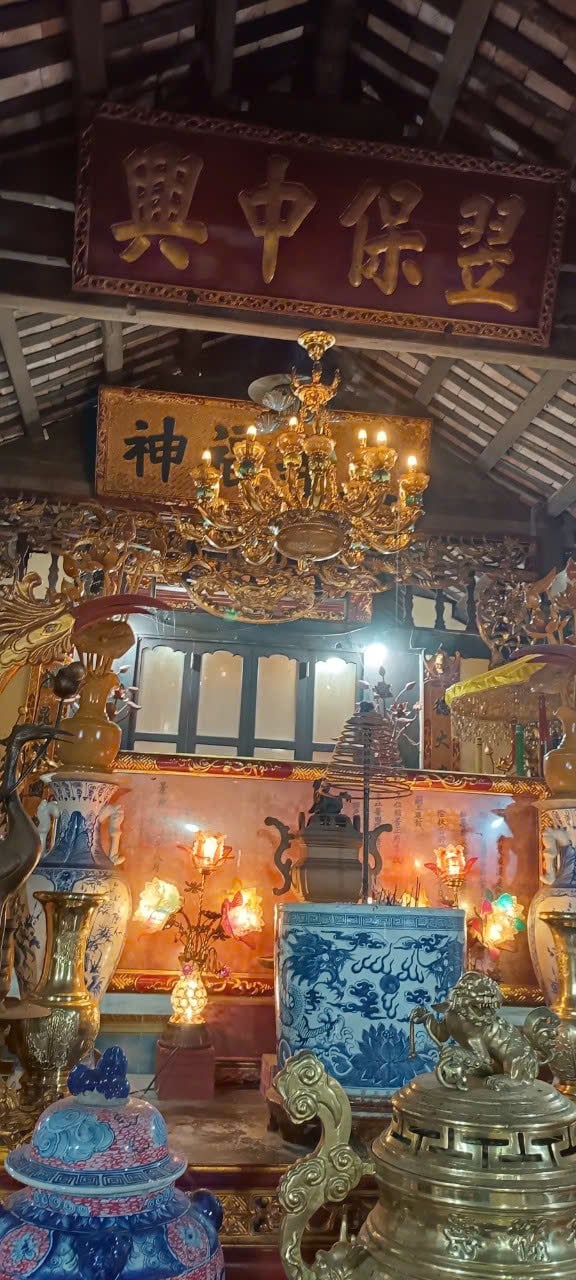
The communal house at its current location was built in 1923, with a 'chuoi vo' layout consisting of the Dai bai (main hall) and Hau cung (rear sanctuary). The Dai bai has five bays, with side aisles on both sides; the wooden column system is combined with stone columns in the central bay. The carved panels on wooden structural elements bear the artistic imprint of the Nguyen era, with themes of dragons, the four sacred creatures, long ngu hi thuy (dragon and fish playing in water), and many traditional motifs. The worship space also preserves a horizontal plaque 'Great virtue flows on forever', meaning 'great virtue is passed down forever' – a message very suitable to the communal house's traditional educational function.
The communal house also preserves many valuable worship objects, ceremonial implements, and edicts. According to the official introduction of the Hanoi Department of Culture and Sports, various dynasties issued 13 edicts to Nam Giang Dai Vuong, which the community respectfully preserves. Some current research sources record different numbers of extant edicts; therefore, when preparing the official interpretive sign, the artifacts should be inventoried directly and cross-checked with the ranking dossier to agree on the number.
A noteworthy folk story says that the communal house formerly faced north, toward Xuan La. After an exchange between the two villages, the communal house was turned to face south. From this arose the story of the close bond between Phu Doi and Xuan La, popularly called the relationship 'elder village – younger village'. Although oral in nature, the story reflects a deeper value: the village communal house is not only a place of worship but also a space for harmonizing community relations and preserving shared memory among rural villages.
Beside the communal house worshipping the tutelary deity is Phu Doi Pagoda, in some documents called Phuc Lam Tu. The pagoda is a space for worshipping Buddha, meeting the spiritual life of the community and together with the communal house forming an integral traditional cultural entity of the village. Research documents on the cultural area of Nam Giang Dai Vuong also record a rather special feature: traces of worship of Nam Giang Dai Vuong appear even in the pagoda space. This shows the process of intersection between the worship of the Village Tutelary God and Buddhism in the life of local residents, a phenomenon not uncommon in Northern Delta village culture but quite clearly manifested in Phu Doi.
Therefore, if the communal house represents the memory of community organization, the Village Tutelary God and the village's origins, the pagoda directs people toward spiritual life, compassion and goodness. The two spaces existing side by side have contributed to forming a common value system: gratitude to those who made contributions, respect for ancestors, community solidarity and guiding people toward goodness.
The value of the Phu Doi Communal House – Pagoda lies not only in its ancient architectural components or royal edicts. A more enduring value lies in the fact that the community still identifies this place as part of itself. The festival, the worship of the Village Tutelary God, spiritual activities, the awareness of preserving the communal house and pagoda, and the stories passed down by elders to later generations have turned the relic into a “cultural memory” of Phu Doi village.
In the process of building the new Phuong Duc commune, this heritage also has added significance for local cultural and tourism development. Commune documents show that the spatial development orientation is setting requirements for preserving relics and craft villages and researching the application of digital technology, VR/AR to serve cultural and tourism introduction. In 2025, the project to restore and embellish the Phu Doi Communal House is also among the relic projects implemented by the locality; the City's public investment plan identifies the project as implemented in the 2024–2025 period.
Visiting the Phu Doi Communal House – Pagoda today means visiting a space where village history, the worship of the Village Tutelary God, Buddhism, traditional architecture and community life coexist. Through the image of Nam Giang Dai Vuong, local people express their gratitude to the one who opened up the land, helped the people and protected the homeland; through the communal house roof and pagoda gate, generations of Phu Doi continue to preserve order, neighborly bonds and the identity of a tradition-rich countryside.
That is also the greatest value of the relic: it not only retells the story of the past, the Phu Doi Communal House – Pagoda also contributes to shaping the cultural identity and image of the people of Phu Doi – valuing righteousness, community cohesion, respecting heritage and always looking toward their roots.



