
An Cu Temple
Good to know
- It is advisable to arrive early for a spacious experience
- Free
- Convenient to travel by taxi or bus.
Introduction
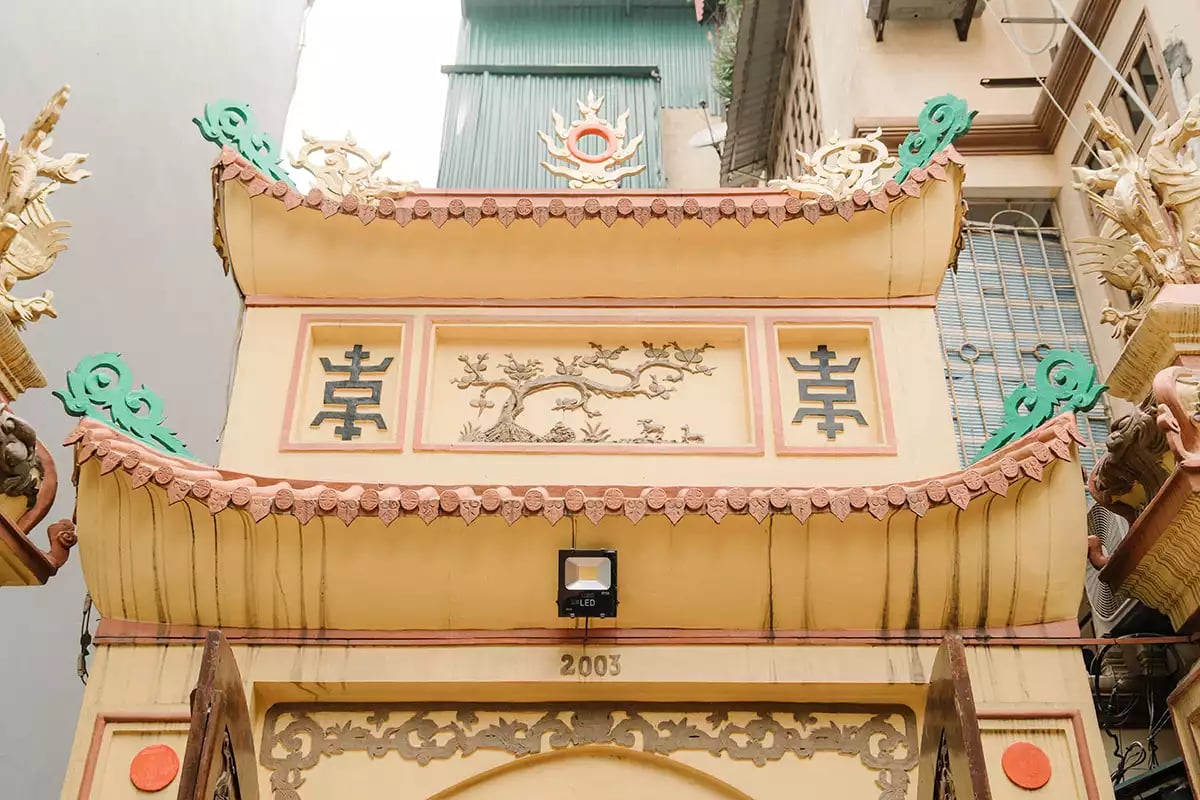
An Cu Temple is located in Alley 281 Tran Khat Chan Street, Bach Mai Ward, Hanoi City. In ancient times, Thanh Nhan Village was a low-lying, wild and desolate area; people from various places came to reclaim land and establish hamlets. Through many ups and downs of history, with its location close to the urban outskirts, the people of Thanh Nhan increasingly developed and their livelihood became stable; Thanh Nhan Village was formed from two hamlets: the upper hamlet and the lower hamlet, also called An Cu Hamlet and Lac Nghiep Hamlet. The people of An Cu Hamlet established a temple to worship the Mother Goddess. The temple was founded during the Nguyen Dynasty with a ground plan in the shape of the character 'nhất', facing northwest, located within the common grounds of An Cu Communal House. The overall layout of the temple relic site includes: Nghi Mon, a narrow courtyard, the main temple, Lau Co, and Lau Cau. Nghi Mon is built as an entrance gate, with brickwork, arched doors, and a roof in the form of two tiers with eight roofs and curved corners. The main temple is built with a closed gable wall style and consists of three bays. Currently, the temple still preserves a collection of cultural artifacts of artistic value, such as an incense table, round statues, horizontal plaques, couplets, and other ritual objects. An Cu Temple is a Mother Goddess worship site – an indigenous belief of the Vietnamese people that contributes to fulfilling the spiritual life of many social classes in the locality.
More Other places
- Other placesVerified
Gioi Duc Pagoda (Hong An Temple)
Ung Hoa Commune
5.0Free  Other placesVerified
Hai Giac Pagoda
O Dien Commune
5.0Free Other placesVerified
Phuong Bang Pagoda (Hung Long)
Son Dong Commune
5.0Free Other placesVerified
Sung An Pagoda, also known as Sung Khang Pagoda (Dong Ba Pagoda)
Thượng Cát Ward
5.0Free
