
Ba Voi Temple
Story
01Ba Voi Temple, Tien Hung Hamlet
The Ba Voi Temple relic is located in Tien Hung Hamlet, Phuc Thinh Commune, Hanoi City.
Ba Voi Temple worships Saint Tam Giang, namely the brothers Truong Hong and Truong Hat, who helped Trieu Viet Vuong defeat the Luong invaders and bring peace to the country.
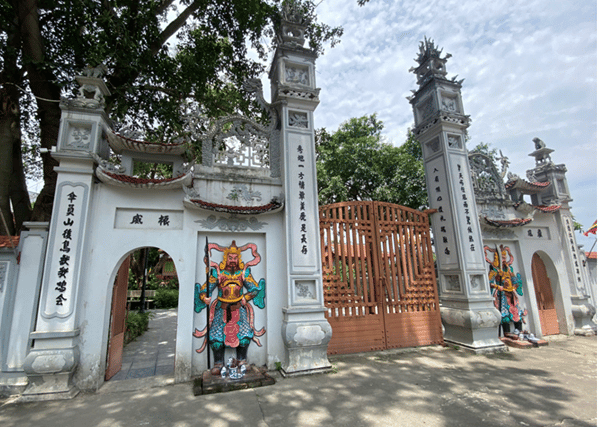
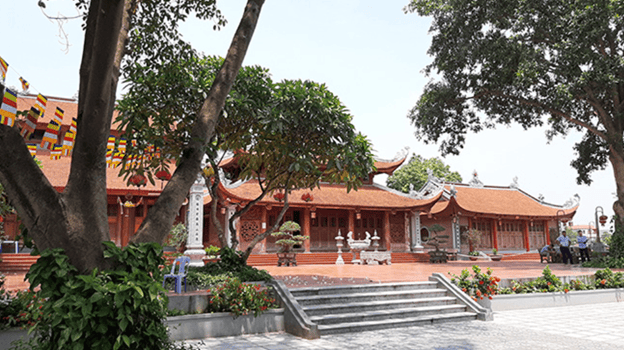
The legend of the two Truong saints is recorded in several ancient texts, all agreeing that the two Truong Saints were born in Van Mau Village, Vo Giang District, Bac Ninh Province, now Que Vo District, Bac Ninh Province. Their mother was Mrs. Tu Nhan, surnamed Phung. At the age of 20, Truong Hong and Truong Hat had exceptional martial prowess and intelligent qualities. At that time, our country was invaded by the Luong enemy, and Trieu Quang Phuc had to withdraw to Da Trach Marsh to defend, consolidate forces, recruit talents, and enlist more soldiers to fight the enemy and save the country. Responding to Trieu Quang Phuc's call, the two Truong brothers joined the army and set out to save the country. The two studied the battlefield terrain, devised a plan to use boats to relieve sieges on four sides, and attacked the Luong invaders. Taken by surprise, the enemy was heavily defeated and fled back to their country. Returning victorious, the two Truong brothers were granted titles and benefits by the king and were sent to guard the Kinh Bac region and Dong Ngan District. When Ly Nam De died, Trieu Quang Phuc proclaimed himself king and established the capital at Long Bien Citadel. When the country was clear of enemies and the realm was enjoying peace, separatist forces rose in many places, including the force of Ly Phat Tu, a nephew of Ly Nam De. The two sides fought several battles; Ly Phat Tu was somewhat at a disadvantage and asked for peace. Later, Phat Tu had his son Nha Lang Vuong ask for the hand of Trieu Quang Phuc's daughter, Cao Nuong. Although the generals and the Truong brothers strongly advised against it, King Trieu did not listen. Afterwards, the two asked to resign and went into Phu Lam Mountain, now Phu Long Mountain in Phuc Tho District, to live in seclusion.
Later, Ly Phat Tu overthrew Trieu Quang Phuc and took the throne, called Hau Ly Nam De. King Ly invited the two Truong brothers to court to serve as officials, but the two firmly refused because they kept loyalty to the old king, through the famous saying A loyal subject does not serve two kingsUpon being refused, Ly Phat Tu ordered their arrest. In a dangerous situation, they decided to die for their loyalty, refusing to submit or be captured.
The two Truong brothers had a large boat built, brought their family and three war elephants aboard, and sailed downstream along the Nguyet Duc River. When the boat reached the area of present-day Tien Hung, formerly a lush guava forest with many fruits and birds, the two had the three elephants disembark and told them to stay and wait for their masters, then continued downstream along the Nguyet Duc River to Xa Junction, now Xa Junction in Yen Phong District, former Bac Ninh. After visiting their mother's grave, they drilled holes in the boat and died for loyalty; that day was the 4th day of the fourth lunar month. The three war elephants waited and did not see their masters return; they huddled together, ate and drank nothing for more than a month, and died. Local people built a temple to Saint Tam Giang on the forest area where the three war elephants died, and the temple is called Ba Voi Temple. In addition to the two Tam Giang Saints, Ba Voi Temple also worships Chau Lang Dai Vuong. He is the local deity who helped the villagers from the time of founding the village, making it increasingly prosperous and developed.
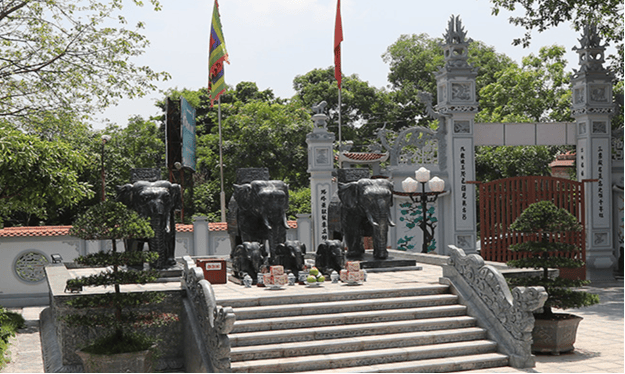
Ba Voi Temple is located beside the former Nguyet Duc River, a river that recalls a story that moves people's hearts. The temple was built facing northeast, toward Xa Junction. The architectural units are arranged in depth, from the outside in including the Nghi Mon, courtyard, Tien Te, and Hau Cung.
The Nghi Mon is built as a four-pillar gate, with one large gate in the middle and two small gates on either side connected by four pillars, two large and two small.
Tien Te consists of three compartments and two lean-tos, built with a two-tier, eight-roofed corbel style, curved sword tips, and the surrounding corbel section made of a system of wooden balusters, creating openness for the temple. On the roof, the theme of two dragons flanking the sun is decorated; the roof ends are decorated with running dragons and unicorns along the ridges. In front are three large doors fitted with wooden folding doors; the two side compartments have walls with windows shaped like the character longevity, with reliefs decorated with the four sacred creatures, tiled roof, and red brick floor. The decoration on the architecture is mainly leaf patterns, seal-script patterns, and spear-head patterns. The Hau Cung is connected with the Tien Te to create the structure of the character Dinh consisting of two compartments running lengthwise, tiled roof, and brick floor. Below, a platform is built to arrange the altar objects. The decoration on the roof truss is mainly leaf patterns and seal-script patterns.
Although Ba Voi Temple has only recently been restored, it still preserves the characteristic appearance of traditional religious architecture. That is the curved-roof architectural style, reasonably planned and harmoniously balanced with the surrounding natural landscape. The carved panels and decorative patterns with themes of the four sacred creatures and four noble plants add to the beauty of the temple architecture, reflecting the aesthetic level and aspirations of the ancients for a full life, for peace, and for harmony between humans and nature and the universe. In particular, the statues of the three war elephants, newly recreated by the villagers in stone, express the people's admiration for the Saint and the three elephants.
The artifacts inside are all painted with vermilion and gilded beautifully. In particular, the altar shrines are made very elaborately, with three worship statues having pink faces, kind expressions, dignified postures, clothes decorated with tiger symbols and dragon motifs, and hands holding sacred objects. The deity statues vividly, realistically, and soulfully depict portraits.
Every year, the village festival is held on the 12th day of the 10th lunar month, the day of the Ky Phuc ceremony, when the people of Tien Hung Hamlet organize offerings to express gratitude for the merits of the worshipped deities. In addition to the main festival, the temple also holds two important ceremonies annually:
Also attending the So Temple festival, Phu Lo Commune, former Soc Son District, now Soc Son Commune, Hanoi City, also called Tam Tong Temple, on the 1st and 2nd lunar days every year. This festival is associated with the legend of Phu Dong Thien Vuong; after defeating foreign invaders, on the way up Soc Mountain, when he stopped here, he used the village's well water for eating and daily activities, so during the festival, the villagers must carry water to the festival to serve worship.
Boat racing festival: The unique feature of Ba Voi Temple festival is the boat racing festival. Previously, the boat racing festival was held on the 21st day of the 7th lunar month every year. The racing boats were divided by the village's factions and groups. The starting point was from Phu Lo Bridge in Tien Hung Hamlet to Xa Junction, where the saints died for loyalty; the people prepared offerings, and there were two model boats. After the ceremony, the boating ritual was reenacted and the boats were burned at the temple.
Ba Voi Temple was ranked as a City-level historical-cultural and artistic relic under Decision No. 5053/QĐ-UBND dated October 6, 2015.
More Other places
- Other placesVerified
Gioi Duc Pagoda (Hong An Temple)
Ung Hoa Commune
5.0Free  Other placesVerified
Hai Giac Pagoda
O Dien Commune
5.0Free Other placesVerified
Phuong Bang Pagoda (Hung Long)
Son Dong Commune
5.0Free Other placesVerified
Sung An Pagoda, also known as Sung Khang Pagoda (Dong Ba Pagoda)
Thượng Cát Ward
5.0Free
