
Temple of Emperor Quang Trung
Good to know
- You should arrive early for an open and airy experience
- Free
- Convenient access by taxi or bus.
Introduction
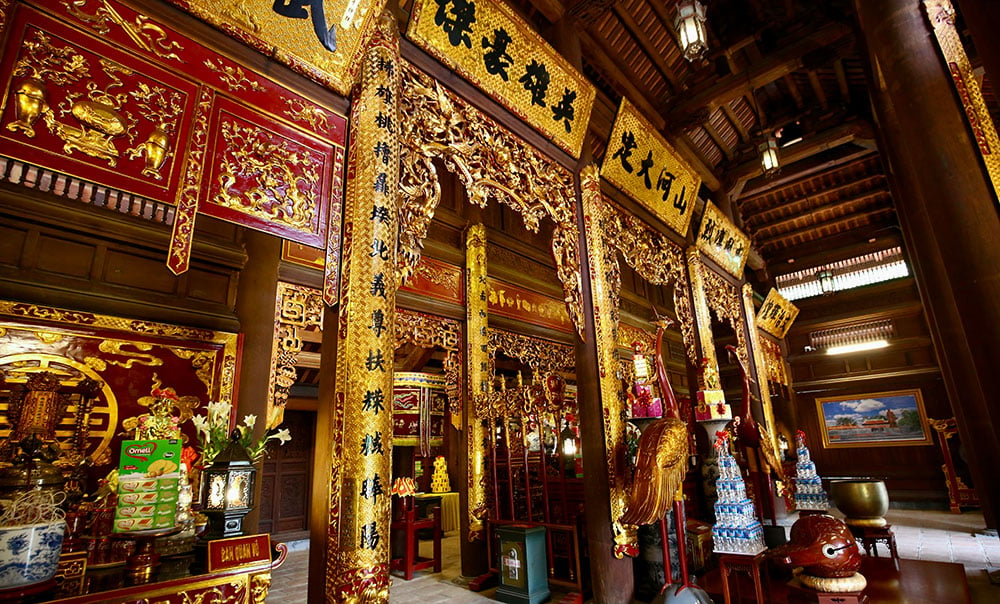
TEMPLE OF KING QUANG TRUNG
The Temple of Emperor Quang Trung is an architectural work rich in historical and spiritual cultural value, the most prominent item behind the monument, enhancing the majestic splendor of the relic site. The Temple of Emperor Quang Trung was built in the spring of the Giap Ngo year 2014 and inaugurated in the first month of the At Mui year 2015 on an area of 300 m2, following traditional architecture with two tiers and eight curved roofs with narrowed co diem neck ridges in the artistic style of the Nguyen dynasty. The worship hall is structured in the Nhi character style with two components: the Dai Bai main hall and the Hau Cung rear sanctuary.
Viewed from outside toward the smooth ridge top, at the two ends of the ridge are two stylized leaf-shaped finials with curled tails. From the two ends of the upper roof ridge, two nguynh segments run out to the four corners. Separating the upper and lower roof tiers is the co diem section, paneled with lua boards on most of its four sides. Only the three central bays at the front have turned-baluster bars and a horizontal plaque bearing five Nom characters “Emperor Quang Trung Worship Hall” The lower tier is enclosed by brick on three sides; at the front, the two side bays have round windows shaped like the character “Longevity” stylized to let in light.
Corresponding to the three central bays are three sets of folding panel doors made in the thuong song ha ban style, with a threshold below that opens and closes for entry and exit. The entire veranda wall around is enclosed by a balustrade and low stone posts, decorated with patterns on traditional themes with sharp, refined carving.
From the courtyard, stepping up the three-step staircase leads to the veranda. The roof trusses here are made in the goose-neck rafter style connecting from the military columns to the veranda columns. Interspersed on the goose-neck rafters is a system of parallel braces between the roof edge and the purlins.
Inside are the roof-supporting trusses made in two structural forms: the four central trusses are made in the style “Upper: gioang frame with stacked beams; middle: half gioang with stacked beams; lower: cantilevered rafters” on six rows of column bases, the two trusses of the side bays are made in the style “Upper: stacked beams; middle: half gioang with stacked beams; corner braces; lower: cantilevered rafters”. On the components of these trusses are decorations of dragons, floral patterns, and clouds. Here three altars are arranged: the central one is the Cong Dong altar decorated with an incense table, horizontal plaque, couplets, and a ceremonial curtain; the two side altars worship military mandarins and civil mandarins.
The Hau Cung rear sanctuary is an item parallel to the Dai Bai, separated by a small courtyard base. The Hau Cung is a variant of the two-tier roof style of the Saint Temple at Boi Khe Pagoda (Song Khe village, Tam Hung commune, Thanh Oai district) but simplified. The dougong system is also replaced by son and braces, and the eight roof-end dao curves upward as if soaring into the sky, decorated like the main hall.
The roof of the rear sanctuary is of scale tiles; the co diem section is decorated with turned-baluster bars on four sides, and the lower tier is enclosed with lua boards on four sides along with a system of veranda rafters projecting out and resting on the veranda columns.
Inside are the roof-supporting trusses made in two structural forms: the two central trusses are made in the style “Upper: gioang frame with stacked beams, lower: cantilevered rafters” on four rows of column bases, and the two trusses of the side bays are made in the style “Upper: stacked beams; lower: half gioang with stacked beams; cantilevered rafters”.
Located within the special national relic complex of Go Dong Da, the Temple of Emperor Quang Trung – a spiritual cultural work – is an attractive destination welcoming visitors from all regions of the country and international delegations to offer incense in remembrance and to express admiration and gratitude to one of the outstanding heroes of the Vietnamese nation in the 18th century. At the same time, it is a red address reminding younger generations and people of all walks of life about heroic historical figures and the proud, glorious pages of the country's history.
More Other places
- Other placesVerified
Gioi Duc Pagoda (Hong An Temple)
Ung Hoa Commune
5.0Free  Other placesVerified
Hai Giac Pagoda
O Dien Commune
5.0Free Other placesVerified
Phuong Bang Pagoda (Hung Long)
Son Dong Commune
5.0Free Other placesVerified
Sung An Pagoda, also known as Sung Khang Pagoda (Dong Ba Pagoda)
Thượng Cát Ward
5.0Free
