
National-level relic: Cung Son Communal House, Phuc Tho Commune
Good to know
- You should arrive early for an open and airy experience
- Free
- Convenient access by taxi or bus.
Introduction
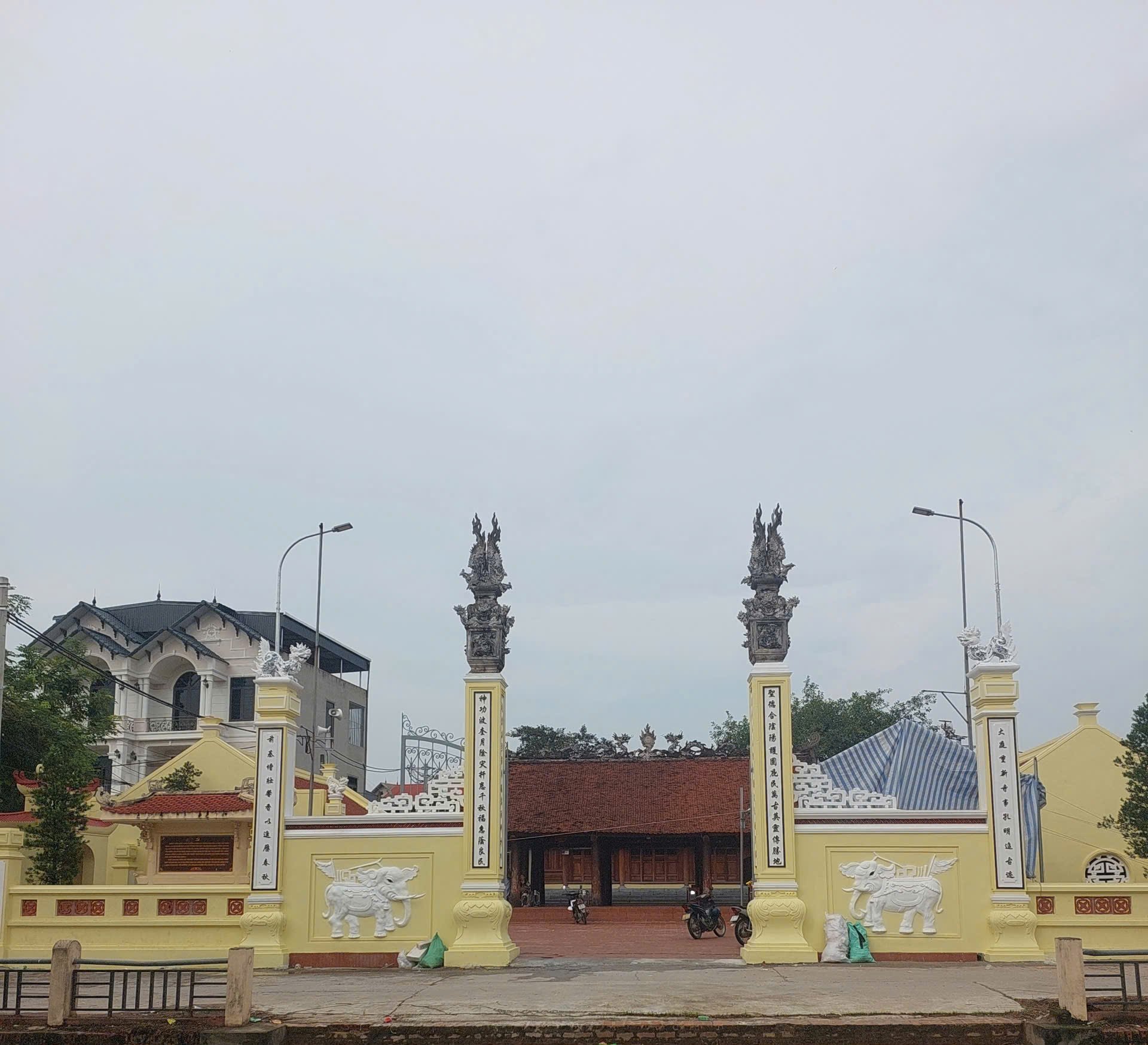
National-level relic: Cung Son Communal House, Phuc Tho Commune
Cung Son Communal House is located in Cung Son Hamlet, Phuc Tho Commune, Hanoi City.
Cung Son Communal House is a large-scale architectural work built during the Later Le Dynasty but destroyed by the enemy. After peace was restored, the local people rebuilt the communal house.
According to revolutionary veterans and local people, before 1947, Cung Son Communal House was a large-scale architectural work comprising a five-bay Great Hall, a Rear Shrine, columns and surrounding walls, a cannon gate, and a communal house pond with a raised mound used as a wrestling ring.
The current Cung Son Communal House is the result of renovations and restorations after the war. Most recently, in 2025, Cung Son Communal House received attention for repair and restoration of items including the Nghi Mon gateway, Left and Right Side Halls, Rear Shrine, and technical infrastructure using the state budget.
The main communal house has a 'Nhi' character layout, consisting of two buildings—the Great Hall and the Rear Shrine—separated by a ceremonial courtyard. In addition, the communal house has other items: Left Side Hall, Right Side Hall, and Nghi Mon gateway. The communal house faces west. In front of it are the communal house pond and the wrestling ring.
Cung Son Communal House worships Duc Thanh Tan, the eldest of the Three Tan Vien Mountain Saints. Tan Vien (also called Son Tinh) is the deity who governs the Ba Vi mountain range (Tan Vien Mountain), one of the four immortals of the Vietnamese peopleThroughout history, Duc Thanh Tan Vien has not only been worshipped as the Tutelary God protecting the village but has also been revered by the people as a Fortune God, a supreme tutelary deity, a hero of water control, a cultural hero, and a national hero since the early days of expanding the territory.
According to folk legend, Saint Tan Vien is also called Son Tinh; he married Princess Ngoc Hoa, daughter of Hung Due Vuong (the 18th Hung King). This marriage led to a lifelong feud: the war between Son Tinh and Thuy Tinh. Son Tinh also helped the Hung King fight invaders. He traveled everywhere and taught the people how to make a living, including teaching them to make fire, farm and hold festivals, hunt, practice martial arts, weave silk, sing and dance... and in the areas of Tuong Phieu, Cung Son, and Tuy Loc, Saint Tan Vien taught the people to pull nets and fish. In particular, he taught the people how to fish by pole-slapping. This is a method of catching fish in water about 2 meters deep that local people still recount and use today.
To remember the merits of Saint Tan Vien Son, the people of ancient Me Village (present-day Cung Son Village) built a communal house to worship him. Later, the villagers also worshipped the first two men who learned the fishing trade as Tutelary Gods. The elder was honored as 'Minh An Vuong' and the younger as 'Minh Dinh Vuong'.
The traditional festival of Cung Son Communal House takes place on the 3rd, 4th, and 5th days of the second lunar month every year, with the main festival day being the 4th day of the second lunar month; notably, the Me Village fishing festival is held by the people at Cung Son Communal House pond on the morning of the 3rd day of the second lunar month every year. In the years of the Rat, Horse, Cat, and Rooster, the people of Cung Son Village organize a grand festival, including a procession of Duc Ong's incense bowl from Cung Son Pagoda to Cung Son Communal House for the festival on the afternoon of the 3rd day of the second lunar month; in regular festival years, the villagers do not organize the procession.
With its outstanding historical, cultural, and architectural-artistic values, Cung Son Communal House was ranked as a National-level relic under Decision No. 74-VH/QĐ dated February 2, 1993, of the Ministry of Culture and Information (now the Ministry of Culture, Sports and Tourism).
More Other places
- Other placesVerified
Gioi Duc Pagoda (Hong An Temple)
Ung Hoa Commune
5.0Free  Other placesVerified
Hai Giac Pagoda
O Dien Commune
5.0Free Other placesVerified
Phuong Bang Pagoda (Hung Long)
Son Dong Commune
5.0Free Other placesVerified
Sung An Pagoda, also known as Sung Khang Pagoda (Dong Ba Pagoda)
Thượng Cát Ward
5.0Free
