
Đống Nước Temple Relic
Good to know
- You should arrive early for an open and airy experience
- Free
- Convenient to travel by motorbike or car
Introduction
Legend has it that in ancient times, in the land where the temple now stands, columns of water gushed up from the ground like a heap of water, hence the name Đống Nước. According to feng shui theory, this land lies on a dragon's vein, so whenever the weather changes, water gushes up again, and the local people built a temple to worship. According to the Ngọc phả records, a girl named Ngọc Nương was born here in an unusual manner; when she passed away, the sky turned gray, it rained heavily, and the river rose (on the 17th day of the 8th lunar month). Since then, water has risen in this land; passersby found it sacred and built a shrine to worship Princess Ngọc Nương. In the reign of Trần Anh Tông (1293–1314), when the king led troops against the Yuan invaders, he stopped here and dreamed of a girl who said she was the Dragon King's daughter and asked to follow him to secretly help him defeat the enemy. After returning in complete victory, the king sent envoys to instruct the people of Đống Nước camp to repair the shrine and bestowed the divine title “Nữ Bạch Ngọc Hồ, Thủy Tinh Lân Tinh Công Chúa” for the people to worship.
According to oral tradition, the temple was established long ago, but a survey of the remaining architecture shows that it was extensively renovated during the Nguyễn dynasty. The remaining architecture is mainly from the Nguyễn period. In 1954, local people contributed money to restore it.
The temple is located on a flat plot of land in Ngọc Hà village; to its right is the Hà Nội Brewery, and to its left are Hữu Tiệp Communal House, Ngọc Hà Communal House, and Bát Mẫu Pagoda. Behind Hoàng Hoa Thám Street is the Thụy Khuê area near West Lake. To the southeast is Đại Yên Communal House, and to the southwest is Liễu Giai Communal House; one could say this is an area with many ancient relics of the capital. Around the temple are many old trees. The temple was built on a narrow plot, and outside its gate is a square pond as large as 3 sào.
The tam quan (three-entrance gate) has two large ornamental pillars; the main gate is built in the style of a two-tier false roof with overlapping diêm tiles and curved corners, and the two side gates also have false overlapping-tile roofs but are lower and smaller.
The left side hall (Tả mạc) consists of 5 bays, used as a guest house and meeting place. (The place of worship for the Lady) is a 3-bay building with two sections forming the character “nhị”, with a truss style that hides columns and has two roof layers. Adjacent to the left and right side halls are two shrines for the Four Palaces of the Cô (Ladies) and the Four Palaces of the Cậu (Lords).
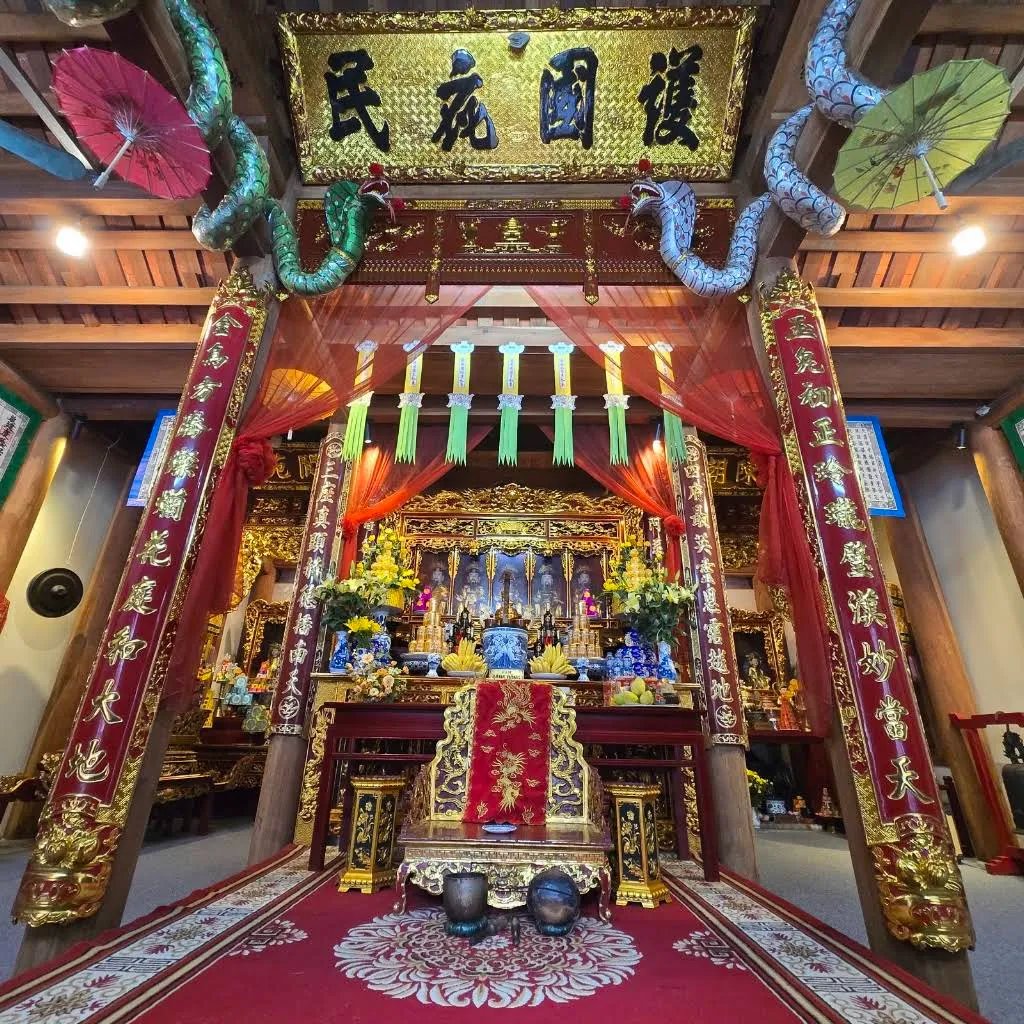
The main temple consists of three buildings: Tiền đường (Front Hall), Trung đường (Middle Hall) lying parallel, and Hậu cung (Rear Sanctuary) behind, connected to the Middle Hall. In the Middle Hall, on the right is the statue of Đức Ông, and on the left is the statue of Thousand-Hand, Thousand-Eye Quan Âm, placed in a niche. In the center is the altar of Ông Hoàng Bảy and Ông Hoàng Mười. The Rear Sanctuary connected to the Middle Hall worships the Three Holy Mothers; the statues are placed in a gilded lacquered niche with glass.
All the worship niches, cửa võng (ornamental curtains), and incense altars are finely carved. Đống Nước Temple has a grand architectural scale and has long been a center of local cultural activities and a meeting place for the village. It is also a relic that preserves the traditional cultural character among the village settlements of the ancient agricultural area west of the former Thăng Long capital, and is being preserved for research into history and art and as evidence of the capital's development.
The Đống Nước Temple festival is held on the 21st day of the third lunar month (in the past it was held for 3 days). During the festival there are ancient ceremonies of incense offering, palanquin processions (Liễu Giai village, which worships Princess Ngọc Nương in absentia, also participates, carrying a palanquin from Liễu Giai to Đống Nước Temple...), and chèo singing...
The temple was classified as an architectural and artistic relic by the Ministry of Culture and Information in 1993.
More Other places
- Other placesVerified
Gioi Duc Pagoda (Hong An Temple)
Ung Hoa Commune
5.0Free  Other placesVerified
Hai Giac Pagoda
O Dien Commune
5.0Free Other placesVerified
Phuong Bang Pagoda (Hung Long)
Son Dong Commune
5.0Free Other placesVerified
Sung An Pagoda, also known as Sung Khang Pagoda (Dong Ba Pagoda)
Thượng Cát Ward
5.0Free
