
Nhị Temple Relic
Contents
Story
01NHỊ TEMPLE RELIC (NHỊ)
Nhì (Nhị) Temple belongs to Nhì Village, Phúc Thịnh Commune, Hà Nội City. At the beginning of the Common Era, it belonged to Vân Trì estate, which was once a settlement of the Hai Bà Trưng insurgent army. Before 1945, Vân Nội belonged to Tuân Lề Canton, Yên Lãng District, Phúc Yên Province. After 1945, it was Vân Nội Commune, Đông Anh District, Phúc Yên Province. From 1950, Vân Nội belonged to Vĩnh Phúc Province. In 1961, Vân Nội Commune of Đông Anh District was merged into Hà Nội and has retained that name to the present day.
Nhì (Nhị) Temple worships two benevolent deities, Đệ Nhất and Đệ Nhị, who are said to have devised strategies and offered plans to help the Hai Bà Trưng defeat the Eastern Han invaders, and were appointed Commandant and Left and Right Generals guarding the two Northeast routes. After defeating the enemy, Hai Bà Trưng rewarded the two with fiefs in Đông Ngàn. The temple also jointly worships a Great King who spiritually assisted the two lords Đệ Nhất and Đệ Nhị and was conferred the title of tutelary deity by Trưng Vương. From the early 20th century to 1945, the temple was also used as the residence of the village patrolmen, so the relic was then called Điếm Nhì. The name Điếm was retained for some time after 1945.
Nhì (Nhị) Temple was first built in the Lê dynasty and restored in the Nguyễn dynasty. In 2005, the temple was repaired and has retained its architecture to the present day. The temple is a place of worship for the village tutelary god and also a community activity venue for the local people.
Nhì (Nhị) Temple is located on the central land of the village; in front of the temple is a small brick yard, and a hamlet road runs past. The overall architectural complex of the temple includes: the main temple, yard, garden, guest house, and auxiliary works, all fully planned.
The main temple consists of the front hall and rear sanctuary combined in the layout of the character “đinh”. The front hall consists of five bays, with gable ends, corner piers with ornamental pillars, roofs covered with native tiles, brick-paved floors, panel doors in the three central bays, walls in the two side bays, and windows shaped like the character “thọ”The trusses and beams are decorated with chrysanthemum-scroll and dragon motifs; the two gable trusses have side braces carved with the Four Sacred Animals and Four Seasons.
The rear sanctuary consists of two bays and one lean-to, built with gable-end walls, roofs covered with native tiles, and floors paved with cast bricks measuring (30x30) cm. Inside the rear sanctuary, an altar platform is built as the village tutelary god's altar in the center of the bay.
The artistic decoration on the temple architecture follows the Nguyễn dynasty artistic style, with brackets depicting the Four Sacred Animals and dragon carvings on the beams. Chrysanthemum scrolls and cloud patterns on the corbels and brackets are executed with refined relief and openwork carving.
The temple still preserves many valuable artifacts, such as: a bronze five-piece ritual set, three altar thrones, throne arms carved with majestic dragons, backrests carved with coiling dragons, below the pedestal carved with water waves, at the bottom a powerful tiger symbol, throne legs carved with lions, two sets of offering trays and stands, two incense burners, and one blue-and-white porcelain wine vessel, all bearing the artistic value of the 19th century.
The Nhị Temple festival and the Ba Chữ Communal House festival are closely related and are jointly organized by Vân Trì Village and nine hamlets. Previously, worship at Vân Trì Communal House was divided among the nine hamlets in the form of giáp groups to handle the work. Vân Trì Village was divided into three giáp: giáp 1 included Đông Tây and Đầm hamlets; giáp 2 included Nhì, Đìa Ma, and Thố; giáp 3 included Ba Chữ and Bảo hamlets. Today, Vân Trì Village is divided into hamlets: Thố Hamlet includes Thố and Bảo hamlets; Ba and Chữ hamlets form Ba Chữ Hamlet. Nhì, Đìa, Ma, and Thố hamlets belong to Nhì Hamlet. These giáp hamlets assign responsibilities in turn for festival affairs at Nhị Temple and Vân Trì Communal House.
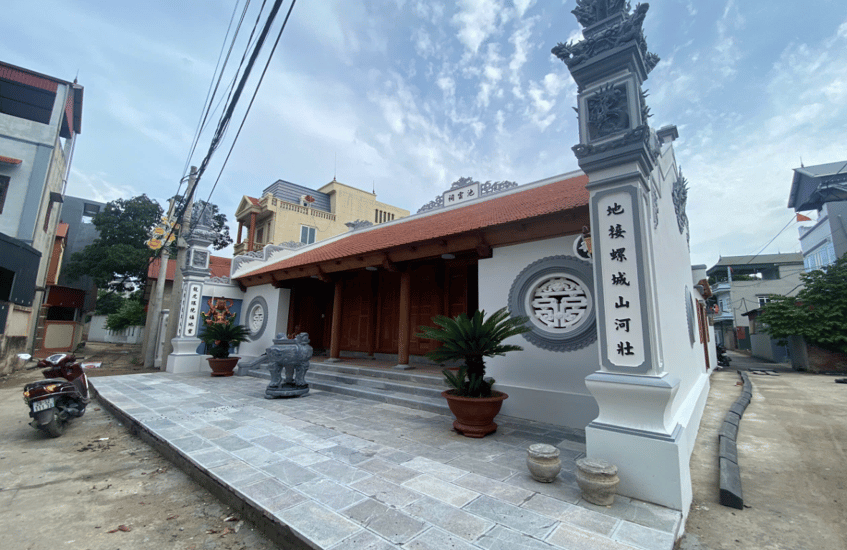
Nhì (Nhị) Temple, Nhì Hamlet, Phúc Thịnh Commune, Hà Nội City
Previously, the Nhì Temple festival was held on the Saint's birthday, the 15th day of the 8th lunar month, and the Saint's transformation day, the 15th day of the 4th lunar month, especially the khánh hạ ceremony on the 6th day of the first lunar month each year. Today, the temple still maintains the offering ceremony for the Saint's birthday on the 15th day of the 8th lunar month, but its scale and duration are more compact than before. On the Saint's transformation day, the 15th day of the 4th lunar month, the temple holds a ceremony but does not sing. The transformation-day ceremony is still maintained today but is simpler.
Nhị Temple was ranked as a City-level historical and cultural relic under Decision No. 487/QĐ-UBND dated January 19, 2012.



