
Thụy Hà Communal House Relic
Story
01THỤY HÀ COMMUNAL HOUSE RELIC
Thụy Hà Communal House relic is located in Thụy Hà village, Phúc Thịnh commune, Hanoi City.
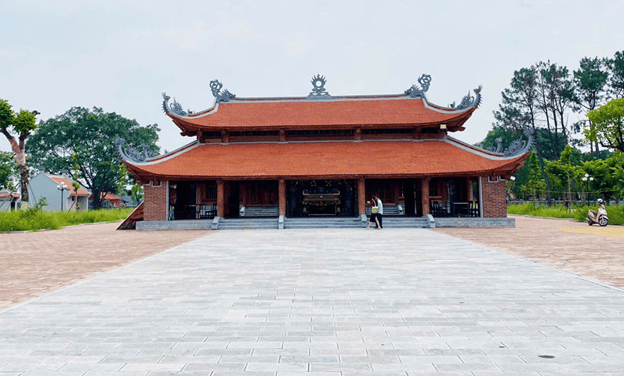
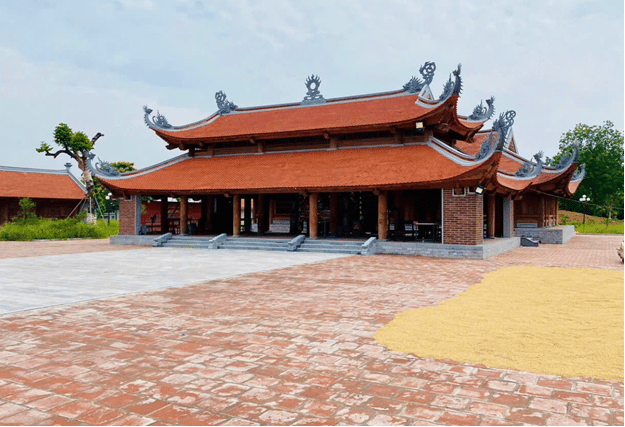
Through the deity legends, royal edicts, and artifacts still preserved at the relic, it can be concluded that Thụy Hà Communal House dates back at the latest to the Later Lê period. Before 1948, Thụy Hà village had a communal house on Phượng mound in the western area of the village (within the grounds of the village's current headquarters). Later, the communal house was moved to the northwest corner of the village. In 1948-1949, Thụy Hà Communal House was demolished. In 1990, it was rebuilt, but not on the old grounds; instead, it was located east of Bãi Chùa. Currently, the relic has just been restored and repaired spaciously, returning the original items of the ancient communal house, namely the gate, front ceremonial hall, auxiliary halls, main communal house, and supporting works.
The communal house worships four village guardian deities: Cao Sơn Đại Vương, Hỗn Độn, Áp Quán, and Tá Phụ Minh Thiên. Further research into local folk legends shows that Tá Phụ Minh Thiên is another title of Saint Tam Giang (Trương Hống and Trương Hát). The deities worshipped at Thụy Hà Communal House all rendered meritorious service to the people and the country and have been worshipped and honored by many villages and communes.
The communal house is located on a separate large plot outside the residential area, surrounded by orchards and green perennial trees, with enclosing walls and fences. The gate is built in the four-pillar style, with two large pillars and two small pillars opening three entrances into the communal house space. Along the stone-paved central processional axis and the large courtyard, on both sides are left and right auxiliary halls built with closed gables and ngai-style arms, tiled roofs, five bays on each side, fitted with folding panel doors. The front ceremonial hall consists of three bays and two lean-tos, with two tiers of stacked roofs and curved roof corners; the roof is decorated with a pair of dragons flanking the sun, unicorns, and flying phoenixes, etc. The main communal house includes the great hall and the rear sanctuary. The great hall has five bays and two lean-tos with curved roof corners, decorated on the roof and in the architecture with the four sacred creatures and four precious plants themes. The rear sanctuary has three bays and one lean-to running lengthwise, with an altar platform inside for arranging worship objects.
At present, Thụy Hà Communal House still preserves a number of worship artifacts of various types and materials. These include a copy of the deity legend kept at the Institute of Social Science Information; five royal edicts, the earliest dated to the 21st year of Minh Mệnh (1840); a bell dated to the 24th year of Tự Đức (1871); four sets of dragon thrones for worship tablets, lacquered and gilded and intricately carved with dragons, phoenixes, tiger faces, flowers, water waves, etc.; eight sets of palanquins and ceremonial vessels of the clans used to carry offerings to the communal house during festivals, with palanquins carved with dragons and lacquered and gilded, also bearing strong artistic imprints of the 20th century; in addition, there are stone steles, including one inscribed with the 21st year of Chính Hòa (1700), and a bronze bell cast in the Nhâm Tuất year, the 2nd year of Bảo Hưng (1802), etc.
Thụy Hà Communal House relic has been ranked as a city-level historical and architectural-artistic relic under Decision No. 4637/QD-UBND dated October 18, 2006.



