
Vinh Phuc Communal House Relic
Introduction
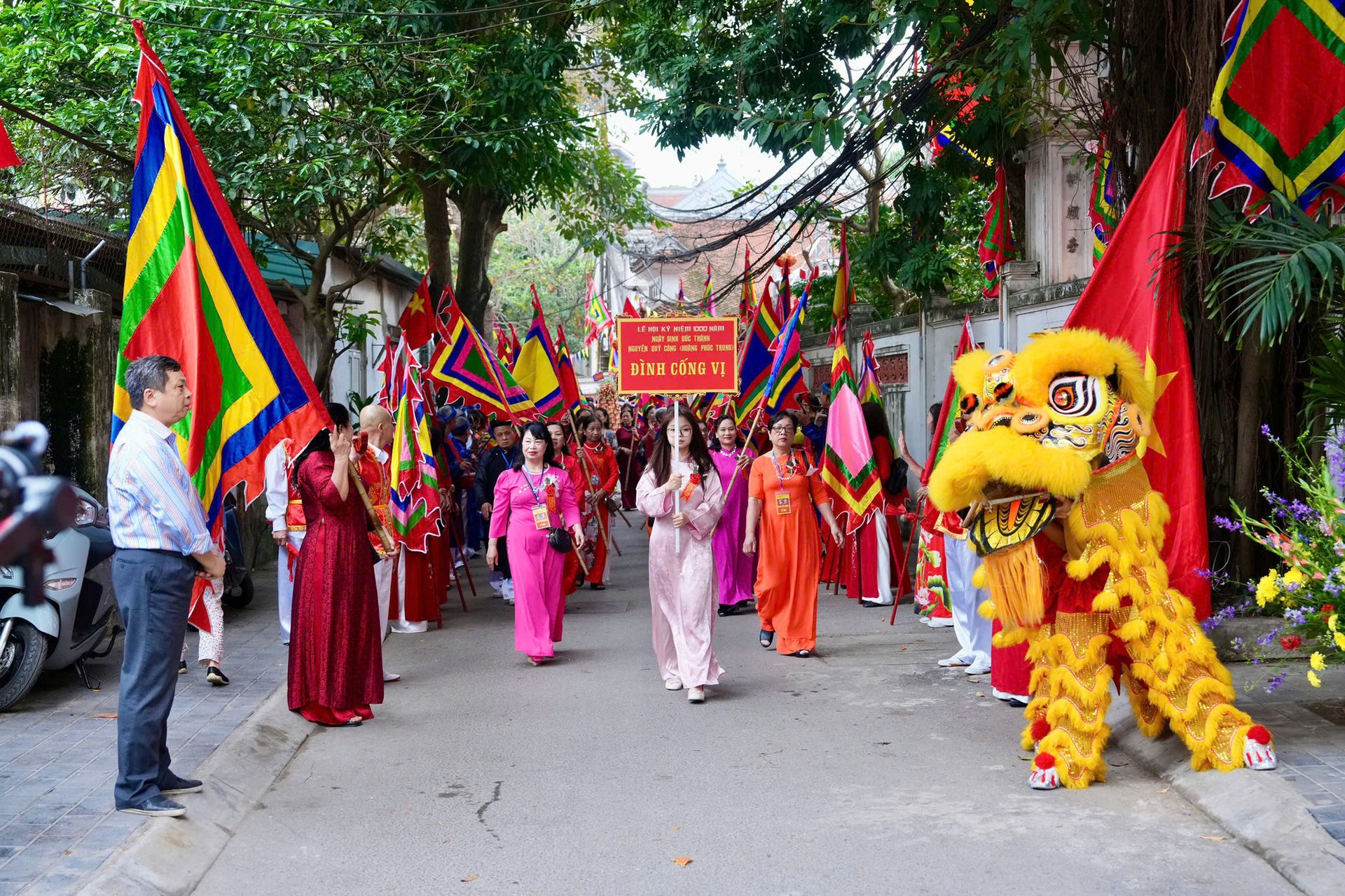
According to legend and surviving hagiographies, during the reign of King Ly Thai Tong (1028–1054), in Le Mat village there was a family that gave birth to a son in the Binh Dan year (1026), named Quy Cong. From childhood, Quy Cong was renowned for being intelligent, strong, and more talented than others. At the age of 13, he already showed talent in military strategy; by the age of 16, he was valued by the court and held the position of Supervising Official in the court.
At that time, there was a eldest princess in the court, beautiful in appearance. During a pleasure trip on the Thien Duc River, the princess's boat unfortunately sank, and her body could not be found. The king ordered the court boats to organize a search, but still without result. Quy Cong, regardless of danger, alone dove to the riverbed, fought the aquatic creatures, and found the princess's body and brought it ashore.
Admiring Quy Cong's talent and courage, the king granted him titles and rank, conferred on him the post of Thai Giam Noi Thi Tu Khanh, and rewarded him with 100 catties of gold and 100 bolts of silk. However, Quy Cong did not accept the reward; instead, he submitted a petition asking the king to allow the poor people of his native place to migrate to the west of Thang Long Citadel, behind Bao Tu Pagoda, to reclaim land and establish camps. The king agreed. The work proceeded smoothly, forming a community known by the name Thap Tam Trai.
Quy Cong passed away in the Ky Hoi year (1119), on the 12th day of the 10th month, at the age of 93. Upon hearing the news, the king was deeply grieved for the meritorious official, granted silk and cloth, and ordered the court officials to bring his body back to his native place in Le Mat. On the funeral procession, before the burial was complete, the earth suddenly rose into a large termite mound, which the people regarded as the sacred grave of the Saint.
The king rewarded the people of the camps with 300 quan in coins as incense-offering money, and also permitted the people of the camps to establish communal houses and temples for worship, rituals, and remembrance of Quy Cong's merits. From then on, the belief in worshipping Saint Le Mat was passed down through many generations, becoming a spiritual cultural feature closely associated with the community of residents in the Thap Tam Trai area.
Vinh Phuc Communal House is one of the relics worshipping the Saint, preserving historical, cultural, and religious values associated with the formation and development of the community of residents in the western area of the ancient Thang Long capital.



