
Bao Loc Communal House Historical Relic
Introduction
Bao Loc Communal House Historical Relic, Phuc Loc Commune, Hanoi City
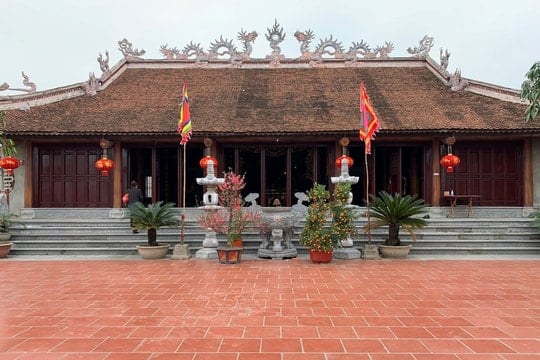
Bao Loc Communal House is located in Bao Loc Hamlet, Vong Xuyen Commune, Phuc Tho District, Hanoi City. Bao Loc Communal House is an ancient communal house built in the 16th century. Through historical changes, the relic still strongly bears late 19th-century and early 20th-century architectural features, including the following items: left and right corridors, gate, main hall, rear sanctuary, shrine... The communal house worships the Tutelary God; the village's Tutelary God was conferred by royal dynasties for worship: 'Duc Bach Hac Dai Vuong' - 'Thuong Dang Than', associated with the legend of Tan Vien Son Thanh.
Regarding His merits, the content of the two 'Than pha' (divine genealogies) clearly states: In the reign of Emperor Duong Duc Ton, the Do Ba Con Lon invaders raided An Nam; the emperor ordered Ly Thuong Minh Cong to attack and drive out the enemy. In only one day and night he reached Son Tay dao. Near evening, encountering the enemy coming out of the forest, Minh Cong gathered his forces, halted, and encamped at Bao Loc Hamlet, at the shrine at the head of the village, to rest overnight. At night, he prayed to the god to send spirit soldiers to help fight the enemy. Before the third watch ended that night, as Minh Cong dozed, he dreamed of an old man in neat hat and robes, of large stature, coming along the shrine path and declaring himself: a descendant of the Hung kings from Bach Hac village, who in life traveled with his brother, vowing to cross the river in one step to cultivate together. Seeing the general leading troops on patrol through the circuits and coming to pray for assistance, I appear, willing to follow the commander to fight the enemy and establish merit. After waking, Minh Cong asked the local people and learned that the hamlet worshipped a deity at the sacred Bach Hac shrine. Then Minh Cong raised troops to attack the Do Ba Con Lon invaders; a great battle put the enemy to flight. From then on the world was peaceful and the country secure. Minh Cong submitted a memorial to the court saying that the early pacification of the Do Ba invaders was also thanks to spirit soldiers' assistance and the gods' support. Hearing this, the king appointed Ly Thuong Minh as governor of Phong Chau and ordered an edict, with the original divine title for worship:
1. Conferred as the local tutelary god 'Tho Lenh' Tam Giang Thong Che - Linh Ung Dai Vuong.
2. Bestowed the title Linh Quang Ho Quoc, Ban Canh Hung Uy, Khang Dan Phu Van, Ta Tu Hien Linh Dai Vuong 'Thuong Dang Than'.
In the reign of King Tran Nhan Tong, the Mongol Yuan invaders came to invade our country. Hung Dao Dai Vuong received the king's order to fight the enemy. Passing here, he was told in a dream by the deity to ask for spiritual support to protect the country. After defeating the enemy, King Tran Nhan Tong additionally conferred: Nghia Tu - Anh Triet Hien Huu Tro Thang - Dai Vuong. 'Thuong Dang Than'....
In the reign of Le Thai To, he rose in uprising, defeated the Ming invaders and recovered the rivers and mountains and the country; King Le Thai To additionally conferred: Pho Te Cuong Nghi Anh Linh Tuan Kiet Dai Vuong Thuong Dang Than.
In the minds of every local person, he is always respected and admired for his talent, virtue, patriotism, and love for the people in fighting foreign invaders as a 'national hero'. To express their reverence, in the past, when passing the communal house gate, everyone voluntarily removed their hats. Those traveling by cart or horse had to dismount and walk; unclean items had to be carried behind the communal house... Today, those customs no longer exist, but funeral processions passing in front of the communal house gate may not use trumpets or drums and may not weep.
To this day, the people of Bao Loc still fully preserve: 3 volumes of divine genealogies (recording His legend) and 13 royal edicts conferred by various dynasties.
The first edict was conferred by King Le Chan Tong, in the 7th year of the Phuc Thai era, on the 20th day of the 2nd month (1649). The last edict was conferred by King Nguyen Hoang Ton, in the 9th year of the Khai Dinh era, on the 25th day of the 7th month, 1924. The basic content of the 13 edicts is briefly translated as follows:
1. Praising His talent and virtue, mettle, heroic demeanor, and patriotic spirit.
2. Praising His merits in responding spiritually and assisting General Tran Quoc Tuan to defeat the Mongol Yuan invaders, protect the country, and shelter the people.
3. Based on His talent, virtue, and merits, He was conferred edicts by royal dynasties for the people of Phuc Loc District and Bao Loc Commune to worship.
The village communal house is the place of worship of Duc Thanh Hoang. It is where annual festivals and deity ceremonies are held, and was formerly the village's only meeting place. The architecture is divided into two main parts: the Rear Sanctuary and the Forbidden Chamber. In front of the rear sanctuary door, in the center above the altar, there is a horizontal plaque shaped like a 'scroll' with two large characters 'Ho Quoc' inlaid with mother-of-pearl. Outside the rear sanctuary is the Great Hall; in the center is the communal house court; above the central altar is a horizontal plaque with three large characters 'Thuong Dang Than' painted vermilion and gilded, with a tiger emblem below. The communal house columns hang 'four sets' of parallel couplets expressing His merits and recalling His heroic history.
Regarding current relics, the village still preserves 3 sets of palanquins: Loan Gia - Gia Van - Long Dinh, used to carry Duc Thanh Hoang from the shrine to the communal house and the sacred palanquin back to the shrine during the three days of the village festival.
One of the highlights associated with Bao Loc Communal House is the traditional festival. Traditionally, every year on the 11th, 12th, and 13th days of the second lunar month, the people of Bao Loc village hold a three-day festival. With the rituals: palanquin procession and deity worship, these are carried out very solemnly and reverently. Each time the palanquin procession welcoming the dragon throne from the shrine to the communal house passes through dozens of small alleys, the villagers assign elderly people to set up altars with incense, flowers, glutinous rice, and bananas to perform ceremonies praying for peace for the villagers. When the Loan Gia palanquin returns to the shrine, upon reaching the large gate of the communal house, the palanquin stops so that small children can crawl under its base - with the belief that He will protect and bestow good luck and fortune on them. The Loan Gia palanquin (Thanh Ngu) is carefully covered with a canopy and shielded with flags and fans. The festival also includes typical activities such as Chinese chess, duck catching, pot smashing, rice-cooking contests.... always leaving deep impressions on local people and visitors from everywhere. In addition to the meaning of worship that helps put people's minds at ease and encourages them to work enthusiastically in production, affirming faith and hope for a year of good harvests and a warm and happy life, the festival also has meaning as the village's Tet, where people can communicate, be open, and encourage one another to actively build a new life, help one another understand more about their roots and ancestors, take pride in their homeland, and from there make each person see more clearly their responsibility to their homeland and country.
Bao Loc Communal House was classified as a 'Historical-Cultural Relic' by decision of the People's Committee of Ha Tay Province, now Hanoi City, in Decision No. 2406 QD/UB dated November 15, 2003.



