
Phuc Tam National Monument (Sen Chieu Pagoda)
5.0Free
5.0Free
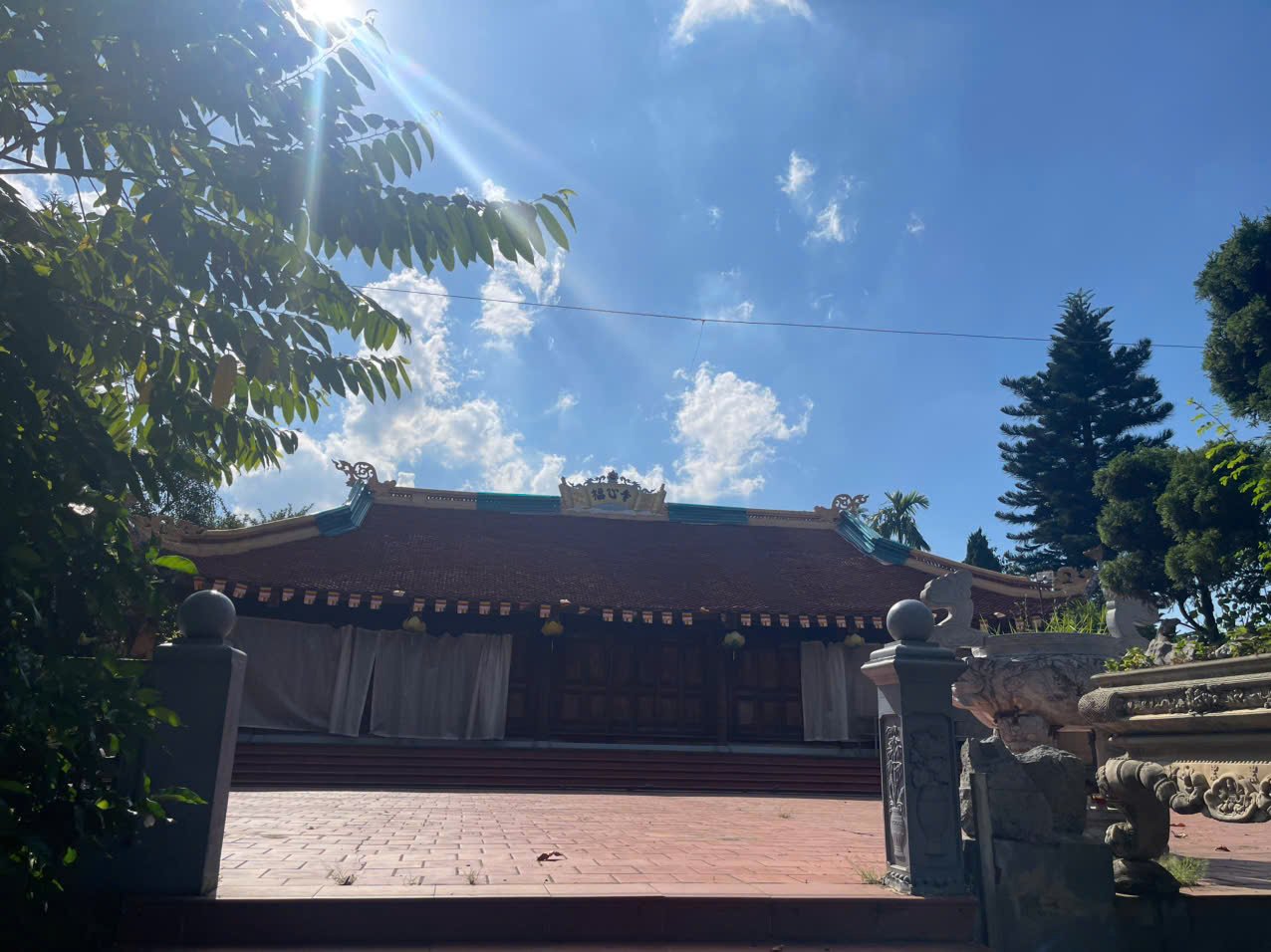
Phuc Tam Pagoda, whose Sino-Vietnamese name is Phuc Tam Tu, is also called Sen Chieu Pagoda after the village place name. The pagoda is part of the Sen Chieu Temple - Shrine and Phuc Tam Pagoda relic complex, a religious structure with a long history closely associated with the spiritual and cultural life of the local people.
The pagoda is currently in Sen Chieu Hamlet, Phuc Loc Commune, Hanoi City. It is located at the entrance to the village, about 50 m from the foot of the Red River dike. The Sen Chieu Temple and Shrine are located near Phuc Tam Pagoda.
The relic complex is on the south bank, near the foot of the Red River dike, about more than 40 km from Hanoi Capital. The pagoda's space is part of a natural landscape associated with a lotus pond and the village's traditional religious works.
According to the records in the genealogical register, the people of Sen Chieu repaired the village's pagoda and shrine as early as the Hung Vuong period. However, the document also notes that this date is too remote and unconvincing. It can at least be determined that Phuc Tam Pagoda existed before the Hong Duc period, when the genealogical register was compiled.
From then on, the pagoda was restored and repaired many times. On the 9th day of the 5th month of the 9th Canh Hung year, i.e., 1748, the pagoda cast a large bronze ritual chime.
In 1800, the 8th year of the Canh Thinh era, the people of Sen Chieu continued to donate money to buy bronze and hire craftsmen to cast a large bronze bell named “Phuc Tam Tu Chung”, meaning the bell of Phuc Tam Pagoda.
In the 19th century, many Buddha and Bodhisattva statues of the pagoda were made anew. In the Nguyen era, the people continued to repair the pagoda many times. Therefore, the remaining physical structures of the pagoda today are identified by the documents as products of Nguyen-era architectural art.
The continuous existence of Phuc Tam Pagoda through many periods shows the local community's care and preservation of the religious structure as well as the cultural values handed down by their ancestors.
Phuc Tam Pagoda is located in the traditional landscape space of Sen Chieu Village, near the foot of the Red River dike and a lotus pond. The Temple, Shrine, and Pagoda are arranged in a space that is relatively harmonious with the natural terrain.
According to descriptive documents, the pagoda is near the foot of the dike, while the Mother Temple is located farther back in a large garden. Between the pagoda and the temple is a short path curving along the natural terrain of the pond. The combination of pond, trees, courtyard, and architectural structures creates a notable landscape for the relic complex.
In terms of architecture, Phuc Tam Pagoda has components described in the documents such as the front hall, incense-burning chamber, and upper sanctuary.
The incense-burning chamber is small in scale, consisting of one bay connecting the front hall and the upper sanctuary. The building has a simple structure of the ke o cau qua giang type. In the center of the interior is a large brick platform, about 2.40 m x 1.80 m x 0.60 m, for displaying ritual objects. On both side walls hang two bronze relics from the Le Trung Hung and Tay Son periods.
The upper sanctuary is a wide horizontal building consisting of one central bay and two side bays. The two main roof trusses are stacked in the chong giuong style. The stacked beams fit closely together to form decorative coving panels. The two side trusses are made in the gia chieng ke chuyen form.
On the two main trusses, the first beam is carved in relief with plant and cloud motifs. The motifs are rendered clearly and with volume, creating artistic value for the architectural space.
In the upper sanctuary, brick platforms are built progressively higher from the outside inward to form the Tam Bao (Three Jewels). At the top is the statue set Tam The, representing the three Buddha worlds of the past, present, and future.
The three Tam The statues are relatively uniform in size, about 75 cm high, with a lap width of 42 cm and a lotus pedestal of 80 cm. The statues sit cross-legged in the lotus position on lotus thrones, with hands forming the samadhi mudra placed in their laps.
In terms of sculptural style, the Tam The set has a strong folk character. The statue proportions do not entirely follow standard proportional conventions; the heads have an antique style. The faces are rendered according to traditional rules: eyes half-closed looking downward, straight nose bridge, and large, long ears extending down to the shoulders.
The lotus pedestals of the statues are made relatively similarly, with three tiers and opening outward to form seats. The lotus petals are large, thick, and taper toward the tips. This type of lotus pedestal is identified in the documents as characteristic of Le Trung Hung-period Buddhist sculpture.
Below the Tam The group is a tier of Amitabha statues seated on lotus pedestals. The next tiers include Guanyin wearing the Seven Buddha crown and Guanyin Song Tu, also called Guanyin Thi Kinh. At the lowest tier is the Nine Dragons throne, depicting the moment when Shakyamuni Buddha was newly born.
In the front hall there are two statues, Guanyin Bodhisattva and Duc Ong, seated facing each other across the central bay. In addition, on the altar of the incense-burning chamber there is a bronze statue of the infant Shakyamuni.
The worship statue system of Phuc Tam Pagoda therefore has both religious value and reflects the characteristics of Buddhist sculptural art across different periods.
Phuc Tam Pagoda currently preserves many valuable relics. The most notable among them is the bronze bell “Phúc Tâm tự chung”.
The bell has a beautiful shape; its handle is a pair of dragons with their backs facing each other. The bell body is divided into 8 panels. The area adjoining the body and the bell base has 4 raised striking bosses in the shape of chrysanthemums. The bell is about 1.15 m high and its mouth diameter is about 0.65 m.
The reign title inscribed on the bell body is ““Cảnh Thịnh bát niên tam nguyệt nhị thập ngũ nhật”, i.e., the 25th day of the 3rd month of the 8th Cảnh Thịnh year, 1800.
In addition, the temple still preserves a large bronze khánh with the reign title Cảnh Hưng 9th year, 1748. The khánh is about 1.15 m high and its widest part is about 1.42 m.
In addition, there are: two wooden cranes from the 19th century, one horizontal plaque, two pairs of parallel couplets, and 13 worship statues, of which 4 date from the 18th century and the rest belong to the Nguyễn period.
These relics are important material sources reflecting the formation, existence, and development of Phúc Tâm Temple over many centuries.
Phúc Tâm Temple is a Buddhist structure with a long history, closely associated with the spiritual and cultural life of the Sen Chiểu community.
Over its existence, the temple has many times been repaired, embellished, and supplemented with worship statues and ritual objects by the people. Artifacts such as the bronze khánh of 1748, the “Phúc Tâm tự chung” bell of 1800, the system of Buddha statues, and architectural components help prove the continuous existence of the relic.
The artistic value of the temple is expressed in its architecture and system of worship statues. Details carved with plant motifs and cloud motifs on the tie beams; the structure of stacked beams and the giá chiêng kẻ chuyền; together with the systems of Tam Thế, A Di Đà, Quan Âm, and Cửu Long statues create notable values in Buddhist architectural and sculptural art.
In particular, the Tam Thế statue set, with a creation style strongly imbued with folk characteristics, together with the lotus pedestal form characteristic of Buddhist sculptural art of the Lê Trung Hưng period, are valuable elements for researching traditional Buddhist art.
Throughout its existence, Phúc Tâm Temple has not only been a place for practicing Buddhist beliefs but has also contributed to the spiritual and cultural life of the local people.
Documentation shows that the temple's endurance is tied to the strength of Buddhism and the local people's awareness of respecting and preserving cultural heritage. The temple contributes to educating and preserving the nation's fine traditions.
Along with Sen Chiểu Đền and Sen Chiểu Miếu, Phúc Tâm Temple forms a distinctive traditional cultural space of Sen Chiểu village, in which the Đền and Miếu are associated with deity worship, while the Chùa is a place of Buddha worship. The presence of these structures in the same space helps reflect the rich religious, belief, and spiritual cultural life of the local community.
Although it has undergone many changes over time and changes in architectural scale, Phúc Tâm Temple still preserves many elements of historical, cultural, architectural, and artistic value.
From architectural traces, the system of worship statues, bells, khánh, and remaining relics, Phúc Tâm Temple helps reflect the development of Buddhism as well as the spiritual life of the Sen Chiểu people across many generations.
Phúc Tâm Temple, together with Sen Chiểu Đền and Sen Chiểu Miếu, are structures closely tied to the spiritual and cultural life of a traditional village in the Red River Delta, creating a relic space of historical, cultural, and artistic value.



