
Special National Relic of Tường Phiêu Communal House, Phúc Thọ Commune
Introduction
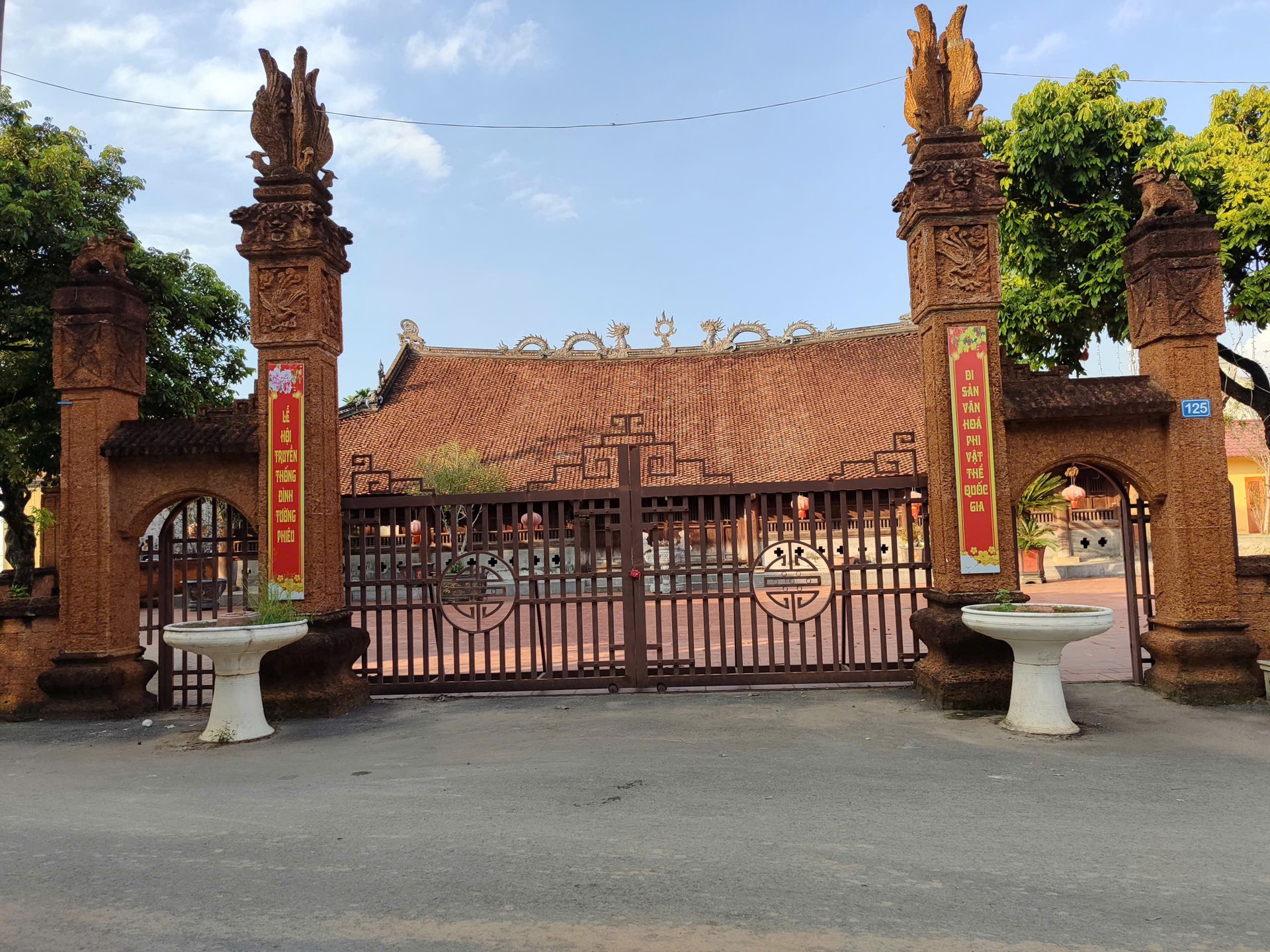
Special National Relic of Tường Phiêu Communal House, Phúc Thọ Commune
Tường Phiêu Communal House, also known as Cả Communal House, is located in Tường Phiêu Hamlet, Phúc Thọ Commune, Hanoi City. It is an ancient architectural work of large scale and high artistic architectural value. Tường Phiêu Communal House dates back to around the early 17th century and is the largest communal house in the region still standing after the challenges of time and wars.
Tuong Phieu Communal House faces southwest, the direction the people of Tuong Phieu chose long ago so they could see Ba Vi Mountain, where the temple to Saint Tan Vien is located. Tuong Phieu Communal House includes the following items: Nghi Mon gate, courtyard, Dai Dinh main hall, Ta Mac left wing, and some auxiliary items. Because it has no Hau Cung rear shrine, the architectural traces from its construction through renovations remain in the character “Nhat” (–). The Dai Dinh consists of 3 bays and 2 double lean-tos; the central bay has an altar niche, above which are a dragon throne and a tablet worshipping the Three Great Kings, Supreme Deities, Tan Vien Son Thanh. The altar niche is elaborately carved with the image of two dragons flanking the moon and a system of bars carved in relief with coiling dragons instead of balusters. This decorative style is rarely found in the region.
Tuong Phieu Communal House worships the Three Saints Tan Vien, mountain deities widely worshipped in Doai, who were always conferred the title Supreme Deity by former dynasties, namely:
Tan Vien Son Quoc Chua, also Supreme Deity (in the center, taboo name Tuan).
Cao Son Dai Vuong, Supreme Deity (on the left, taboo name Sung).
Quy Minh Dai Vuong, Supreme Deity (on the right, taboo name Hien).
In addition, the villagers also jointly worship Quan Son, the village tutelary god, at an altar placed on the right side of the Dai Dinh.
In terms of architecture, the structural frame of the Dai Dinh has 4 main trusses with a structure of 6 rows of columns. The roof trusses of the 4 main trusses are made in the style gia chien - ke ngoi, the main columns and subordinate columns are all made of lim wood, with a floor. The main column system is quite large, with a circumference of about 1.5m - 1.6m.
Currently, the communal house bears many marks of different periods from the 17th to the 20th century; however, the most valuable feature of Tuong Phieu Communal House is its system of architectural components decorated with carvings dating from the 17th century. Compared with the 17th-century carving style of communal houses in the Doai region, Tuong Phieu Communal House has its own distinctive, easily recognizable character. This is clearest in the way earlier people shaped dragons on the corner brackets. They still used the familiar Doai dragon form, with the face facing forward, large round eyes, wide-spread ears, thick lips that look amusing and strongly folk-like. The difference is that the dragon's fins are made sparse and very large. Yet they remain soft rather than stiff thanks to rows of decorative details carved on the fins. On the dragon's head and feet there are also spiral patterns with carefully carved decorative details that are very beautiful. With this manner of shaping, the dragons of Tuong Phieu Communal House, although characteristic of the 17th century, also hint at the carving style of the Mac era in the 16th century. In addition, the communal house still preserves valuable carved panels depicting the life of people of that period, such as the panel about the story “Mr. Ba Vang and his son carrying offerings to the communal house,” and many other panels of sacred animals such as phoenixes and nghe…
Besides its outstanding values in artistic architecture, Tuong Phieu Communal House also preserves many distinctive intangible cultural heritage values expressed in the village festival through the ritual of burning Dinh Lieu - night palanquin procession.
At Tuong Phieu Communal House there are four main annual ceremonies: the Spring Festival from the 14th to the 16th of the first lunar month; the Saint Transformation Ceremony on the 14th of the fifth lunar month (with the custom of making round glutinous rice cakes); the Deity Conferment Ceremony on the 15th of the eighth lunar month; and Chap Dinh - the year-end ceremony on the 15th of the twelfth lunar month. There are also other observances such as: the 7th day of the first lunar month, Khai Ha Ceremony; the 1st day of the fifth lunar month and the 28th day of the seventh lunar month, Thuong Dien and Ha Dien ceremonies… Among them the Spring Festival period takes place from the 14th to the 16th of the first lunar month and is the main and largest festival period of the village; every three years, the villagers hold a grand festival in the years of the Rat, Horse, Cat, and Rooster: there is a procession of the Saint's palanquin to Ngo Son Temple (Ngo Temple) for worship in the morning and a procession of the Saint back to the communal house on the night of the 14th of the first lunar month; this is also the unique feature of the Tuong Phieu Communal House festival. The Traditional Festival of Tuong Phieu Communal House was recognized as a national intangible cultural heritage in 2024.
With its great historical, cultural, and artistic architectural values, Tường Phiêu Communal House was ranked at the National level under Decision No. 74 VH/QĐ dated February 2, 1993, of the Ministry of Culture and Information (now the Ministry of Culture, Sports and Tourism). On December 24, 2018, Tường Phiêu Communal House was honored to be ranked as a Special National Relic under Decision No. 1820/QĐ-TTg of the Prime Minister.



