
Sen Chiểu National Relic
5.0Free
5.0Free
Introduction
INTRODUCTION TO THE SEN CHIỂU SHRINE RELIC
INTRODUCTION TO THE SEN CHIỂU SHRINE RELIC
The Sen Chiểu Shrine, also known as Sen Shrine, is an important religious structure of Sen Chiểu village. According to documentary sources, the Shrine is the site of the village's principal deity, associated with the worship of Chiêu Ứng An Dân Hộ Quốc Đại Vương.
The Sen Chiểu Shrine is part of a traditional relic complex that includes the Sen Chiểu Temple and Phúc Tâm Pagoda. The complex currently belongs to Sen Chiểu Hamlet, Sen Chiểu Commune, Phúc Thọ District, in the outskirts of Hà Nội, located on the south bank near the foot of the Red River dike.
In history, the Sen Chiểu area underwent many changes in administrative boundaries. Before the early 19th century, the locality belonged to Sen Chiểu Commune, Phúc Lộc District, Quảng Oai Prefecture, Sơn Tây Garrison; from the late 19th century to 1945 it belonged to Phù Sa Canton, Phúc Lộc District, Sơn Tây Province. In 1956, Liên Chiểu and Linh Chiểu Communes were merged into Sen Chiểu Commune, Phúc Thọ District, Sơn Tây Province; after subsequent administrative changes, from 1979 it belonged to the outskirts of Hà Nội.
According to the sacred genealogy “Chiêu Ứng Hộ Quốc Đại Vương” written in the second year of Hồng Đức (1471), the land of Sen Chiểu has a history dating from the Hùng Vương era. The ancient village of Sen Chiểu then consisted of two hamlets, Phương Độ and Đông Bảo, which later developed into Lan Chiểu, Liên Chiểu, and then Sen Chiểu.
Documentary sources record that this place is associated with two famous figures of the Hùng dynasty: Bạch Ngọc Thánh Mẫu and Chiêu Ứng Hộ Quốc Đại Vương. Because of their merits in internal governance and resistance against foreign invaders, after their transformation, they were permitted by the king to establish places of worship.
Hùng Chiêu was a man talented in martial arts and military strategy. After being selected and appointed as Grand Equerry, he was sent by the court to suppress banditry in the Đoài region. In Phúc Lộc District, he pacified the people and brought the bandits into submission, and was thereafter appointed Administrator of the land of Hưng Hóa.
At the end of the reign of Hùng Duệ Vương, when the country faced the threat of invasion by northern invaders, Hùng Chiêu, together with Tản Viên Sơn Thánh, took part in commanding the Văn Lang army against the invaders. After his victories, Hùng Chiêu was conferred the title Hộ Quốc Đệ Vương. In the second resistance against the invaders, he commanded the naval forces in coordination with the land forces of Tản Viên Sơn Thánh, defeated the enemy in the Bạch Hạc area, and pursued them all the way to their headquarters.
After Hùng Chiêu's transformation, the Hùng king conferred upon him the title Chiêu Ứng An Dân Hộ Quốc Đại Vương and also conferred upon his mother the title Bạch Ngọc Thánh Mẫu Công Chúa. Lan Chiểu, the homeland of the Holy Mother, is regarded as the main temple among the 54 villages that worship together.
Every year, the people hold ceremonies on the birth and transformation days of Hùng Chiêu and the Holy Mother. These rituals help maintain community cohesion and preserve the village's traditional religious customs.
The Sen Chiểu Shrine is located within the traditional landscape space of the relic complex, built along the western shore of the lotus pond. The Shrine is oriented to the south, facing the temple dedicated to the Holy Mother.
The natural space around the relic combines a pond, a brick yard, and traditional architectural structures. From Phúc Tâm Pagoda to the Temple and the Shrine is a short path winding along the natural terrain of the pond, creating a harmonious landscape between architecture and nature.
According to documentary sources, the Sen Chiểu Shrine formerly had a large scale, with architecture in the shape of the character Nhị. Over its long existence, the architectural scale of the Shrine gradually narrowed. Traces of a once imposing structure are still shown through the large three-entrance gate and the ground plan of the main worship hall located in the middle of the wide yard behind the three-entrance gate.
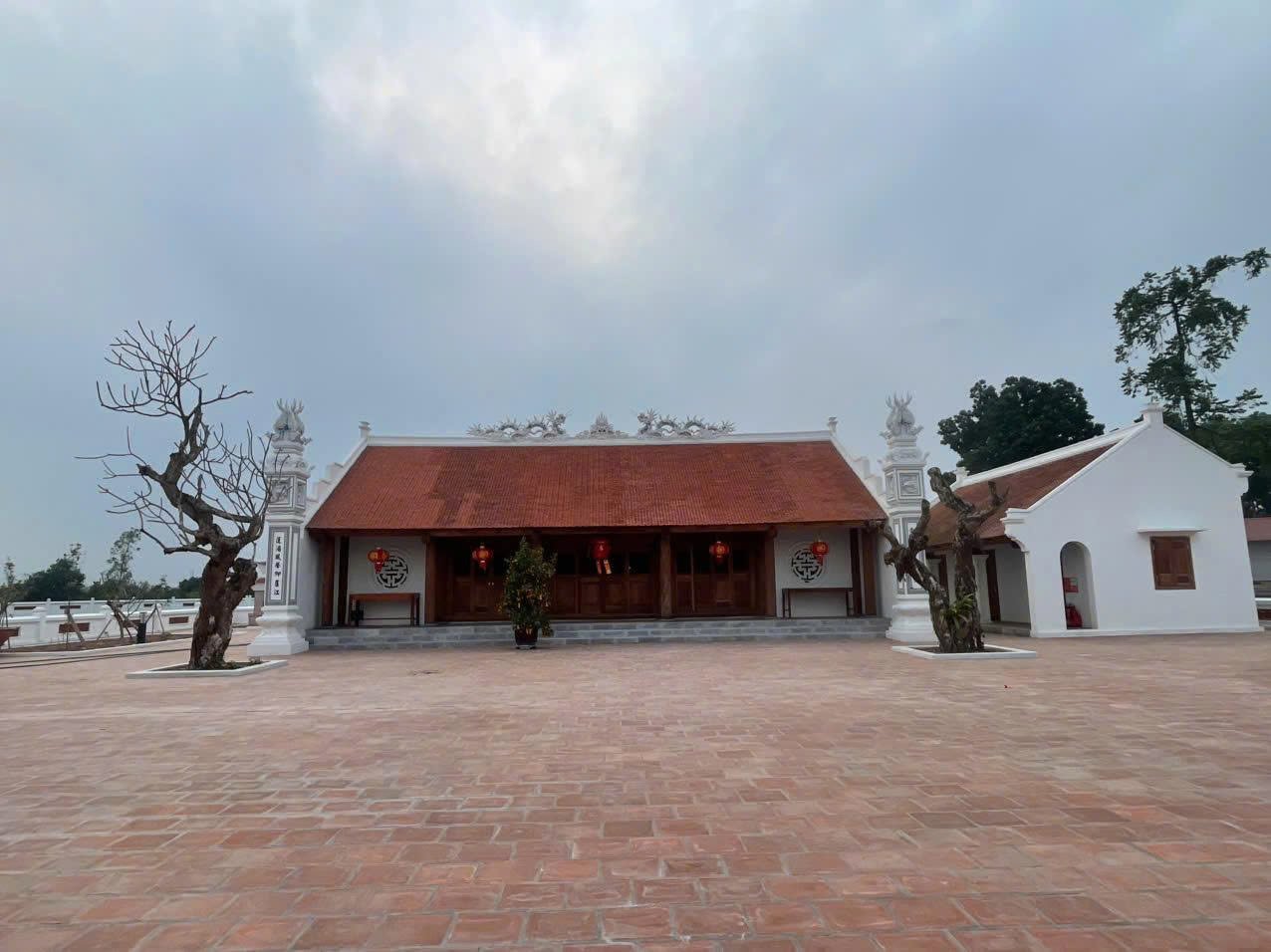
Currently, the overall Shrine consists of the three-entrance gate, a wide square brick yard, and the main architectural area. The three-entrance gate was built in the front position, forming a straight axis toward the front hall.
The three-entrance gate is large in scale. The central gate is large, formed by two ornamental pillars. The pillars have square cross-sections. At the top of each pillar is a decorative motif formed by four phoenixes with their tails joined together. Below are four dragon heads facing the corners of the pillar. The dragon bodies are connected through the bodies of the ornamental pillars.
Below are decorative panels in relief with the theme of the four sacred creatures: dragon, ly, turtle, and phoenix. Along the pillar bodies are long panels for recording couplets in ancient Hán characters.
On both sides of the main pillars are large wall sections connected to two side gates. The side gates are arched, with stacked-tile roofs above, and the corners of the curved roofs rise upward. Behind the three-entrance gate is a wide square brick yard, whose floor has three levels rising gradually from the outside to the front hall.
The main architecture of the Shrine has a structure in the shape of the character Đinh, consisting of the front hall and the rear sanctuary. The two buildings are closely connected, forming a relatively enclosed worship space.
The front hall consists of 3 bays, built in the style of tường hồi bít đốc tay ngai. The roof is covered with traditional tiles, and the ridge is molded in the shape of the character Đinh. The two front gable walls extend about 2 m beyond the veranda. On the outside of the walls are small pillars. On the inner face of the wall are reliefs of two large elephants, expressing the authority of the worshipped deity.
The frame of the front hall consists of 4 identical trusses, in the style of “vì kèo quá giang và bẩy hiên”. The trusses are executed in the “bào trơn đóng bén” manner. The floor of the front hall is about 30 cm high, and the front is left open for ventilation. The floor is paved with Bát Tràng tiles measuring 30 cm x 30 cm. In the center of the building is a low rectangular brick platform for displaying ritual vessels.
The rear sanctuary consists of two longitudinal bays connected to the center of the front hall, with simple kẻ truyền-style architecture. Inside the rear sanctuary is a large altar, the site of the worshipped deity. On the brick platform in the most solemn position is a large arched-roof shrine cabinet dating from the Lê Trung Hưng period. Inside the cabinet is the site of the deity Chiêu Ứng.
The Sen Chiểu Shrine currently preserves a system of valuable artifacts, including many objects dating from the 18th and 19th centuries.
Typical artifacts include:
- A small bronze bell from the Nguyễn period.
- Two bronze ding cauldrons from the 19th century.
- One royal edict from the Nguyen dynasty.
- Two incense burners dating from the 18th century.
- One stone stele from the Le dynasty, Chinh Hoa reign era. The stele measures 1.14 m x 0.60 m x 0.15 m; its top is decorated with two dragons flanking the sun, and its border with floral scrolls. The inscription records the construction of the village's civil shrine.
- One 18th-century altar shrine with a curved roof, measuring 1.70 m x 1.60 m x 1.20 m, carved with motifs of the sun, two dragons flanking the sun, dragons, phoenixes, and chrysanthemum vines.
- One ceremonial palanquin decorated with dragons, tiger emblems, and bodhi-leaf motifs, dating from the 19th century.
- One procession palanquin set decorated with dragons, turtles, lotus flowers, and water waves, dating from the 19th century.
- Two sets of palanquin poles decorated with dragons, dating from the 18th century.
The above-mentioned collection of artifacts is an important source for researching the history of the shrine as well as the local traditional beliefs, rituals, and craftsmanship.
Sen Chieu Shrine is a religious structure closely associated with the community of Sen Chieu village. The relic is both a place of worship for the village's main deity and a space preserving historical, cultural, architectural, and artistic values.
The shrine's value is reflected in the combination of legends about the worshipped figures, the system of sacred genealogies, royal edicts, stone steles, altar shrines, ceremonial palanquins, procession palanquins, and architectural and decorative elements.
Although the current architectural scale is smaller than before, the shrine still retains important architectural components, especially the three-entrance gate, brick courtyard, front hall, and rear sanctuary. Decorative details such as dragons, phoenixes, the four mythical creatures, tiger emblems, lotus flowers, and water waves… help express the characteristics of traditional architectural and sculptural art.
Sen Chieu Shrine, together with Sen Chieu Temple and Phuc Tam Pagoda, forms a closely linked relic space, reflecting the religious, spiritual, and cultural life of the local community over a long historical process.



