
An Hoa Communal House
Introduction
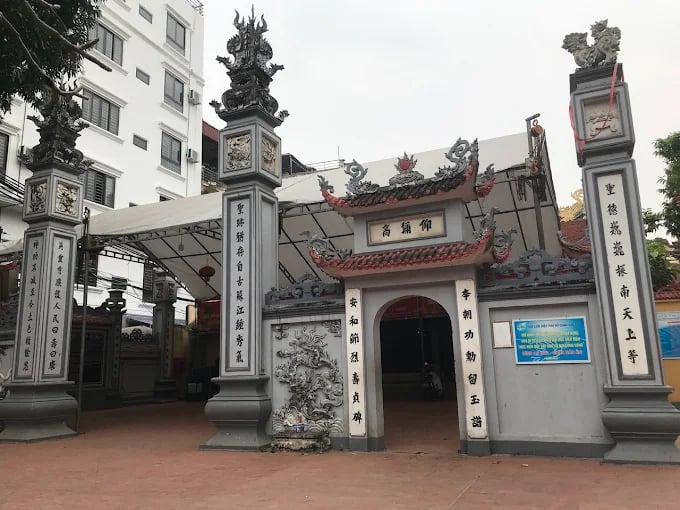
An Hoa Communal House It is located on a high, spacious and airy plot of land in An Hoa Village. This is an ancient relic with a total area of 1,861.4m2; in front is a clear blue pond covering 1,026m2; in the middle of the pond is the Thuy Dinh water pavilion, where villagers place a stele commemorating the martyrs, the children of An Hoa Village who bravely fought and sacrificed in the resistance wars to liberate the nation, reunify the country and defend the Fatherland; inside the communal house courtyard is the Stele House inscribed with the names of 10 Confucian scholars of An Hoa Village who passed the great examinations at the metropolitan examinations organized by the feudal state courts during the Le Dynasty; hidden under the shade of an ancient banyan tree is a pond bridge with 5 steps up and down, next to it is an ancient dug well built of stone mortars and stacked bricks, all blending together to create a beautiful image rich in meaning as a traditional folk cultural symbol: “Banyan tree, water landing, communal house courtyard.”
Before 2010, An Hoa Communal House was a fairly intact and ancient relic, built in the shape of the Chinese character “cong”, an architectural style strongly characteristic of the early Nguyen Dynasty, with the main worship hall consisting of 3 bays and 2 side wings, connected to the rear sanctuary by 3 tubular bays; the frame consists of 16 columns and 4 trusses made mainly of Dinh wood, structured in the “Gia chieng, ke chuyen” style; the rear sanctuary has 3 bays, built in the “Tuong hoi bit doc” style, with its floor about 50cm higher than the main worship hall; in the center of the main worship hall is a set of curved doors carved with the four characters “Thanh Cung Van Tue” along with exquisite patterns and motifs; in the two side bays are hung horizontal lacquered boards and pairs of ancient couplets; 04 sets of palanquins crafted by artisans from the early Nguyen Dynasty, about 200 years ago, are still preserved intact.
The tutelary deities worshipped at An Hoa Communal House were granted many royal edicts by the feudal state dynasties, including:
The deity Thuong Yen Quyet was granted 06 royal edicts; King Le Hien Tong (1740 - 1787) was granted 09 royal edicts; King Ly Than Tong (1128 - 1138) was granted 03 royal edicts.
Every year, on the 10th, 11th, 12th and 13th days of the second lunar month, the people of An Hoa Village joyfully organize the traditional festival at An Hoa Communal House. According to village custom, every three years the festival includes a palanquin procession ceremony. About 60 days before the festival takes place, villagers enthusiastically gather in the communal house courtyard to elect capable and virtuous people to the Organizing Committee. A prominent highlight of the festival is the solemn and respectful rituals praying for favorable rain and winds, a prosperous nation and peace for the people; the festival activities include traditional folk song performances by the art teams of An Hoa Village, contributing to preserving the national cultural identity and enhancing the traditional cultural values of the locality.



