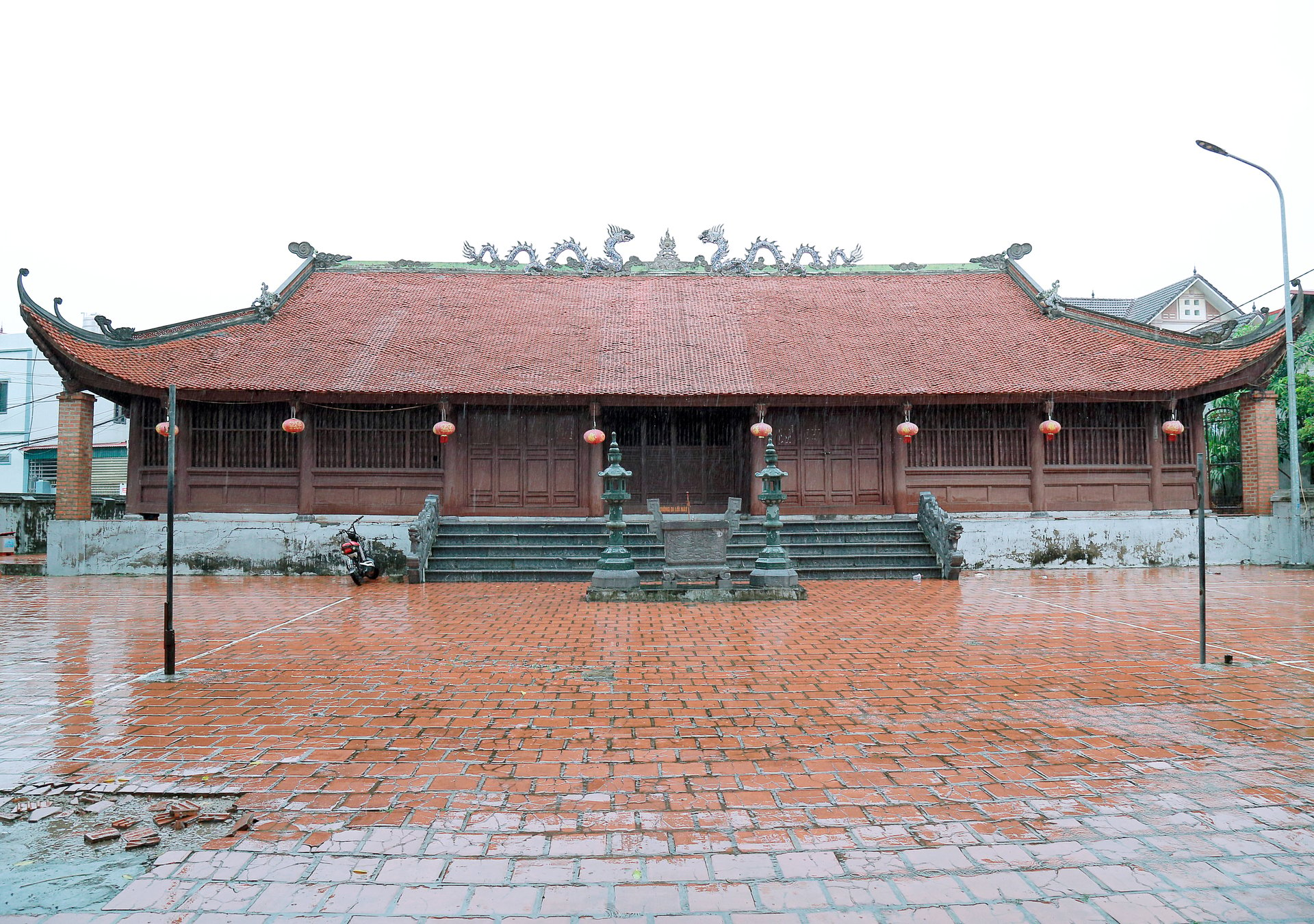
Huong Tram Pagoda (Vien Thanh Temple)
Story
01INTRODUCTION TO HUONG TRAM PAGODA
Bang Lam Village, Thu Lam Commune, Hanoi City
Huong Tram Pagoda, whose Sino-Vietnamese name is 'Vien Thanh Tu', currently belongs to Bang Lam Village, Thu Lam Commune, Hanoi City. This is a religious and belief site long associated with the cultural life of the local community. Before 1945, Huong Tram (Ram Tram) was a village of Bang Lam trang, later renamed Thu Lam. The name Thu Lam means 'forest of letters', reflecting the region's tradition of learning associated with Tham hoa Nguyen Khac Kiem. Thu Lam village formerly belonged to Phuong La canton, Yen Phong district, Tu Son prefecture, Bac Ninh province. In 1905, Thu Lam village was separated from Phuong La canton and, together with Thuy Loi and Dao Thuc, formed Thu Lam canton in Dong Ngan district, later Dong Anh district, Phuc Yen province. In 1946, Thu Lam and Thuy Loi villages were merged under the name Duc Hop commune; in 1949 Duc Hop commune incorporated Dao Thuc village to form Tien Bo commune, later renamed Thuy Lam commune. In 1961, Dong Anh district was incorporated into Hanoi City.
According to documents preserved in the relic file and folk legends, Huong Tram Pagoda is linked to the legend of Quy Minh. At that time, in Ai Chau dao, there were Mr. Cao Hoang and his wife, whose family name was Le. They practiced medicine and healed people, often doing good deeds and treating the poor, so they were respected by the people around. Though advanced in age and without a son, they discussed finding a place to pass on their medical craft, believing that doing good would meet good fortune. When they came to the Huong Tram area, Bang Lam trang, Tu Son prefecture, Kinh Bac dao, they saw this as a precious land with a curved terrain, where a pagoda and shrine gathered in one place.
The couple entered the pagoda and saw the three characters 'Vien Thanh Tu'. As it grew dark, they stayed overnight at the pagoda. At the fourth watch, Cao Hoang dreamed that a person in neat hat and robes came from the shrine, calling himself a son of Lac Long Quan and the mountain god of the local shrine, and saying that by Heaven's command he would be reincarnated as the couple's child. That same night, his wife also dreamed that a brightly shining star fell into her mouth and she swallowed it. Later she became pregnant and on the 12th day of the 11th month of the Nam Ngo year gave birth to a handsome, dignified son, whom they named Quy Minh.
Quy Minh grew up intelligent and studied well; by the age of 15 he was skilled in military texts and martial strategy. When he became an adult, Quy Minh took the examination under King Hung's edict to recruit the worthy and treat scholars well, demonstrated outstanding civil and martial talent, and was appointed Commander and General of the Right Route. When the Thuc army attacked, Quy Minh was assigned to lead troops against the enemy. On the way to battle, Quy Minh came to the Huong Tram area of Bang Lam trang and had his soldiers rest. According to legend, this place recalled traces of his parents' practice of medicine and was also associated with the auspicious sign before his birth. After victory, Quy Minh was granted a fief by King Hung at Bang Lam trang, Huong Tram. This legend has become part of the cultural and religious memory passed down through many generations in the locality.
Huong Tram Pagoda is a place of Mahayana Buddhist worship, a branch of Buddhism introduced into our country early in the Kinh Bac region. In the development of folk belief life, besides Buddhism there was also interaction with Confucianism, Taoism, and Mother Goddess worship. Therefore, Huong Tram Pagoda not only worships Buddha but also has a space for Mother Goddess worship, expressing the characteristic religious syncretism of the Vietnamese community.
According to the relic file, since ancient times the people of Huong Tram have had the idea of arranging worship spaces close together. The main pagoda was later destroyed, and the people moved the Buddha statues from the main pagoda to the building that had been the ancestral house, which was later repaired into the present pagoda. The pagoda space thus both meets religious needs and is closely tied to the traditional cultural activities of the village.
Huong Tram Pagoda has a construction area of about 50m², consisting of a five-bay building. The architecture is relatively simple, built in the style of upper rafters, front beams, and rear braces. To make the pagoda interior wider, the building uses two rows of main columns to support crossbeams instead of walls; the front and rear wall rows are set back to the veranda. The columns and rafters are all made of xoan wood, planed smooth and tightly jointed; the roof is covered with Vietnamese tiles. The pagoda walls are built of brick on three sides and plastered with lime; the front has a door system, and the side bays have walls and windows.
Each bay in the pagoda has a brick platform for arranging statues. The central bay has a three-tier platform. At the top is an Amitabha statue seated on a lotus throne, both hands placed on the thighs, palms holding a precious jewel—the Minh Chau pearl. The statue bears typical Buddha features such as large ears, long neck, a Buddhist character on the chest, a blue robe, and snail-shell hair; it is identified as twentieth-century art.
The second tier is a Jade Emperor statue about 0.80m high, seated, holding a record book in both hands. The statue is well proportioned, wears a binh thien crown, a great court robe, and shoes, and bears twentieth-century artistic style. The third tier is a statue of the infant Shakyamuni with a plump appearance, one hand pointing to heaven and one to earth, associated with the phrase 'above heaven and below earth, I alone am honored'; this statue also belongs to twentieth-century art. Outside is a glazed ceramic incense burner decorated with the theme of two dragons facing the moon.
In the right bay is a Holy Monk statue about 0.80m high, seated, wearing a pilu hat and a blue robe. The statue has balanced proportions, with soft wave-like folds on the robe; one hand is raised in a mudra, the other holds a cup of nectar. In the left bay is a Duc Ong statue about 1.80m high, seated, wearing armor and holding a sword to protect the Dharma; according to traditional belief, Duc Ong manages the pagoda's property. These statues are identified as twentieth-century art.
In the side bay there is a Mother Goddess statue about 0.60m high, seated with her feet resting freely on a wooden platform. The statue is well proportioned with soft lines and belongs to twentieth-century art. According to the file, the Mother Goddess legend is also linked to the name Lieu Hanh or Lady Lieu, a figure ranked among the 'Four Immortals' in folk belief. The file also cites the book 'Nam Hai di nhan', published in 1988, in the section on the legend of Lieu Hanh Tien Chua.
One of the particularly precious relics of Huong Tram Pagoda is the stone bell placed in front of the pagoda. The bell measures about 1.50m x 0.80m x 0.18m. In the middle of the bell is a hole for threading a hanging handle, also shaped like a crescent moon; on both sides are carved two dragons flanking it. Both faces of the bell are engraved with Chinese characters; one part records the names of benefactors and those who initiated the making of the bell, while another part praises the beautiful scenery of Huong Tram, expressing the wishes of the village community and the sacredness of the stone bell.
The inscription engraved on the bell mentions 'Vien Thanh Tu', in An Phong district, praising the pure scenery, the carving of jade and stone into a crescent-moon shape, the worship of the Three Jewels, cultivating virtue and accumulating merit, praying for blessings and prosperity, family harmony, having both sons and daughters, a joyful village, increasing people and livestock, a full life, and the development of literary pursuits. The inscription also records 'Popularly called Tram village – Commune name Bang Lam', a valuable textual trace for understanding the history of local names and the cultural space of the area.
On the side of the stone bell there is also a passage about erecting the bell, exalting morality, virtue, and the spirit of reverence for Buddhism. The content emphasizes the concept of 'heaven has one principle, the Way has one mind', taking the Way and the mind as the foundation; at the same time it links the making of the bell with recruiting the worthy, caring for the people, governing the country, and the duty of a subject. The stone bell is identified as an eighteenth-century artistic artifact.
The outstanding value of Huong Tram Pagoda also lies in the stone bell itself, which bears the characters 'Vien Thanh Tu'. According to the relic file, few stone bells survive at pagodas; the bell can both produce sound and has a beautiful form with artistic and historical value. Later, even when bells were made of bronze or other materials, the traditional form still inherited from the appearance of ancient stone bells.
Not only a place of religious practice, Huong Tram Pagoda is also a space for the community's spiritual and cultural life. Over many generations, people have come to the Buddhist gate to express reverence, meet and interact, and receive teachings guiding people toward goodness. This is also an environment that helps educate descendants to live usefully for society, cultivate neighborly affection, and preserve fine customs and traditions.
In the process of preservation, the relic is cared for by the local community; when damage occurs, they report it to the authorities and relevant organizations for repair plans, while mobilizing people to participate. The protection and use plan in the file also mentions landscaping, planting shade trees, building fences, and placing the stone bell in a suitable position to protect the rare relic.
Today, Huong Tram Pagoda – Vien Thanh Tu in Bang Lam Village, Thu Lam Commune, Hanoi City is a cultural and religious address containing many layers of value. From the folk story associated with the Bang Lam area, the system of worship statues bearing Buddhist and folk-belief imprints, to the precious stone bell dating to eighteenth-century art, each element helps reflect the spiritual life, history, and cultural traditions of the local community. Preserving and promoting the values of Huong Tram Pagoda not only helps conserve a long-standing religious site but also helps present and future generations better understand the history, culture, and identity of their homeland Thu Lam.