
Trường Lâm Communal House and Pagoda
Introduction
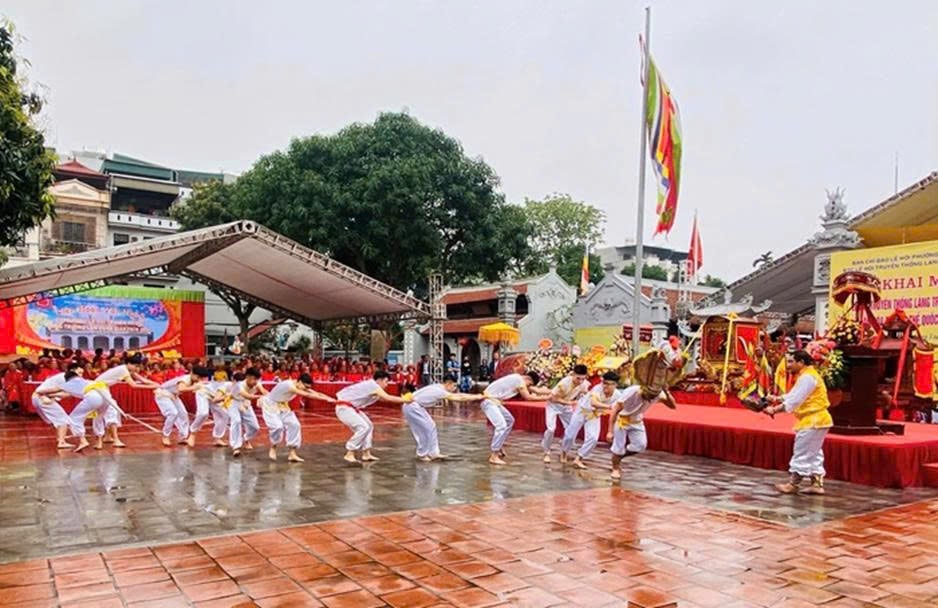
Trường Lâm Communal House worships three deities: the three village tutelary gods are Đức Thánh Linh Lang Đại Vương - a top-rank guardian spirit; Princess Đào Hoa (also called Thiên tiên Đào Anh phu nhân - a top-rank deity) and Princess Phù Nương - a middle-rank deity.
According to the legend, Linh Lang Đại Vương was named Hoàng Chân, the fourth son of King Lý Thánh Tông (1054–1072); his mother was Hạo Nương, the ninth concubine, a native of Đông Đoài - Bồng Lai Commune - Đan Phượng District - Sơn Tây Trấn.
In 1075, our country faced foreign invasion; Prince Hoàng Chân asked the king, together with Prince Chiêu Văn, to command the fleet across Vĩnh An estuary to attack and rout the enemy's posts along the border. He coordinated with the army of General Tôn Đản to capture strategic bases and the central food and logistical rear base of the Song enemy at Ung Châu Citadel. Our army won a great victory; the king held a grand banquet and wanted to abdicate to him, but Prince Hoàng Chân refused.
After the country had been peaceful for some time, in the Đinh Tỵ year (1077) the Song invaders again sent troops to invade and annex our country. Once again, Prince Hoàng Chân, together with Prince Chiêu Văn and Grand Commandant Lý Thường Kiệt, commanded the fleet from Vạn Xuân upstream along the Khao Túc River to launch a surprise attack on the enemy's eastern defense line on the bank of the Như Nguyệt River, making a great contribution to driving the Song invaders out of the Đại Việt border and opening an era of national independence. Considering Prince Hoàng Chân's merits, King Lý Nhân Tông granted him an honorific title and allowed 269 villages across the country to build shrines and temples to worship him and conferred on him the title Linh Lang Đại Vương Thượng Đẳng phúc thần.
Among the 269 places worshiping Linh Lang Đại Vương, only Trường Lâm Communal House has the snake-shedding dance. The dance both reenacts the legend of Linh Lang Đại Vương and expresses the people's desire for water drainage and flood control. The winding image of the snake symbolizes the flowing water up and down, and also the people's aspiration for a new year with favorable rain and wind, many smooth things, and good luck. The snake-shedding dance ritual and Trường Lâm village festival date back to about the 15th century. The unique dance: 'snake-shedding dance'. This dance involves 15 unmarried young men moving while clinging to each other and bending into snake shapes, undergoing three molts, expressing the legend of Linh Lang and the aspiration for water control and drainage. Every year, the festival also includes an incense-offering ceremony to commemorate the three tutelary gods (Linh Lang, Đào Hoa, Phù Nương).
The traditional festival of Trường Lâm Communal House is held in spring, usually opening on the 9th, 10th, and 11th days of the second lunar month; it was recognized as a National Intangible Cultural Heritage (Decision No. 266/QĐ‑BVHTTDL dated January 30, 2018).
Trường Lâm Pagoda: also known by its Sino-Vietnamese name Linh Quang Tự. Previously, Trường Lâm Pagoda belonged to Việt Hưng Commune, Gia Lâm District, Hà Nội. In the past, the pagoda was located in the ancient land of Lâm Ấp; in the Lê period it was Hoa Lâm sở, in the 19th century it was Trường Lam sở (also called Tràng Lâm at one time), and together with Lệ Mật, Kim Quan Thượng, and Ô Cách it was one of the four villages of Gia Thụy Canton, Gia Lâm District, Bắc Ninh Province.
Trường Lâm Pagoda has a long history of construction and is a place where local people perform Buddhist worship rituals. According to elderly villagers, the pagoda was built during the Lý dynasty. Over the years, the pagoda has moved locations several times. It was first in the Lâm Ấp area, then at Đồng Trại, and later moved to the central area of Trường Lam village - its current location. So was Trường Lâm Pagoda built during the Lý dynasty? This is indeed a question many people care about and want to understand thoroughly. Unfortunately, to date, no source material has been found proving that the pagoda was founded under the Lý dynasty. In field research, scientists found only one artifact with the earliest date: a statue of the infant Shakyamuni, created around the 17th century. This is a precious and most valuable artifact of the pagoda at present, through which (though not fully) it can be partly determined that the pagoda existed under the Lê dynasty. Based on the current architecture, the pagoda mainly shows the style of the Nguyễn period.
Trường Lâm Pagoda is fairly large in scale and architecture, facing south (the same direction as Trường Lâm Communal House). Since its construction, Trường Lâm Pagoda has undergone many restorations and repairs, so its architecture and landscape have not been preserved intact as when it was first built. The architectural works currently preserved include: the main worship area comprising the Tiền đường (front hall), Thượng điện (upper sanctuary), the Tổ and Mẫu worship house, the guest house, the courtyard, and the stupa and tomb area behind the pagoda.
Trường Lâm Pagoda currently preserves valuable artifacts such as: 19 round statues, among which the most notable is the statue of the infant Shakyamuni, depicting a boy standing on a lotus pedestal... In addition, the pagoda also keeps a bronze bell cast in 1879, a stone stele made in 1930, a porcelain vase dating from the 19th century, horizontal plaques, incense bowls...
The greatest honor was that on February 18, 1958 (the first day of the lunar new year), at the Trường Lâm communal house and pagoda area, all the people of Việt Hưng welcomed Uncle Hồ on his visit. He wished them a happy new year and advised the people to unite, take care of production, fight drought to save rice, ensure exceeding the plan, and contribute to building the homeland and country to become increasingly rich and beautiful.
The Trường Lâm communal house and pagoda complex was recognized as a National Monument in 1992. In addition, Trường Lâm Communal House is listed as a revolutionary historical relic (with revolutionary resistance significance). The Trường Lâm Festival was recognized as a National Intangible Cultural Heritage (in 2018). The communal house also has a commemorative plaque for the event of Uncle Hồ's visit (during the Tết Mậu Tuất in 1958).



