
Co Ngua Ha Communal House
5.0Free
5.0Free
Introduction
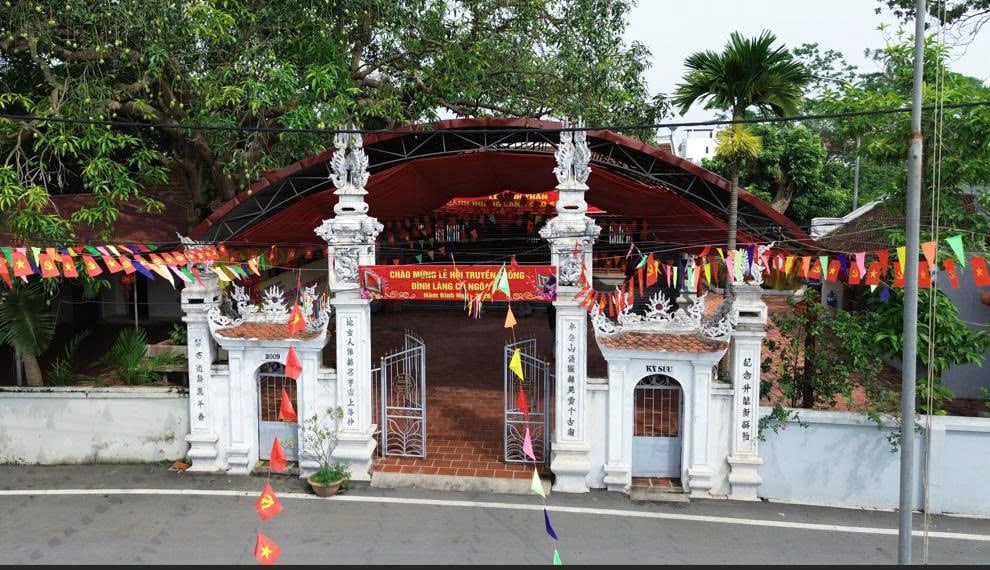
Co Ngua Ha Communal House is an architectural work dedicated to Cao Son Dai Vuong as the village tutelary god and also co-worships deities who rendered merits to the people and the country, such as Le Binh Quan Cong and Hue Minh Princess.
According to the book “Than tich Viet Nam”, Cao Son Dai Vuong is currently worshipped in many places. The origin of this deity has many variants. According to Assoc. Prof. Dr. Nguyen Ta Nhi of the Institute of Han-Nom Studies, in many localities Cao Son Dai Vuong is worshipped as the figure recorded in the jade genealogy “Tam vi dai vuong thuong dang than Tan Vien Son Thanh”; in some places Cao Son Dai Vuong is worshipped as Tran Thu Do, but at Co Ngua Ha, Cao Son Dai Vuong is worshipped as an important figure in the pantheon of the Vietnamese people in the past. At present, the relic still has an altar tablet inscribed “Duong canh Thanh hoang Cao Son Dai Vuong Thuong dang than”. Cao Son Dai Vuong is worshipped in many places in the residential areas of the ancient Vietnamese. As part of the mythological system concerning the earliest period of nation-building and national defense, the legend of Cao Son Dai Vuong is very rich and has increasingly been historicized, so in many rural areas of the country there have existed different versions of this legendary figure.
The earliest is perhaps the legend that Cao Son was the son of Lac Long Quan and Au Co and one of the 50 children who followed their father up into the mountains. Later, Cao Son became a close general of Son Tinh (that is, Saint Tan Vien) and once joined Son Tinh in resisting Thuy Tinh and the leader of the Au people when they attacked the Van Lang state. Because of his merits to the country, Cao Son was later worshipped as the second deity at the Tan Mountain temple. In the Le period, when the feudal state considered the granting of titles to tutelary gods an important matter, the legends of Cao Son already included his full name. This was the trend of historicizing legendary figures that occurred very commonly under the Le dynasty. Most legends hold that Cao Son was named Nguyen Hien and his younger brother was Nguyen Sung (that is, the deity Qui Minh), both sons of the paternal uncle of Son Tinh. They were from Thanh Uyen village, now Thanh Uyen commune, Tam Nong district, Vinh Phu province. When Thuy Tinh brought troops to attack Son Tinh and the Au people besieged the Van Lang state of Hung Vuong, Cao Son rendered great merit together with Son Tinh in defeating the water invaders and the Au troops and protecting the Hung dynasty.
At the beginning of the Le Trung Hung period, Cao Son Dai Vuong was especially elevated by the feudal state. The reason for this was that the deity had rendered merit in assisting King Le to regain the throne and suppress the arbitrariness of maternal relatives. The above historical event was recorded by Le Tung, an official with the title Quang Tien Than Loc Dai Phu, Thieu Bao, Minister of Rites, Dong Cac Grand Academician, concurrently Rector of the Imperial College in charge of lectures, in the Canh Ngo year, the 3rd Hong Thuan year (1510).
Based on the legend of Cao Son Thanh copied by Ho Phien ward of Kim Lien on the 17th day of the 12th month of the 7th Canh Hung year (1746), the tutelary god Cao Son Dai Vuong can be summarized as follows:
On March 16, in Bao Son, Quang Nam district, Da Minh country, a couple surnamed Cao gave birth to a son named Hien, courtesy name Cuu Truong. At birth, his appearance was handsome and perceptive; he was naturally intelligent and had extraordinary spirit and intellect. As a child he was well versed in the classics, poetry, and books, especially in discussing the Five Classics.
At the age of 27, he took the Tuong examination and passed. In the 6th year of the Ming reign, he took the palace examination and twice passed as a doctoral laureate; he was appointed to the position of Grand Chancellor and sent to suppress rebellions.
After returning in complete victory, the Ming king again conferred on him the title of acting Marshal. Because of such merits, at the age of 78, the king allowed him to return to his native place. Cao Son Dai Vuong then went traveling and passed through this Co Ngua Ha land. Seeing that this was a land of beautiful scenery and rich farming, he stopped here and taught the people to cultivate, then continued traveling to places with remarkable mountains and waters.
Legend has it that he lived to be 103 years old. After his death, the king, remembering his merits, conferred on him the title Cao Son Quoc Chua Dai Vuong and granted him the posthumous name Trung Trinh; thereafter he issued an edict for places he had passed through to establish temples for worship and to proclaim his merits forever after.
With such divine power, after moving the capital, King Ly Thai To chose him as one of the Four Guardians of Thang Long at Kim Lien Communal House (Hanoi).
In addition to worshipping Cao Son Dai Vuong, Co Ngoa Ha Communal House also co-worships Quan Cong Le Binh, who helped the local people build a dike to block water from Thuong Mo to Doai Khe during the Hong Duc period (1470–1497), and Hue Minh Princess.
Co Ngoa Ha Communal House worships Cao Son Dai Vuong. Therefore, the festival is also related to the birth and death days of these deities. The festival is held on March 16, the main festival day, which is the birthday of the tutelary god. The festival is held every 3 to 5 years.
According to village custom, since ancient times a number of regulations were set here: for men, the age of 48 was the age of entering the communal house, and at 49 they became “ong cai dam” responsible for raising a pig for offering at the village festival, called raising a votive pig (the pigsty had to be high and clean; the pig had to be bathed; vegetables washed; cooking water had to be from the village communal house well; vegetables clean and bran fragrant and tasty; each meal for the pig had to be cooked fresh, not left spoiled). If by the day of the pig procession the pig had died or was missing, the village fined them and they had to surrender fields to the village. For poor families unable to raise a pig for offering, the village generously stipulated 10 kg of glutinous rice for steaming and one live capon, with full offerings of betel and areca, incense and lamps, and the family had to carry them to the communal house themselves for the village to hold the sacrifice ceremony.
During the festival days, welcome gates and village-lane gates are firmly erected; lanterns, square lanterns, star lanterns, and rotating lanterns are placed along both sides of the village's main road. The village also organizes folk games such as human chess (co nguoi), cheo singing, ca tru singing, and a number of other joyful activities.
The offering to the saint includes a pig of 50 kg or more, with hair scraped and belly cut open but kept whole; only the pig's innards are cooked, and 20 kg of yellow-flower glutinous rice is steamed and spread on two offering trays.
Those who wish to hold a village title, those who have passed exams and hold social positions, and those celebrating longevity or offering thanks to elders all present offerings; the offerings may be glutinous rice with pork or glutinous rice with chicken... to be offered to the saint (this offering can be made on the 1st, the full moon, October 10, or Tet).
The main festival day is March 16. This is also the birthday of the tutelary god. Before the festival, village dignitaries meet to organize the cai dam. This work must be prepared one year in advance.



