
Dinh Quan Communal House
5.0Free
5.0Free
Introduction
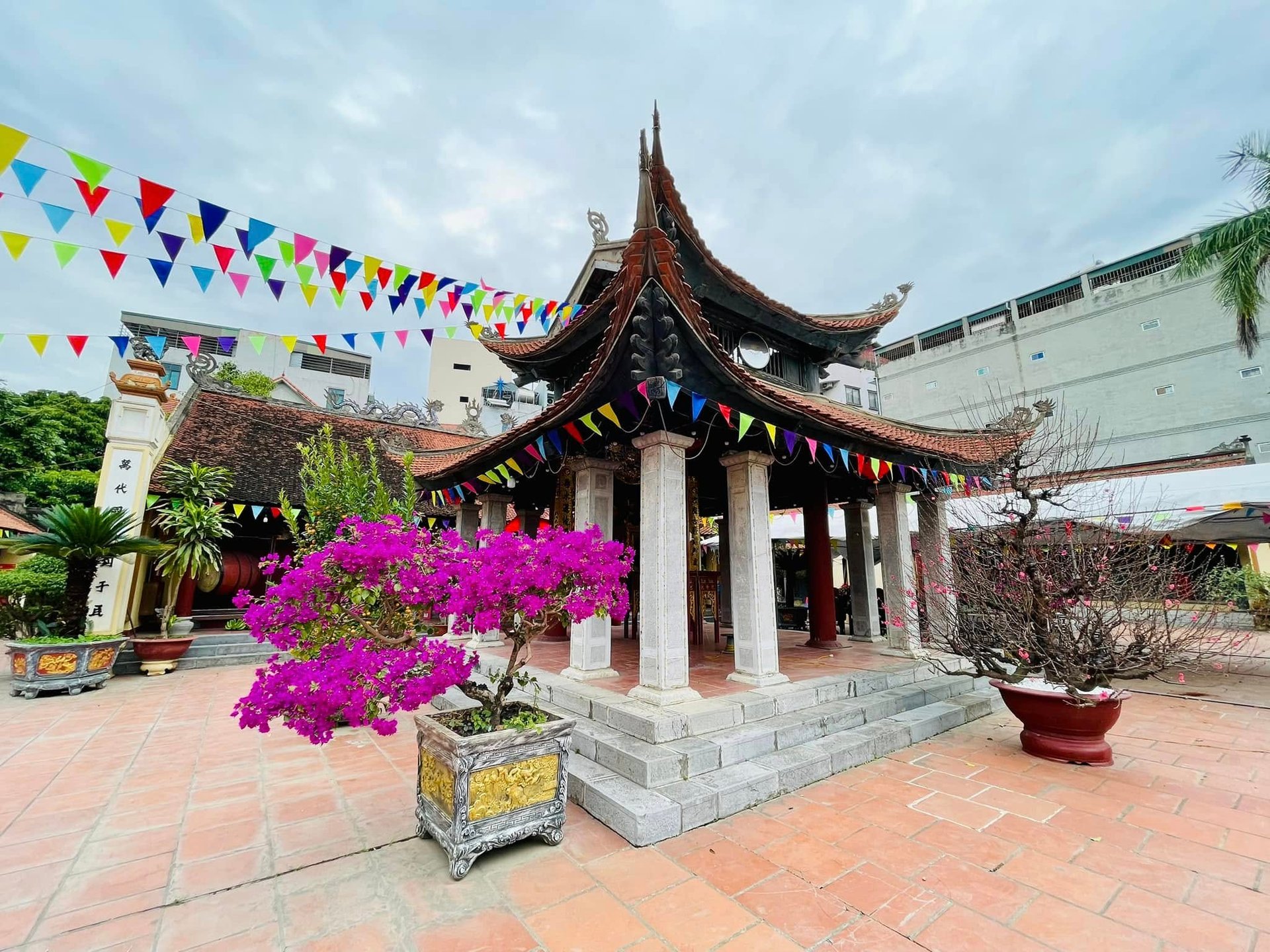
Located in Residential Group No. 3, Dinh Quan, Phu Dien Ward, Hanoi City (about 12 km west of the capital's center), Dinh Quan Communal House is an ancient relic with distinctive historical, architectural, and artistic value. It is not only a spiritual activity space for the community of the former Dinh Quan village but also preserves many precious cultural heritages of the land along the Nhue River.
Dinh Quan is an ancient land with a Nom folk name, Ke Dien – a colloquial name dating from before the Northern Domination period. The name 'Dinh Quan' appeared around the Le Trung Hung period (early 18th century). According to local legend, when Royal Prince Trac Quan Cong contributed to building the communal house for the village, because the population was sparse and still poor, it was initially called Dinh Quan, later mispronounced as Dinh Quán and became the village name to this day.
The communal house was founded by Royal Prince Trac Quan Cong in the early 18th century under the Le Trung Hung period. Over nearly 300 years of existence with several restorations under the Nguyen dynasty (notably the repair of the Main Hall in 1889 and the restoration of the Inner Sanctuary in 1925), the communal house has maintained its imposing architectural scale and enduring vitality through historical periods.
Dinh Quan Communal House has a unique feature in spiritual life, as it worships two important historical and mythological figures:
· Village tutelary deity Bach Hac Tam Giang (Tho Linh Dao Truong): A general under the 18th Hung King who was credited with commanding the navy to defeat invaders, keeping the borders of the country of Van Lang secure, and was conferred the title Tho Linh Thong Quoc Dai Vuong. He is a symbol of the nation's resistance against foreign invasion and its Dragon-Fairy origin.
· The Rear Deity - Royal Prince Thai Bao Trac Quan Cong (Than Y): A son of King Le, a native of Dinh Quan, who during his lifetime showed much benevolence and made contributions to the villagers and the communal house. His deeds and worship regulations were composed by King Le Hien Tong himself in an inscription carved on the stone stele 'Hau Than Bi Ky' erected in the 17th year of Canh Hung (1756).
Dinh Quan Communal House stands on high, spacious ground, facing south, with a large brick-edged pond in front, creating a harmonious water-and-landscape setting.
· Main layout includes: the Main Hall and the Inner Sanctuary.
o Main Hall: Comprises 5 bays built of brick with closed gable walls and ngai-style arms, roofed with local tiles whose projecting ridges ripple like waves. The roof ridge is decorated with two large dragons facing a fiery sun. The wooden frame consists of 6 sturdy trusses supported by a system of large main columns and subsidiary columns. The panels of the two central trusses are exquisitely carved with motifs of dragons and clouds, dragons and leaves, and the Four Sacred Creatures (dragon, unicorn, turtle, phoenix).
o Inner Sanctuary: Comprises 3 bays running lengthwise and connected to the Main Hall, where the incense table, dragon throne, and deity memorial tablets are placed. The dragons and trusses in the Inner Sanctuary are carved with sacred animals (tiger emblems, phoenixes) and vivid cloud-and-leaf patterns.
· Auxiliary works: In addition to the main architecture, the communal house also has a 4-bay Left Auxiliary Hall, together with a system of courtyards, gardens, and a communal pond, forming a typical village communal house architectural complex of the Northern Delta.
Through many changes, Dinh Quan Communal House still preserves an extremely rich and diverse collection of artifacts:
· Ancient stone steles: Includes 3 stone steles, most notably the stele 'Hau Than Bi Ky' erected in the 17th year of Canh Hung (1756), with the stele text composed by King Le Hien Tong himself.
· Rich ritual objects: A set of thrones and memorial tablets, wooden Phong statues, worship palanquins, a pierced-carved hanging valance with dragons facing the sun, 19th-century white-glazed blue-and-white ceramic jars, bronze gongs, along with a set of Eight Treasures and a splendid lacquered and gilded ablution vessel.
Not only is it a valuable historical and architectural-artistic relic, Dinh Quan Communal House is also a center for cultural activities and traditional education in the spirit of 'When drinking water, remember its source' for the local community. During the resistance wars against the French and the Americans, the communal house served as a headquarters for spreading the national script and organizing Popular Education classes to eradicate illiteracy, as called for by President Ho Chi Minh.
Every year, the Dinh Quan Communal House festival is solemnly held with traditional rituals, palanquin processions, and many folk games such as chess, cockfighting, and communal-house singing, attracting a large number of local people and visitors from far and wide.



