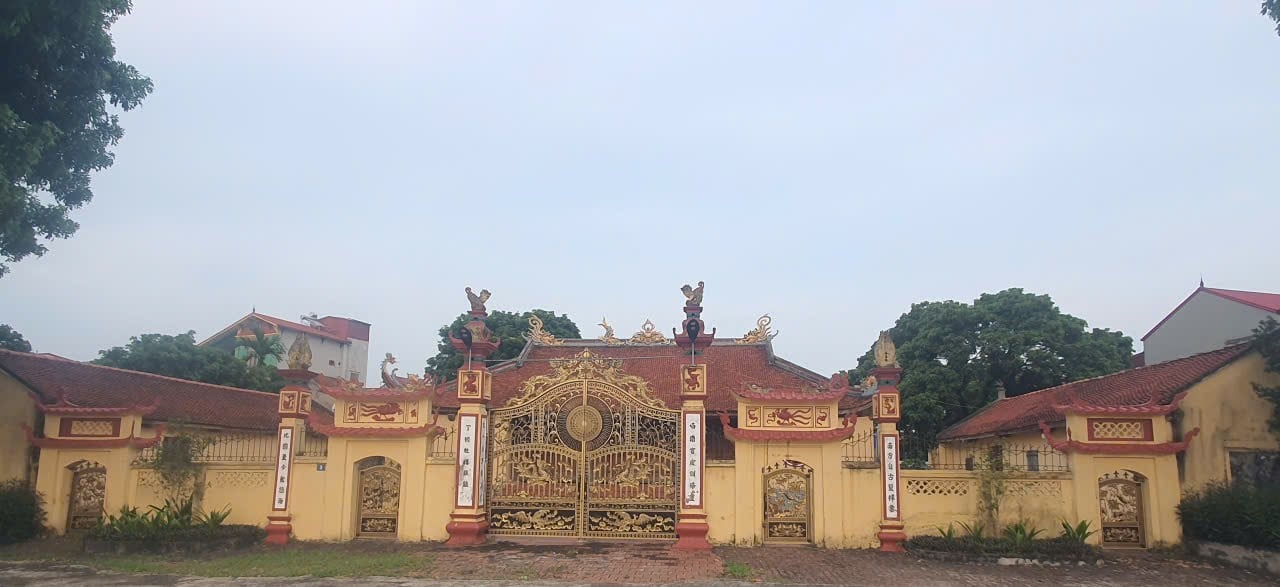
Duc Thu Communal House, Duc Thu Village, Hong Son Commune, Hanoi City
Introduction
Duc Thu Communal House belongs to Duc Thu Village, Hong Son Commune, Hanoi City.
Duc Thu Communal House was The People's Committee of Ha Tay Province (now Hanoi City) issued Decision No. 174 QĐ/UB dated February 5, 2002, to protect the historical and cultural relic.
The communal house stands on a beautiful elevated plot at the entrance to the village, facing northwest. In front of the communal house is the entire traditional cultural space of the Vietnamese countryside with “Banyan tree, water wharf, communal house courtyard”. The banyan tree is a tree that gathers vital spirits. The well and pond are points of “water gathering” and “blessing gathering” for the whole village. Thus, the architecture on high ground carries the yang element and combines with the low pond carrying the yin element to form a balanced yin-yang entity, harmonizing the energy of Heaven and Earth for all creatures to develop. This is the land where deities reside, bringing a good life to the villagers. The communal house includes the Nghi Mon gate, Dai Bai main hall, Hau Cung rear sanctuary, and Ta Huu Mac left and right side buildings. The communal house still preserves a number of precious relics such as the deity genealogy, royal edicts, thrones, and worship statues... The communal house worships the Two Great Generals, Dang Hieu and Dang Cong, extraordinary talented generals under King Dinh Tien Hoang who helped the country quell the rebellion of the 12 warlords, contributing to the cause of national unification.
The communal house includes the following items:
Ceremonial gate: It is built in the pillar-style gate form with three passageways. On both sides of the main passage are two large pillar structures, with two nghe mythical creatures on top, below is a system of mui luyen, followed by lantern panels in relief of the four sacred creatures; the pillar bodies bear carved couplets in Chinese characters. At the base of the pillars is a base shaped like a găng fruit. On both sides, connecting the large and small pillar structures, are two covered gates. On top of the small pillar structures are reliefs of four phoenixes. From the two small pillar structures outward on both sides are two low walls continuing to two small auxiliary gates.
Ta Mac and Huu Mac houses: They were built on a single-line plan, with closed gable walls, roof-supporting structures of miscellaneous wood, and roofs covered with mui tiles.
Main communal house: It is designed in the Dinh shape, including Dai Bai and Hau Cung. Dai Bai consists of 3 bays, 2 lean-tos, and 2 wings, with curved wing edges. On the roof ridge is a ho phu motif; on both sides of the ridge are ridge ornaments. The structure is wooden. The doors are of the folding panel type. Hau Cung is connected to Dai Bai by 3 wooden structural bays. The entire communal house is paved with bat tiles. The roof is covered with mui hai tiles.
Duc Thu Communal House has the structural layout of an ancient relic and is located on a beautiful plot in the village. The combination of architecture and natural landscape further enhances the value of the relic. The rich decorative motifs such as dragons, phoenixes, unicorns, and lions... and patterns such as clouds and water waves... all carry profound philosophical and spiritual meanings. The communal house is a place for the spiritual and cultural activities of the Duc Thu Village community. Through ritual ceremonies and cultural and religious activities at the relic, it is an occasion to strengthen village community bonds, preserve and inherit the village's traditional cultural identity, and contribute to enriching Vietnam's cultural heritage treasure.
About the festival: The Duc Thu Village festival dates back to ancient times; the village elders do not remember exactly which year, knowing only that when they were children they participated in the festival. During the war period, the festival was interrupted, with only the ritual part and no festive part; in 1995 the festival was restored. The festival is held over three days on the 11th, 12th, and 13th of the first lunar month, and the main celebration is held once every three years; annually, on the 12th of the first lunar month, only the ritual ceremony is held.