
Ha Duc Communal House, Ha Duc Village, Hoa Phu Commune, Hanoi City
Good to know
- You should arrive early for an open and airy experience
- Free
- Convenient access by taxi or bus.
Introduction
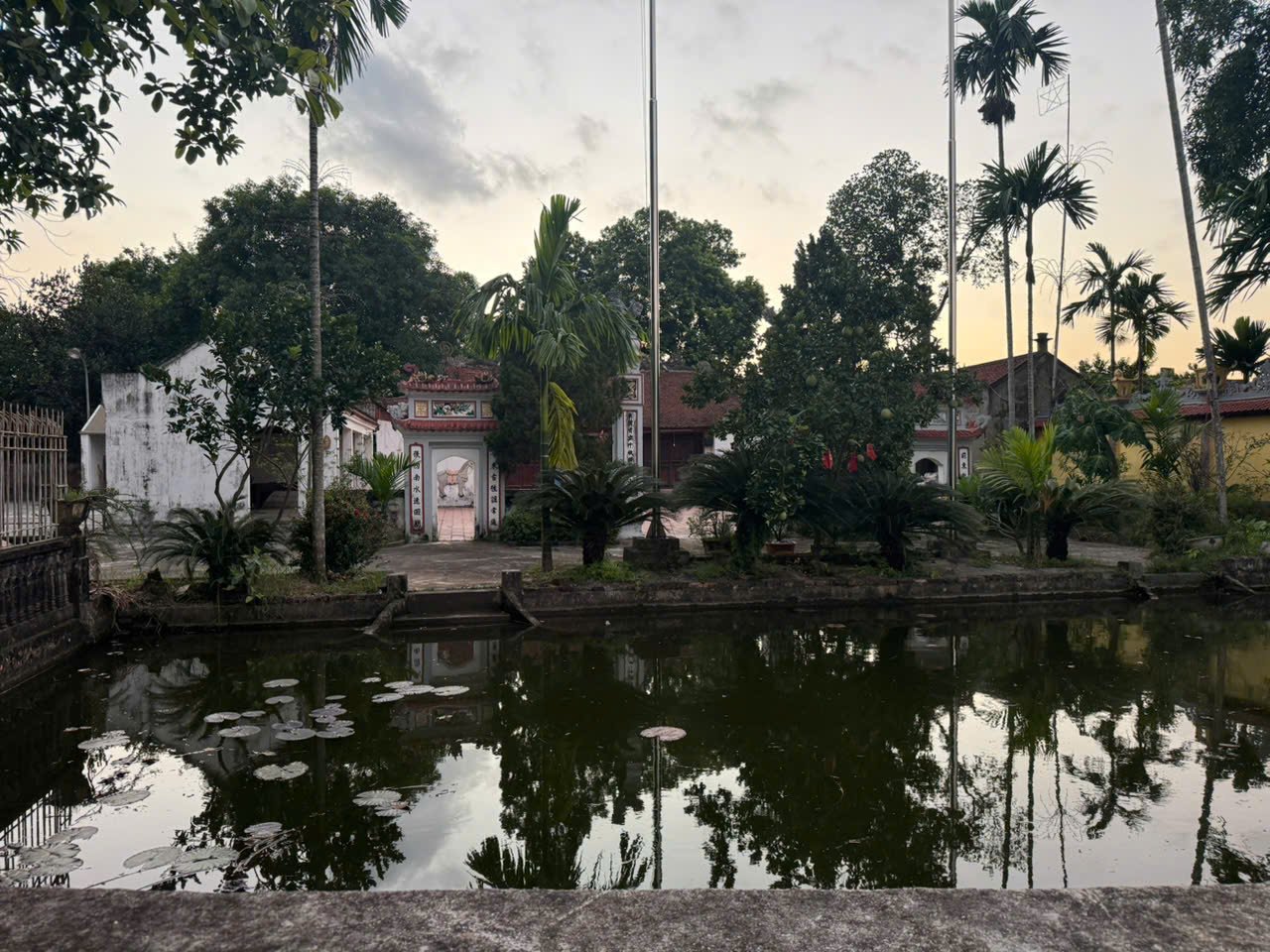
Ha Duc Communal House is located on a high, dry plot in the middle of the village; in front is Provincial Road 80, and behind is the Bui River.
The communal house includes a ceremonial gate system, the main worship hall, and left and right side halls.
In front of the communal house is the ceremonial gate system; on both sides are the cannon gates, and in the middle are two large bronze pillars.
From the ceremonial gate, across a wide courtyard, one reaches the main communal house, built in the Dinh-shaped plan and consisting of the main worship hall and the rear sanctuary.
The main worship hall has five bays and two side bays, six rows of column bases, and four curved roof eaves. On the roof ridge are two dragons flanking the moon; on the roof ridges are two pairs of kneeling nghe creatures, and the ends of the roof eaves are decorated with upward-facing phoenix heads. Entering the main worship hall through the threshold of the folding panel doors and looking upward, one sees a traditional wooden frame structure; the two central-bay trusses are made in the style of upper con with stacked ruong, lower ruong with nach and ke bay, and at the top are two ruong placed closely on top of each other.
In the central bay of the main worship hall is displayed a set of long swords and eight treasures; at both ends of the sword stand are two wooden boards, each inscribed with two characters, 'tich tuc, hoi ti'; next is an altar 170 cm long, 140 cm high, and 88 cm wide, carved quite elaborately with a tiger emblem, floral scrolls, the four seasons, and the four sacred creatures 'dragon, unicorn, turtle, phoenix'. This altar has an early 20th-century style, and on it is placed an 18th-century Tho Ha incense bowl bearing the image of two dragons flanking the moon.
The rear sanctuary of the communal house is built with closed gable walls (bit doc); inside it has been vaulted and displays two dragon thrones and ancestral tablets in early 20th-century carving style.
More Other places
- Other placesVerified
Gioi Duc Pagoda (Hong An Temple)
Ung Hoa Commune
5.0Free  Other placesVerified
Hai Giac Pagoda
O Dien Commune
5.0Free Other placesVerified
Phuong Bang Pagoda (Hung Long)
Son Dong Commune
5.0Free Other placesVerified
Sung An Pagoda, also known as Sung Khang Pagoda (Dong Ba Pagoda)
Thượng Cát Ward
5.0Free
