
Hòa Mỹ Communal House
5.0Free
5.0Free
Introduction
HÒA MỸ VILLAGE COMMUNAL HOUSE
HÒA MỸ VILLAGE COMMUNAL HOUSE
Located within the space of the ancient Hòa Mỹ village, Phượng Dực Commune, Hà Nội City, Hòa Mỹ Village Communal House is a place where layers of historical, cultural, and religious sediment preserved by many generations of local people converge. Before the new Phượng Dực Commune was established, Hòa Mỹ belonged to Hồng Minh Commune, Phú Xuyên District. After the process of rearranging administrative units and reorganizing villages in 2026, the residential areas Cầu, Đình, Giữa, Đông, and Bóng again converged under the traditional name Hòa Mỹ – a village name long associated with the memories and affections of local people.
In that cultural space, the village communal house holds a special position. It was not only a place of worship but also, since ancient times, a place where the community entrusted its faith, organized festivals, met, discussed common affairs, and passed on stories of origins to descendants. The previous development planning for the Phú Xuyên area also identified Hòa Mỹ Communal House and the ancient Hòa Mỹ village as cultural values capable of being linked with cultural, rural, and ecological tourism development.
One of the most important layers of belief in Hòa Mỹ is the custom of worshipping Quý Minh Đại Vương Thượng Đẳng Thần. At Đình Hạ of Hòa Mỹ village, the official source of the Hà Nội Department of Culture and Sports confirms that Quý Minh Đại Vương is the deity worshipped.
According to folk legends in the Sơn Nam region and Đoài region, Quý Minh Đại Vương is a deity associated with the reign of the 18th Hùng King and related to the Tản Viên Sơn Thánh belief system. Legend says that he and his generals had merit in fighting the Thục invaders, protecting the borders, and guarding the lowlands of Sơn Nam. After his transformation, he was conferred titles by many dynasties and worshipped by the people in communal houses and temples in many places. These contents belong to hagiographies and folk legends, reflecting how the community over many generations interpreted and remembered the patron deity of their homeland.
Set within the natural conditions of the former Phú Xuyên region – a low-lying delta area where people's lives were closely tied to fields, rivers, irrigation, and water control – the image of a deity sheltering the land and protecting the villagers carries even deeper meaning. The worship of Quý Minh Đại Vương therefore not only expresses gratitude to those with merit according to traditional beliefs but also conveys the aspiration for favorable rain and wind, good crops, peaceful villages, and a sustainable community.
Đình Hạ Hòa Mỹ currently has items such as the communal house pond, ceremonial gate, great hall, rear sanctuary, left and right side halls, and auxiliary works. The communal house is located on elevated land, creating a solemn space close to the traditional rural landscape. In 2024, the Hà Nội City People's Committee officially ranked Đình Hạ as a City-level Historical – Artistic Relic.
But the value of the communal house is not measured only by the age of its architecture or its ranking level. More importantly, the communal house still lives in community life. On holidays, festival days, and during incense-offering and tutelary god remembrance rituals, people turn together toward a common origin, recall the merits of their ancestors, and strengthen bonds among families and clans.
For this reason, the village communal house can be seen as the “common spiritual home” of the people of Hòa Mỹ. People born and raised in Cầu, Đình, Giữa, Đông, or Bóng, although their residential areas have different names, all share a cultural space, customs, and memories of Hòa Mỹ. The unification of the five residential areas back into Hòa Mỹ Village in 2026 further highlights the significance of the traditional village name and shared cultural institutions in strengthening neighborly ties.
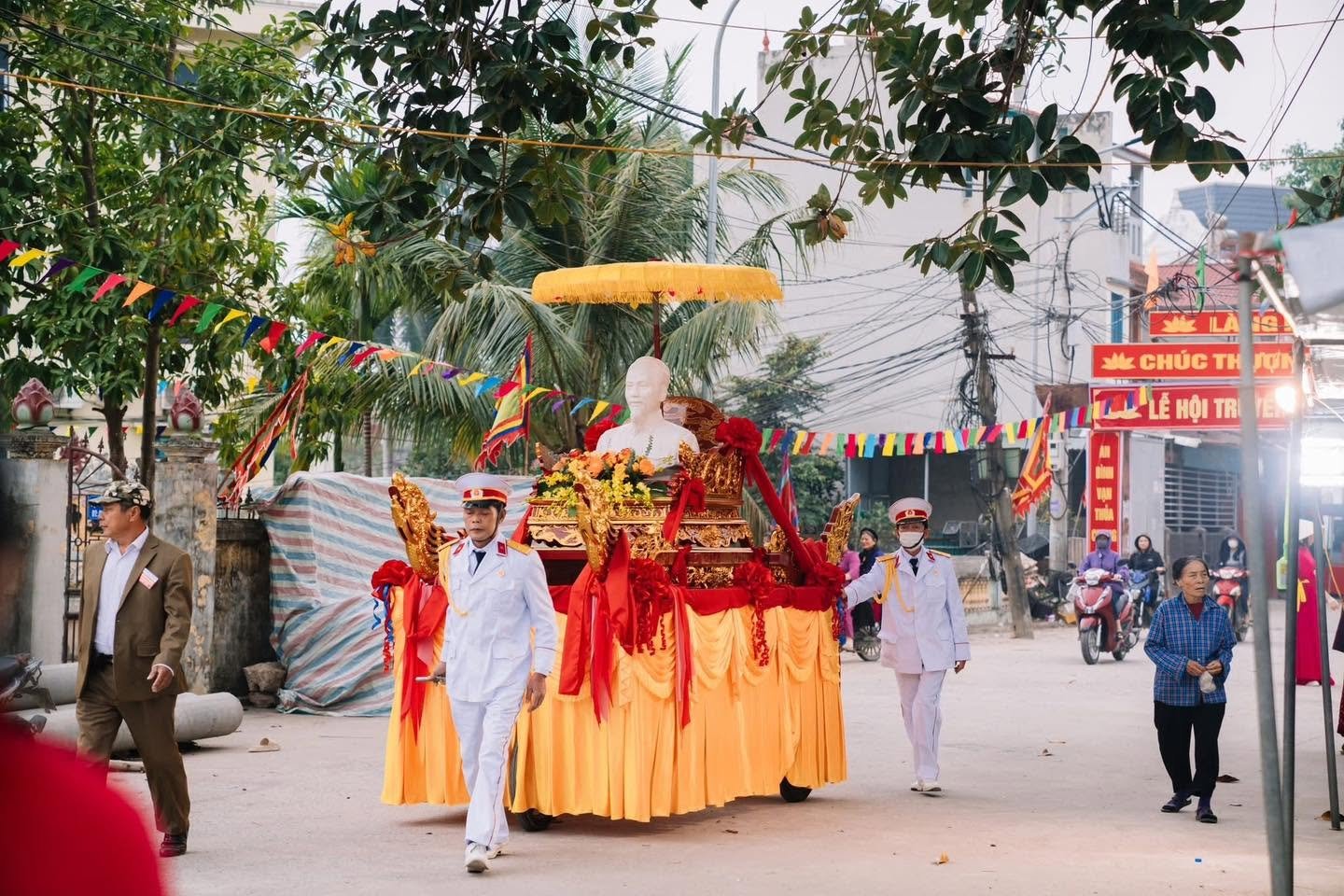
The traditional Hòa Mỹ Festival is an important part of the people's religious life. In 2024, the ceremony to receive the ranking certificate for Đình Hạ was held in association with the Traditional Festival of Hòa Mỹ Village, showing that the tutelary god belief is still maintained and continued by the community in contemporary life.
Through worship rituals, incense offerings, ceremonial processions, and community activities, the festival is both an occasion to honor the guardian deity and an opportunity for descendants far from home to return, for elders to pass on the village's stories to younger generations, and for the community to join hands in preserving good customs. The value of the festival therefore lies not only in rituals but in the transmission of memory across generations.
The history of a communal house is ultimately the history of the people who built, protected, and preserved it.
Through many changes in administrative boundaries, village organization, and the strong transformations of modern life, the people of Hòa Mỹ have still maintained the village name, festivals, belief facilities, and community relationships. Documents of the commune People's Committee identify Hòa Mỹ as an area with a system of relics, belief institutions, and traditional cultural activities, creating a favorable foundation for continuing to preserve village identity and build grassroots cultural life.
From that perspective, the village communal house reflects quite clearly the qualities of Hòa Mỹ people: valuing affection and loyalty, attachment to homeland, reverence for ancestors, respect for solidarity, and awareness of preserving what previous generations left behind.
Today, as Phượng Dực commune is gradually taking on a new appearance, Hòa Mỹ Communal House together with the system of pagodas, communal houses, and cultural spaces in the village has the conditions to become a site for introducing local history, educating young generations in tradition, and connecting with other heritage sites in the area.
Visiting Hòa Mỹ village communal house, visitors do not only learn about an architectural work or a Tutelary God. Through the communal house roof, festivals, and stories still preserved by the people, one can feel more clearly the relationship between people and homeland, between present and past, and between each family and the village community.
That is precisely the enduring value of Hòa Mỹ village communal house: a place to remember origins, for the community to meet, and for the good values of Hòa Mỹ people to continue being passed from generation to generation in the journey of building Phượng Dực into an increasingly civilized and prosperous place while still preserving the identity of the traditional countryside.



