
Kieu Mai Communal House
Good to know
- You should arrive early for an open and airy experience
- Free
- Convenient access by taxi or bus.
Introduction
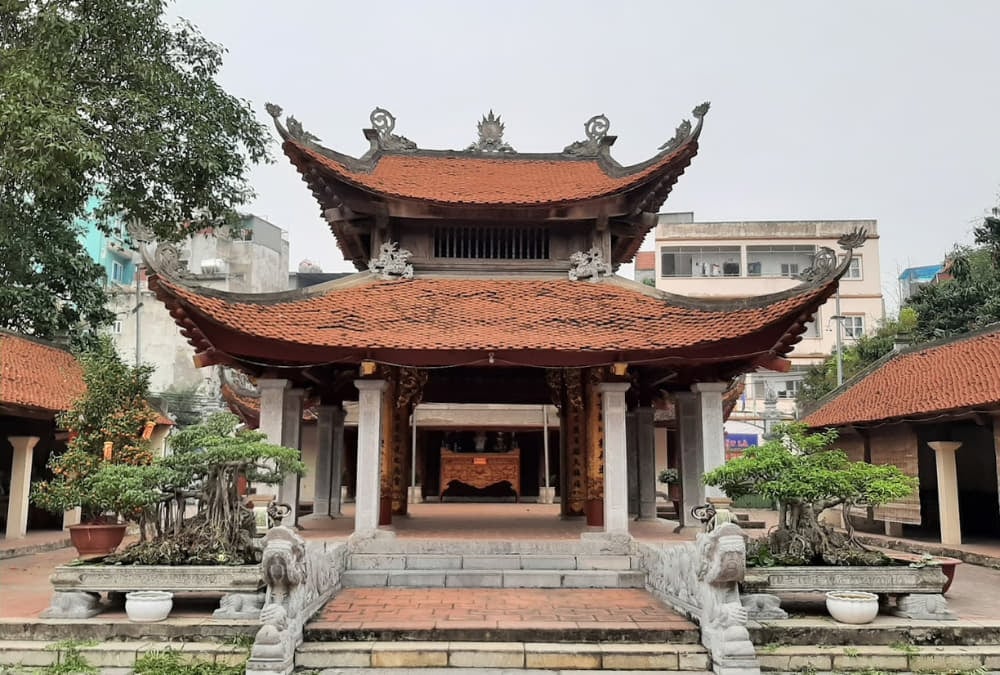
Kieu Mai Communal House is the ancient communal house of Kieu Mai village, a long-established community in the western area of Hanoi. According to previous administrative boundaries, the relic belonged to Kieu Mai hamlet, Phu Dien commune, Tu Liem district; after several administrative changes, this area now belongs to Xuan Phuong ward, Hanoi city.
The communal house was built on an elevated plot of land and faces southeast. In front are an ancient well, the communal yard, and a water area, creating an open space before entering the worship area. From the outside in, the overall relic includes the yard, the square pavilion, two side halls, the main hall, and the rear shrine. This arrangement both creates architectural depth and clearly separates communal activity space from the place where the tutelary god is worshipped.
On both sides of the yard are side halls, each with five compartments. In the middle is a two-story, eight-roofed square pavilion, forming a transition point before entering the central building.
The most prominent structure is the main hall. It consists of five compartments, built on a wooden frame with six rows of columns. The roof trusses are organized in the styles of chong ruong, gia chieng, and bay hien – familiar structural forms of traditional Northern Vietnamese architecture. A rather rare feature is that the gable end is arranged longitudinally and faces forward, giving Kieu Mai Communal House a distinctive appearance among Hanoi’s ancient communal houses.
Artistic value is concentrated mainly in the corbels, beam ends, altar curtains, and roof system. These feature familiar motifs such as dragons, mythical lions, long ma, the four sacred creatures, the four precious plants, clouds, and waves. Some carved panels still bear the artistic imprint of the 17th century. Many structural components, altar curtains, and worship objects are lacquered and gilded, creating a solemn space that is still rich in decoration.
The rear shrine lies deep inside and is where the altar cabinet, throne, and memorial tablet of the tutelary god Bach Hac Tam Giang – Dao Truong are placed.
Besides its architecture, Kieu Mai Communal House preserves many valuable artifacts. Notable among them are a genealogy of the deity bearing the Hong Phuc first-year era name, 1572; a system of imperial edicts, including the fifth Quang Trung edict of 1792 and the ninth Canh Thinh edict of 1801; along with many stone steles, ceremonial objects, palanquins, thrones, memorial tablets, bronze cranes, bronze censers, and ritual vessels.
A stele bearing the Canh Tri first-year era name, 1663, records the repair of the communal house and is an important basis showing that the structure has existed at least since the mid-17th century.
On July 20, 1994, Kieu Mai Communal House was ranked as a national-level architectural and artistic relic by the Ministry of Culture and Information. More than an ancient structure, the communal house is also a place preserving many layers of memory concerning the beliefs, art, and community life of Kieu Mai village over many centuries.
One of the most special values associated with Kieu Mai Communal House is the ket cha custom between Phu My and Kieu Mai villages. This is not merely an exchange relationship between two neighboring communities; it has become a custom maintained across many generations.
According to surviving records, on the 10th day of the fourth lunar month in the sixth Canh Hung year, i.e., 1745, dignitaries of the two villages jointly established a written covenant, officially confirming the ket cha relationship. Since then, the two communities have regarded each other as brothers, attended ceremonies together, supported each other in daily life, and especially participated in each other’s festivals.
The most notable feature of the ket cha custom is the ritual of carrying the tutelary god in procession to visit the partner village.
On the 7th day of the first lunar month, the people of Kieu Mai organize a procession of the deity to Phu My. At Kieu Mai’s festival, the Phu My community in turn organizes a ceremonial delegation to Kieu Mai Communal House to offer incense and commemorate Bach Hac Tam Giang.
During major festivals, the procession is organized solemnly with palanquins, festival flags, drums, ceremonial objects, a ritual team, elders, and a large number of local people. When the partner village’s delegation arrives, the host community receives it according to ritual, showing respect and an equal relationship between the two sides.
It is noteworthy that the people of the two villages do not merely attend each other’s festivals. They also join in rituals, commemorate the tutelary god together, and regard preserving the festival as a shared responsibility. For this reason, the ket cha custom has gone beyond the framework of a single ritual to become a way of maintaining community relations.
The festival also includes many folk activities such as Chinese chess, cockfighting, duck catching, pot smashing, communal games, and traditional forms of performance.
Through many changes, the Phu My – Kieu Mai relationship has been maintained. Major festivals are held periodically, while the annual customary festival continues with an appropriate scale.
On May 27, 2021, the Phu My – Kieu Mai ket cha ceremony was included in the National List of Intangible Cultural Heritage by the Ministry of Culture, Sports and Tourism.
The greatest value of the festival therefore lies not only in the procession or the ritual of worshipping the tutelary god. It is also a story of how two village communities have preserved their bond of friendship for hundreds of years – a relationship passed down through rituals, memory, and the reminder that the two villages have always regarded each other as one family.
More Other places
- Other placesVerified
Gioi Duc Pagoda (Hong An Temple)
Ung Hoa Commune
5.0Free  Other placesVerified
Hai Giac Pagoda
O Dien Commune
5.0Free Other placesVerified
Phuong Bang Pagoda (Hung Long)
Son Dong Commune
5.0Free Other placesVerified
Sung An Pagoda, also known as Sung Khang Pagoda (Dong Ba Pagoda)
Thượng Cát Ward
5.0Free
