
Tốt Động Village Communal House
Good to know
- You should arrive early for an open and airy experience
- Free
- Convenient access by taxi or bus.
Introduction
Contents
Story
011. General introduction
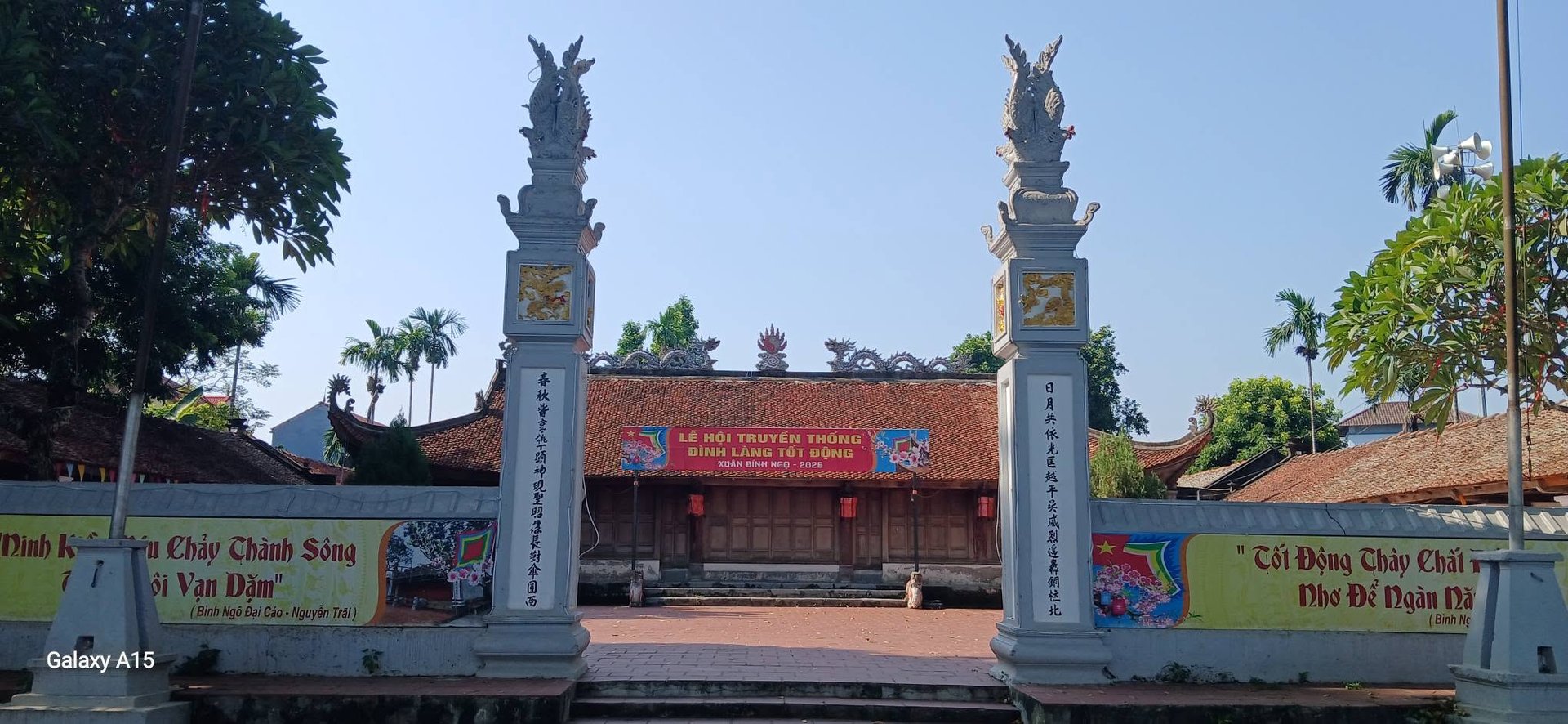
Tốt Động Village, also called Tụy Động and known by its vernacular name Làng Rét, is located in the southwest of Chương Mỹ District, a land of learning with a long historical tradition. This peaceful rural village lies beside the Bùi River. Here there is a communal house named after the village, called Tốt Động Communal House. This is a typical historical and cultural relic of Tốt Động land, Chương Mỹ District, Hanoi City (now Quảng Bị Commune, Hanoi City), associated with the Tốt Động – Chúc Động victory in 1426.
The communal house is located on a beautiful, elevated, and airy plot in the middle of Tốt Động Village. It currently has an architectural scale with many components such as the main gate, left and right side halls, main worship hall, and upper sanctuary, along with other structures, forming an inner Đinh and outer Quốc layout.
The communal house was built in the 15th century to commemorate and honor two famous generals, Lê Ngân and Đỗ Bí, who made great contributions to the Lam Sơn uprising.
Lê Ngân was from Đàm Di Commune in Lam Sơn, Thanh Hóa. He followed Lê Lợi from the very first days of the Lam Sơn uprising. General Lê Ngân achieved many victories, and his name is associated with the victories of Bồ Đằng, Khả Lưu, Nghệ An, Thuận Hóa, Tây Việt, Đông Đô, etc. Thanks to his many contributions in the uprising, by 1429, when Lê Lợi evaluated merits, rewarded, and engraved tablets recording the names of founding meritorious officials, he was ranked fourth and granted the title Á thượng hầu (a title granted only to Lê Ngân). In 1434, Lê Ngân was appointed to the rank of tư khấu and the position of Đô tổng quản Hành quân Bắc Đạo, and together with Grand Minister Lê Sát he held the regency for King Lê Thái Tông. In 1437, when Lê Sát was dismissed, he was appointed Chancellor, then entered the court as Grand Admiral, Phiêu kỵ thượng tướng quân, Đặc tiến Khai phủ Nghi Đồng Tam Ty, Thượng trụ quốc, and granted the title Thượng hầu. His daughter, Lê Nhật Lệ, was also bestowed the title Huệ phi of King Lê Thái Tông. In terms of family hierarchy, he was the king's father-in-law. However, while at the peak of power, he met great misfortune. In November 1437, he fell out of favor and was later forced to die because of accusations by people in his household. It was not until 16 years later, during a general amnesty, that King Lê Nhân Tông returned 100 mẫu of land to his son. In 1484, King Lê Thánh Tông posthumously conferred on him the title Thái phó hoằng quốc công. Today, the people of Tốt Động Village worship him at Quán Đừn.
Đỗ Bí was one of the two village tutelary gods of Tốt Động. He was from Cung Hoàng Hamlet, now in Nông Cống District, Thanh Hóa. He joined the Lam Sơn uprising from its earliest days as an ordinary soldier in the insurgent army at that time. But from the time Lam Sơn began massive attacks on Nghệ An, Đỗ Bí's name quickly rose. He was truly a talented general. His military career was recorded through major events such as: participating in commanding the Khả Lưu battle and, together with the insurgent army, stopping the enemy's march, preventing them from recapturing Trà Lân—a highly important position guarding the traffic artery in western Nghệ An. Đỗ Bí was also one of the outstanding generals commanding Lam Sơn's first army in the outskirts of Đông Quan in September 1426, directly commanding two battles, Ninh Kiều and Nhân Mục. Today he is worshipped by the people of Tốt Động Village at Quán Bến.
022. Historical value
Tốt Động Village Communal House dates from the 15th century, was rebuilt in 1840, and underwent repairs and embellishments in 1930 and 2018. The communal house worships two generals, Lê Ngân and Đỗ Bí, who in 1426 joined the Lam Sơn insurgent army to drive out the Ming invaders in the 15th century. In particular, the Chúc Động – Tốt Động battle, which destroyed and captured 60,000 Ming troops, has been recorded in history. Tốt Động Communal House was ranked as a national-level historical relic by the Ministry of Culture and Information on December 29, 1985, and is a place for cultural and religious activities for the people of Tốt Động and visitors from everywhere.
According to the spirit records and especially the book “Tạp ký bản xứ chi sự” written in the Giáp Tuất year, in the fourth decade of the 15th century, that is, in 1437 after Lê Ngân died and in 1460 after Đỗ Bí died, Tốt Động Village established a communal house to worship the two men. At that time the communal house was built in Xóm Giữa (whose literary name was the old Xóm Trung Nam); unfortunately, after many years, traces of that relic no longer remain today. This likely corresponds to what is recorded in the miscellany that “the main sanctuary of the old communal house of Liên Bạc Commune, Sơn Linh District, was brought to be erected at the place where the earth god of Leo Hamlet, whose literary name was Phù Linh, was worshipped.” After much time and damage from wind and rain, and after many repairs, by the Minh Mệnh Ất Mùi year (1835), at the request of the village, the communal house was again sold to Quảng Bị Commune for the second time. Nine years later, in the Thiệu Trị Giáp Thìn year (1844), the villagers bought the upper sanctuary of Ninh Sơn Communal House and erected it at the current site of the communal house. One year later the communal house was restored and expanded, with an upper sanctuary, main hall, left side hall, and right side hall more than 50 bays long in the nội công ngoại quốc style. Currently, on the upper beam it is still recorded: “Hoàng triều Bảo Đại ngũ niên tuế thứ Canh Ngọ 1930,” when the communal house was again repaired and expanded to a more spacious scale. Using artistic methods to determine the date, all traces of carved art and architecture in the communal house are consistent with that absolute date.
033. Architecture and art
Tốt Động Communal House has a ground-plan architecture built in the fifth year of Bảo Đại (1930), in the nội đinh ngoại quốc style, with an imposing scale comprising the upper sanctuary, main hall, left side hall, right side hall, and rear hall, symmetrically arranged in the traditional manner to form a unified and harmonious whole, preserving not only architectural unity but also the natural landscape. However, the current ground-plan architecture retains only the original state of the upper sanctuary and main hall in the Đinh character layout. Nevertheless, it still maintains a dignified appearance thanks to a site that is both high and wide and beautiful. The most prominent architecture is the main hall; the main structural trusses are built in the style of upper beams and lower braces, a traditional structure that is both sturdy and ensures that the beam surfaces are carved with artistic sculptures. In addition, the trusses in different architectural components are uniformly in the simple one-brace style but still ensure a solid structural force; in terms of artistic carving value, the highlight of Tốt Động Communal House is its strongly folk-art value in theme, ideology, and landscape composition. Overall, the artworks were arranged by ancient artisans harmoniously, without being cumbersome or greedy for decoration everywhere; only focused description was needed. First, in terms of folk-art themes, there is a considerable richness of scenes of leisurely daily life and familiar animals such as tigers, deer, and elephants, which became artistic subjects and were respectfully admired. In particular, there is a monumental wooden relief painted in color depicting the folk tale “cá hóa rồng” (fish transforming into a dragon).
The corner panels (cốn) in the communal house remain intact; their main theme is “Ngư long hý thuỷ” (fish and dragon playing in water), but the composition of each panel has its own beauty and is symmetrical and balanced. Dragon imagery appears quite often on the đầu dư, cốn, and cửa võng. In addition, some “tứ quý” motifs (pine, plum, chrysanthemum, bamboo) are also skillfully rendered by the artisans in other positions. Overall, Tốt Động Communal House is quite imposing and dignified. It still has enough columns, surrounding walls, and soaring curved roof corners. Other components include a brick yard and rows of left and right side halls. This is the sacred space during the village festivals, where folk games with a martial spirit such as stick dancing and wrestling take place, bringing joy to the whole region.
044. Festival and cultural activities
The Tốt Động Village Communal House Festival is held according to convention once every five years. The festival lasts three days, from the 6th to the end of the 8th day of the Lunar New Year (the palanquin procession takes place on the 6th day of Tet). The festival rituals are offerings and palanquin processions, which have become a saying passed down for generations.
Traditionally, on the seventh day of the first lunar month
Tốt Động holds its festival with drums and gongs to welcome the deities
Before the scorched-earth resistance, the Tốt Động Village Communal House Festival consisted of two main parts: the ritual part, including offerings and palanquin processions, and the festive part, including folk games and the opening of the first market of the year. There were also folk performances imbued with a martial spirit, such as stick dancing and wrestling, famous throughout the region. When the communal house was restored, the rituals and ceremonies were preserved almost intact; the festive part still includes folk games and adds cultural, artistic, and sports activities.
The cultural space associated with the Tốt Động Communal House Festival includes: Tốt Động Communal House, Quán Bến, and Quán Đừn (In addition to Tốt Động Village Communal House, the two famous generals Lê Ngân and Đỗ Bí are also respectfully worshipped by the people of Tốt Động at two relics, Quán Đừn and Quán Bến).
055. Current values and significance
The festival is a form of religious activity to remember the merits of the two generals and village tutelary gods Lê Ngân and Đỗ Bí, together with the generals and soldiers of the Lam Sơn insurgent army; to pray for favorable rain and wind, good harvests, and harmonious families; and to educate younger generations in the tradition of patriotism and resistance against foreign invaders. It is also an occasion for people far from home to return and gather with their families, strengthen community bonds, and enrich the hometown's tradition of solidarity.
More Other places
- Other placesVerified
Gioi Duc Pagoda (Hong An Temple)
Ung Hoa Commune
5.0Free  Other placesVerified
Hai Giac Pagoda
O Dien Commune
5.0Free Other placesVerified
Phuong Bang Pagoda (Hung Long)
Son Dong Commune
5.0Free Other placesVerified
Sung An Pagoda, also known as Sung Khang Pagoda (Dong Ba Pagoda)
Thượng Cát Ward
5.0Free
