
Mai Dich Communal House
Good to know
- You should arrive early for an open and airy experience
- Free
- Convenient access by all means of transport
Introduction
Story
01MAI DICH COMMUNAL HOUSE - AN ANCIENT SOUL IN THE HEART OF THE CITY
The thousand-year civilized land of Thang Long - Hanoi is proud not only of its grandiose landscapes, but also of countless ancient communal houses and pagodas hidden in the heart of the modern city.
Located right beside Ho Tung Mau Street (now in Phu Dien Ward, Hanoi City), Mai Dich Village was formerly a large post station connecting Thang Long with the Doai region. Mai Dich Communal House is not only a space for the community's cultural and religious activities of local people, but also a place preserving heroic pages of history and the distinctive beauty of the nation's traditional architecture.
The ancient village of Mai Dich was established in the late 15th century under King Le Thanh Tong (1460 - 1497). The current communal house was built in the Tan Dau year (1741) under King Le Canh Hung on the foundation of the old communal house.
Mai Dich Communal House worships the village tutelary god Hau Ly Nam De (Ly Phat Tu) – a historical figure from the early period of resistance against Northern domination, about 1,400 years ago. Ly Phat Tu was a general of the same clan as Tien Ly Nam De (Ly Bon). He actively participated in the uprising to drive out the Cực/Lương protectorate administrators, contributing to building the Van Xuan state. After Ly Nam De passed away, he and Dao Lang Vuong continued to lead the people against invaders, pacify the enemy, and unify the country. Because he had merit in protecting the village and supporting the people, he was worshipped by Mai Dich villagers as the tutelary god. Through the Later Le, Tay Son, and Nguyen dynasties, he was conferred the title of Thuong Dang Phuc Than.
In addition, Mai Dich Communal House also jointly worships the local notable Ho Bo Thuong Thu - Liem Quan Cong - Thai Tu Thieu Bao Nguyen Kha Trac (1598 - 1672), an incorruptible official who made many contributions to his homeland and the country.
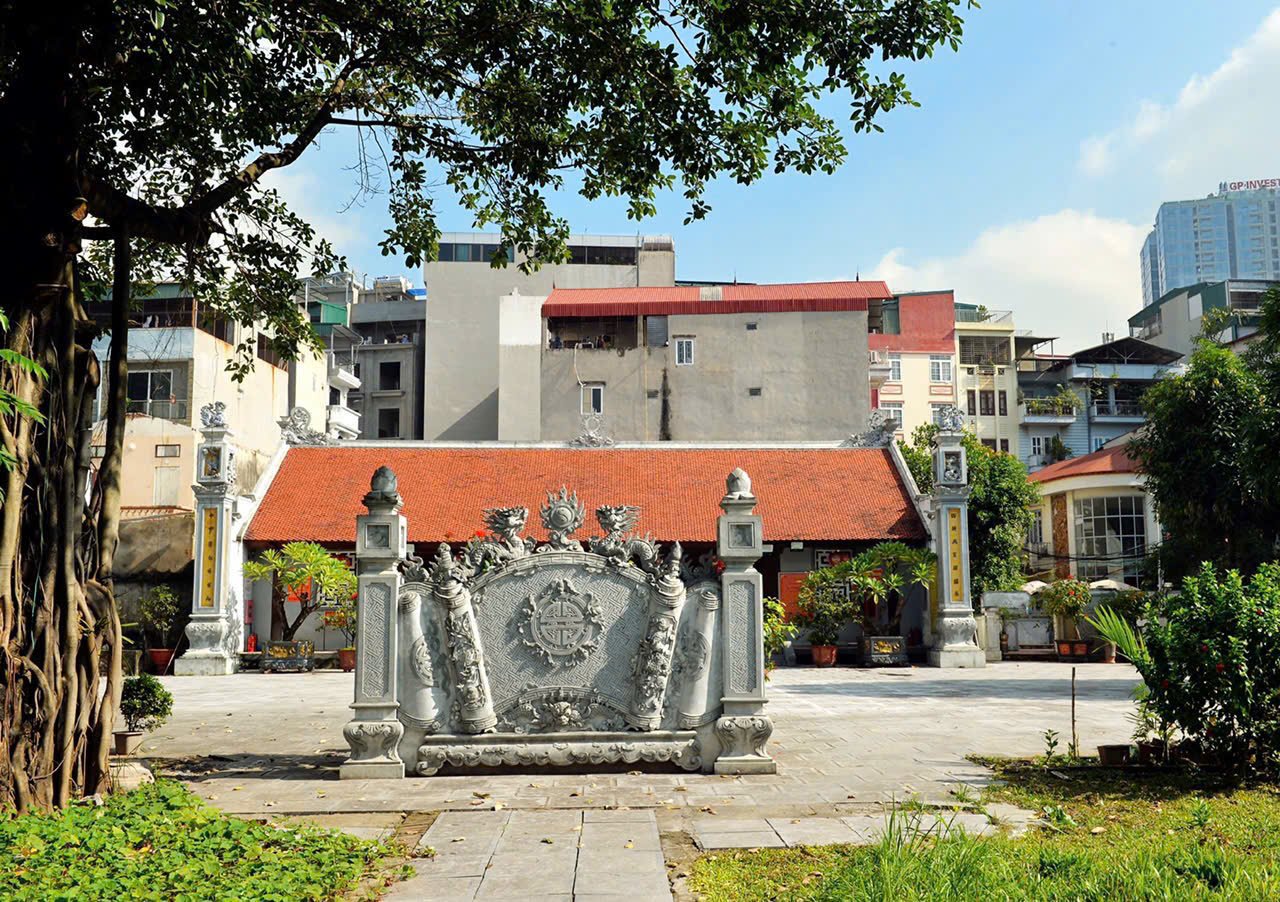
Mai Dich Communal House was built on a spacious, airy plot, planned according to the "Inner temple, outer landscape" style with a majestic North-South sacred axis:
• Exterior area: including the Nghi Mon (ceremonial gate), communal courtyard, and cool green garden, creating a harmonious and pleasant space.
• Main architectural area: featuring architecture in the Cong (工) shape (or "inner Cong, outer Quoc") including:
1. Dai Dinh Hall: Consists of 5 brick-built bays, with gently wave-like tiled roof. The wooden frame system is firmly linked according to the structure "Thuong chong giuong gia chieng, ha ke". The wooden components are strongly mortised, wedged, and meticulously planed.
2. Phuong Dinh Pavilion: Located right behind Dai Dinh Hall and in front of Cung Cam. The building has a unique two-story, eight-roof structure. The frieze between the two roof tiers has wooden bars for natural light. The upper roof tier stands firmly on four large columns, creating extremely exquisite carved cloud and dragon patterns. This is a rare structural style among village communal houses in Hanoi.
3. Cung Cam: The most solemn place, where the altar and throne of the village tutelary god are located. The floor is paved with Bat Trang bricks, giving an ancient and solemn appearance.
Over nearly 300 years of existence, Mai Dich Communal House has preserved a rich treasure of relics:
• 9 precious divine ordinations from the Le, Tay Son, and Nguyen dynasties (including an ordination from the 5th Quang Trung year - 1792).
• A system of horizontal plaques, parallel sentences, incense tables, bat buu, and worship cranes meticulously carved with 18th-19th century artistry.
• Most special is the stone stele 'Cung phung bi ky' erected in the 21st Canh Hung year (1760). This stele records the buying and selling of shares, regulations for offerings and sacrifices, and the distribution of sacred blessings during festivals. This is extremely unique documentation that helps researchers understand the economic and social life aspects of traditional Vietnamese village festival management.
With great historical, architectural, and cultural values, in 1995 Mai Dich Communal House was honored to be granted a Certificate recognizing it as a National Historical-Cultural Relic by the Ministry of Culture and Information.
Every year, on the 12th day of the second lunar month, the people of Mai Dich joyfully hold the traditional festival to express gratitude for the merits of the village tutelary god. The communal house is not only a historical witness through periods of upheaval but also a 'thread' connecting the community and preserving the nation's cultural identity in the heart of the modern capital.
More Other places
- Other placesVerified
Gioi Duc Pagoda (Hong An Temple)
Ung Hoa Commune
5.0Free  Other placesVerified
Hai Giac Pagoda
O Dien Commune
5.0Free Other placesVerified
Phuong Bang Pagoda (Hung Long)
Son Dong Commune
5.0Free Other placesVerified
Sung An Pagoda, also known as Sung Khang Pagoda (Dong Ba Pagoda)
Thượng Cát Ward
5.0Free
