
Mieu Nha Communal House
Introduction
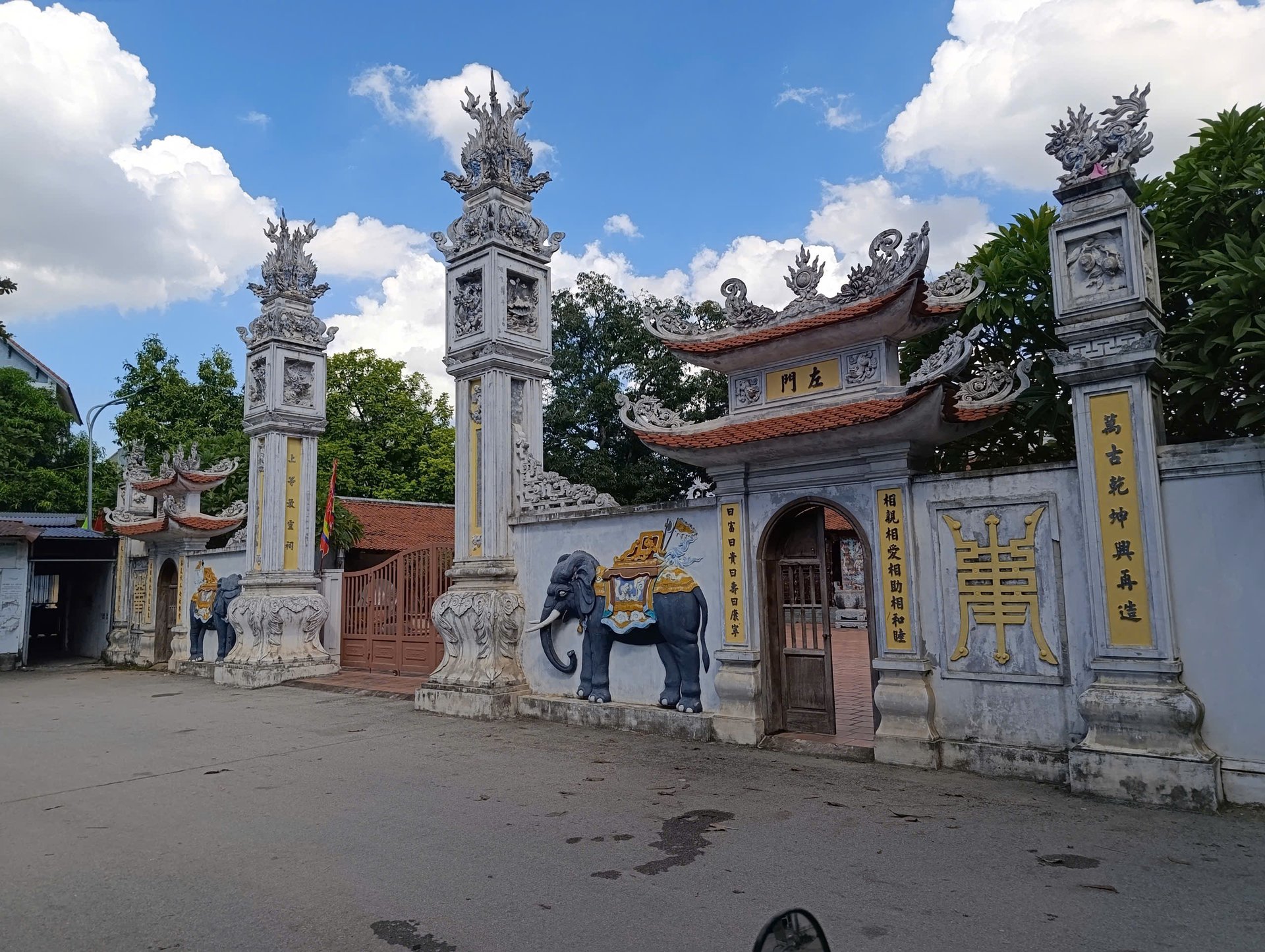
Mieu Nha Communal House is the ancient communal house of Mieu Nha Village, whose vernacular name is Ke Nga, now belonging to Xuan Phuong Ward, Hanoi City. Previously, the village belonged to the Tay Mo area, Tu Liem District. After many changes in administrative boundaries, Mieu Nha now lies within the urban area west of Hanoi but still retains fairly clear traces of an ancient village.
The communal house was built on a high plot of land, facing northwest. In front is a square pond, creating an open space and forming the characteristic landscape layout of a Northern Delta village communal house. The architectural complex includes the gate, courtyard, two rows of Giai Vu side halls, Tien Te front hall, Ong Muong corridor, and Dai Dinh main hall. The successive layers of structures form a plan nearly the character Cong.
The Tien Te front hall consists of three bays with two side wings. On the roof trusses, many carved panels remain in the artistic style of around the 17th–18th centuries. Prominent are images of dragons, tiger-face motifs, flowers and leaves, and highly symbolic decorative panels.
From the Tien Te, passing through the Ong Muong, is the Dai Dinh, consisting of five bays with two side wings. The corner beam in the central bay is carved with dragons facing the sun and tiger-face motifs, creating a focal point for the worship space. Inside there are also worship cabinets lacquered red and gilded, decorated with dragon, li, turtle, and phoenix.
More than two hundred meters from the communal house is Mieu Nha Shrine, built later, around the early 20th century. The shrine has a plan in the shape of the character Nhi, consisting of a Tien Te front hall and Hau Cung rear sanctuary, with a semicircular pond in front. The communal house and shrine form a closely linked relic complex in the saint procession ritual.
In terms of artifacts, the communal house–shrine complex still preserves many valuable documents such as the Chinh Hoa stele of 1682, a system of royal edicts, the Ngoc Pha genealogical record of Ly Nam De, an eight-bearer palanquin, two dragon palanquins, a pair of wooden horses, an incense table, a worship platform, worship cabinets, horizontal plaques, scrolls, and parallel sentences.
In particular, the earliest recorded royal edict bears the era name Vinh Khanh the second, 1730, showing that the worship of the Tutelary God here was recognized by the court quite early.
On January 21, 1989, the Mieu Nha Communal House–Shrine was ranked by the Ministry of Culture as a national-level relic.
Today, the value of Mieu Nha lies not only in its ancient architecture or system of artifacts. It is also a living space of belief, where memories of Ly Nam De, the January festival, and the friendly ties with Ngoc Mach Village are still maintained by the community.
The main figure worshipped at Mieu Nha Communal House is Ly Nam De, whose real name was Ly Bi, one of the important figures in sixth-century Vietnamese history.
In 542, Ly Bi gathered forces for an uprising against the Liang dynasty administration. After successive victories, in 544 he ascended the throne as emperor and adopted the era name Thien Duc and established the country name as Van Xuan.
Proclaiming himself emperor and establishing a separate country name carried special significance. It was not only a military victory but also expressed the aspiration to build an independent state with sovereignty and its own court.
In the beliefs at Mieu Nha, Ly Nam De is not only remembered as a king in history. Local legend says that during his military activities, he marched through this area, assembled forces, and stopped at several places around the village.
Folk tradition also says that the day the 12th day of the first lunar month was the time when Ly Nam De left Mieu Nha to continue his march. For this reason, this day later became an important milestone in the village's traditional festival.
The details of Ly Nam De's journey at Mieu Nha belong to the realm of local legend, but they play a very important role in explaining the origin of the belief.
In the communal house there still remain the Ngoc Pha, royal edicts, a dragon throne, a memorial tablet, and many worship objects related to the Tutelary God. Through many generations, Ly Nam De has been revered by the community as a guardian deity, a symbol of the spirit of independence and the will to build the nation.
Therefore, the worship of Ly Nam De at Mieu Nha is both religiously meaningful and a way for local people to recall an important period in the nation's history – the period when the state Van Xuan came into being in the sixth century.



