
Ngoc Mach Communal House
Introduction
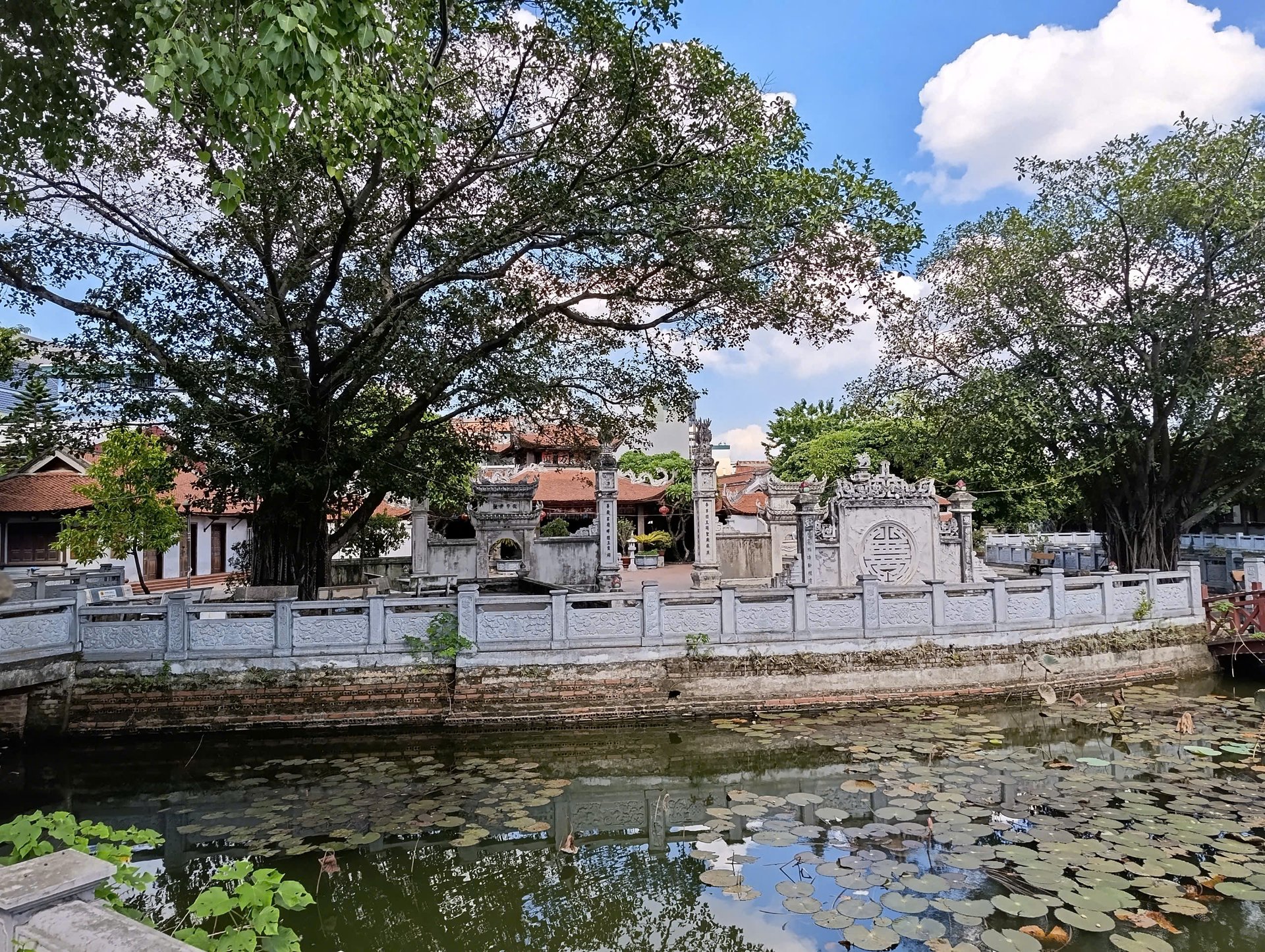
Ngoc Mach Communal House is an ancient communal house of Ngoc Mach Village, now belonging to Xuan Phuong Ward, Hanoi City. This is an ancient Vietnamese village in the western Thang Long region, formed on the foundation of a long-standing agricultural community. In traditional life, the communal house was both a place to worship the Tutelary God and the center for rituals and communal activities of the villagers.
The communal house is set in spacious grounds with many ancient trees, creating a quiet and ancient landscape. The overall architecture includes Phuong Dinh, Dai Bai, Hau Cung, Ta Vu and Huu Vu.
Prominent at the front is Phuong Dinh, with a square floor plan, built in the style of two tiers and eight roofs. The roof corners curve upward, and the architecture features familiar motifs such as the four sacred creatures and the four noble plants.
Behind Phuong Dinh is Dai Bai, consisting of five bays and two side wings. The special value of the structure lies in the system of carvings on the cốn panels. Besides dragons, clouds, and sacred creatures, the artisans also introduced scenes very close to daily life, such as civil and military mandarins, people drinking wine, people plowing, boats amid rivers and mountains, a person riding a horse, and the long ma image. These richly dynamic carved panels create a rather rare distinctive feature of Ngoc Mach Communal House.
Deeper inside is Hau Cung, where the throne, memorial tablet, and important ritual objects of the Tutelary God are placed.
The communal house also preserves many valuable artifacts. Notably, there are an 18th-century-style bat cong palanquin, an incense table, a worship throne, a ceremonial curtain, and a 19th-century set of eight precious objects. The worship throne is carved with dragons, tiger tallies, flowers, and leaves; the set of eight precious objects, lacquered red and gilded, includes symbolic items such as a sword, brush, fan, gourd, musical stone, fly whisk, and objects representing the nobility of the deity's altar. Local records also mention a silver precious sword.
Other research sources also indicate that the communal house preserves deity records, many royal edicts, stone steles, horizontal plaques, and couplets related to the Tutelary God and village history.
On April 22, 1992, Ngoc Mach Communal House was ranked by the Ministry of Culture and Information as a National Architectural and Artistic Relic.
Amid the rapidly urbanizing area of western Hanoi, the eight roofs of Phuong Dinh, the vivid carvings, ancient trees, and system of ritual objects still help Ngoc Mach Communal House retain the appearance of an ancient Vietnamese village space.
The figure worshipped by Ngoc Mach villagers as the Tutelary God is commonly called Ly Lang. However, extant documents also use several other names, such as Ly Nha Lang or La Nam De Dai Vuong, and there is still no complete consensus on the character's genealogy. Therefore, stories about him should be understood mainly within the scope of the community's deity records and belief legends.
According to locally transmitted deity legends, Ly Lang belonged to the Ly family during the Van Xuan period. One variant says he was the son of Hau Ly Nam De; other sources call him Ly Nha Lang, son of Ly Phat Tu and of a generation after Ly Nam De. Despite differing details of his background, the transmitted versions all portray Ly Lang as a person of extraordinary appearance, wisdom, bravery, and military talent.
In folk memory, he is associated with wars defending the country during the turbulent period after the Van Xuan state was formed. That image was later deified and became a guardian deity for many communities.
At Ngoc Mach, the reverence for Ly Lang is expressed not only through Hau Cung, the worship throne, and royal edicts, but also through the festival maintained annually. Some documents also record that many villages in the former Son Tay region worshipped this deity and once sent representatives to Ngoc Mach to attend the festival.
Therefore, for the people of Ngoc Mach, Ly Lang is not only a character in a deity legend. He has become a symbol connecting the community with memories of the Van Xuan era, as well as the Tutelary God to whom people entrust their hopes for peace, good harvests, and a prosperous life.



