Nha Communal House
Introduction
The historical and cultural relic complex of Nha Communal House and Nha Pagoda formerly belonged to Nha Village, Co Linh Commune, Thuan An District, Kinh Bac Region. In the Nguyen period it was in Bac Ninh Province; today it belongs to Nha 2 Residential Group, Long Bien Ward, and Cu Dong Residential Group, Long Bien Ward, Hanoi City.
The Nha Communal House relic site is located in the southeast of Long Bien Ward, on the bank of the Red River, about 5 km from the center of Hanoi, across Vinh Tuy Bridge, about 300 m along the Long Bien–Bat Trang dike road. An ancient communal house with moss-covered tiled roofs appears before the eyes; first is the four-pillar ceremonial gate with phoenix and betel-leaf patterns, followed by the communal-house courtyard. Nha Communal House was built in the three-part layout, including the Great Assembly Hall, Central Hall, and Rear Sanctuary, with Left and Right Side Houses on both sides, following Nguyen-period architecture, and was most recently restored in 2013. The work was inaugurated with a plaque marking it as a project celebrating the 10th anniversary of the establishment of the former Long Bien District (06/11/2003–06/11/2013).
When was Nha Communal House built? To date, no documentation has been found mentioning its founding date; the patterns, carvings, sculptures of the four sacred creatures, and couplets on the communal house still retain traces from repairs during the Nguyen period (early 19th and 20th centuries). According to elderly villagers, Nha Communal House was formerly outside the Red River dike; due to flooding, the rebuilding of the dike gave the communal house its present position.
According to the genealogy of deities compiled by Hanlin Academy scholar Nguyen Binh on the 10th day of the first lunar month in the first year of Hong Phuc (1572), the main spirit tablets worshipped at Nha Communal House are: Linh Lang Great King – Superior-grade Tutelary Deity. (Nha Communal House was also granted worship by dynasties to two deities: Do Thong Anh Linh and Xuyen Hoa Princess)
According to the genealogy of deities, Linh Lang Great King was originally a son of the Dragon Lord, who, obeying Heaven's mandate, was sent down to become the fourth prince of King Ly Thanh Tong. He was born on the 13th day of the twelfth lunar month in 1054, was very handsome and talented in both letters and martial arts, and had as his mother Hao Nuong, the ninth concubine, from Bong Lai Commune, Quoc Oai Prefecture, Son Tay. During his lifetime he lived with his mother at Thu Le Camp, now Thu Le Ward, Cau Giay District, Hanoi. When he grew up and learned that the King was selecting talented people to help the country fight the enemy, he asked his mother for permission to join the army. Thanks to his all-round strategy and intelligence, he made great contributions to defeating the Song invaders in the 11th century and pacifying the country, and was granted many rewards and titles by the King, his father. It is said that during the years in the position of prince he devoted himself to caring for the people. After a few years he contracted smallpox and knew he could not survive. He asked his father, the King, for a red flag and a long spear, and threw the flag and spear up so that wherever this spear was seen a shrine would be established; Voi Phuc Temple is the main temple, and Nha Communal House and 268 places were granted worship. He passed away on the 10th day of the second lunar month in 1072 and was conferred by the King, his father, the title: Linh Lang Great King – Superior-grade Tutelary Deity.
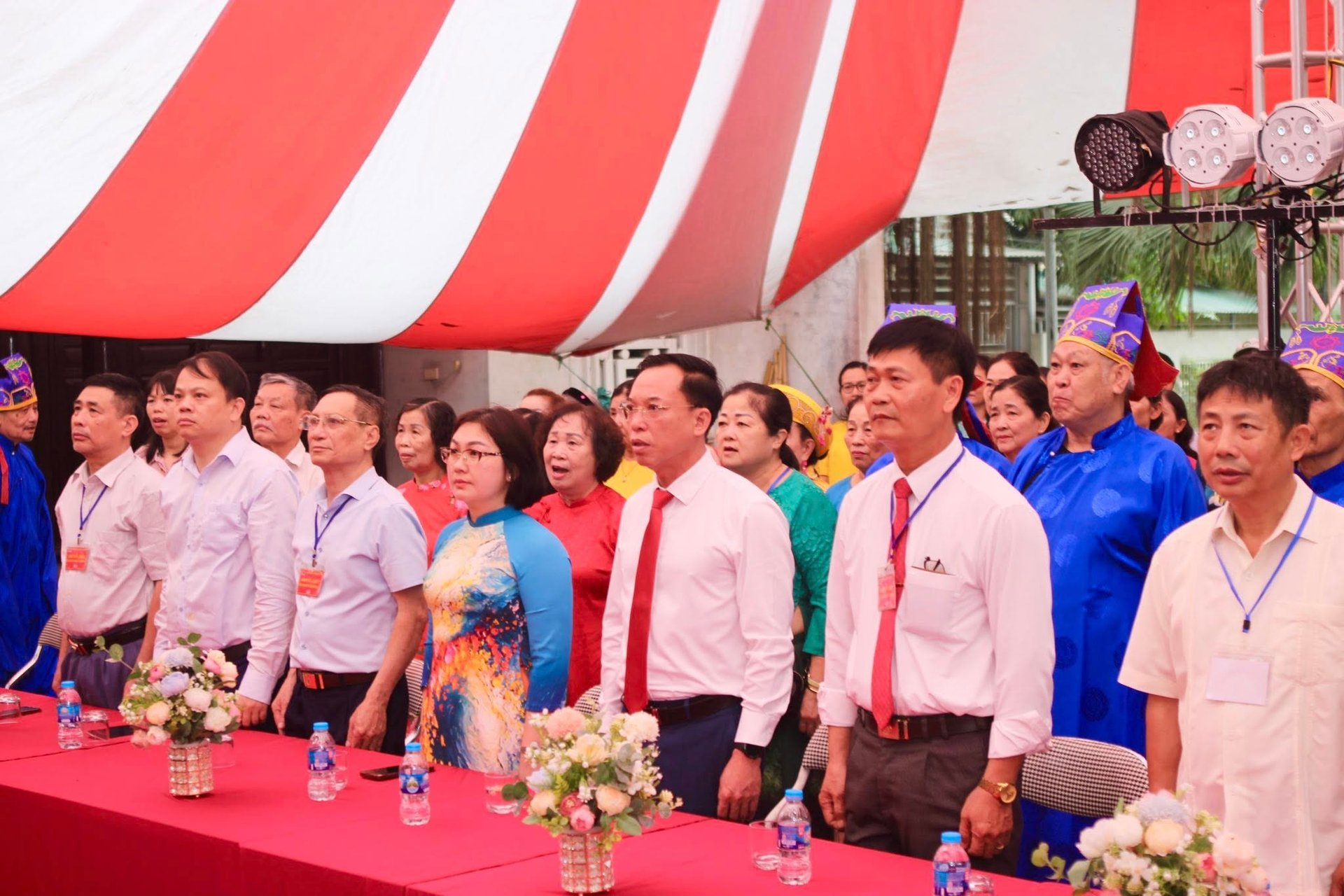
Village festival and folk games: The Nha Communal House Festival takes place from the 9th to the 11th day of the second lunar month every year, with the 10th being the main festival day. Villagers hold the festival in even years, and every five years they organize a large village festival (also called the Main Festival), while odd years are usually called the customary festival. The Nha Village Communal House Festival is a beautiful cultural feature of the Vietnamese nation and a ritual of ancestral worship by our forefathers. The village festival expresses the respect and reverence of descendants for their ancestors; it also demonstrates the cultural behavior of all members in the community of the village and commune, characteristic of the Vietnamese nation. It is a school that passes on to descendants the good customs, practices, ethics, and family traditions of our forefathers; it passes on to descendants a treasure of folk culture, artistic culture, architecture, sculpture, fine arts, painting, and more; it preserves tangible and intangible cultural values such as quan ho folk songs, cheo singing, xoan singing, vi singing, and other folk melodies; and folk games such as cockfighting, duck catching, human chess, tug-of-war, blindfolded drum beating, and more. Speaking of folk games at the Nha Communal House Festival, one must mention the former glutinous rice cake pounding contest performed by the clans, from selecting the rice (Nha sticky rice) to cooking the rice and competing in pounding cakes, with 3–5 young men demonstrating around the mortar until the cakes are ready, then arranged on a bronze tray and scored by the organizing committee, which announces the winning clan. In the past, the organizing committee's awards were first prize with a square of red cloth, second prize with a square of yellow cloth, third prize with a square of green cloth, along with some silver and copper coins. Today the festival organizing committee organizes folk games together with modern games and sports such as health exercises, football, badminton, and more. Through the Dinh, Le, Ly, Tran, Le, and Nguyen dynasties to the present day, the customs and practices of the traditional Nha Communal House Festival have still been preserved by descendants, who offer incense and fine wine to the deities and the village tutelary deity. The rich cultural features of a community and the good customs and practices, the precious heritage left by our forefathers, are continued in the work of building the cultural life of the people of Nha Village in particular and the people of Long Bien in general, contributing to building the elegant and civilized people of Hanoi.
On September 28, 1990, Nha Communal House - Pagoda was ranked as a National-level historical and cultural relic.