
Nhan Tai Communal House, Thu Lam Commune
Good to know
- You should arrive early for an open and airy experience
- Free
- Convenient access by taxi or bus.
Introduction
Story
01NHAN TAI COMMUNAL HOUSE – THU LAM COMMUNE
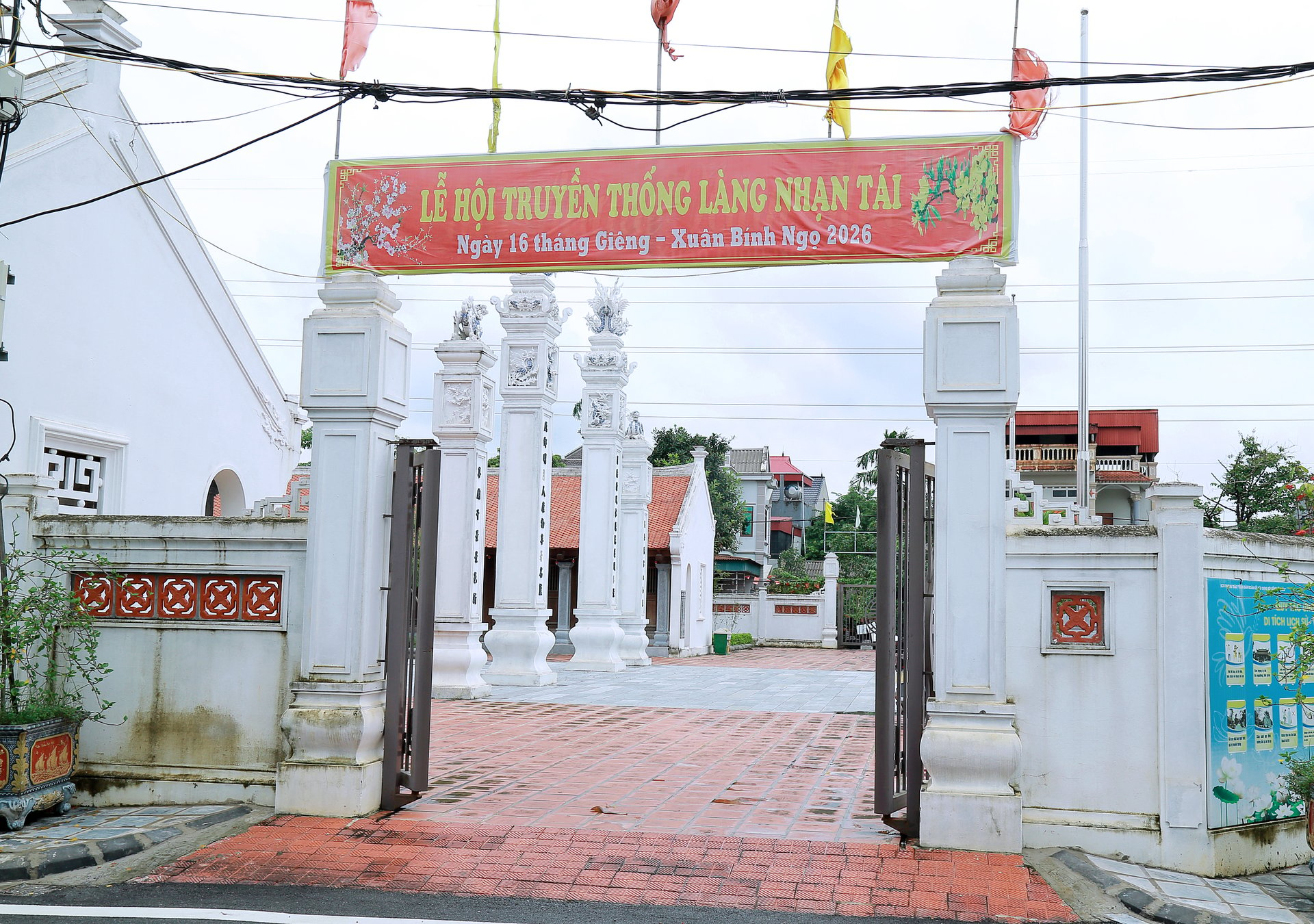
Nhan Tai Communal House belongs to Nhan Tai Village, Thu Lam Commune. The village is named Nhan Tai because it lies on a plot shaped like a swallow with wings spread flying east, its head turned back. The name Nhan Tai carries a profound meaning that the ancients wanted to leave to future generations: always strive forward, but never forget one's ancestors and roots. The history of the founding of Nhan Tai Village is no longer clear, but based on folk legends and the surviving system of relics, it can be inferred that Nhan Tai Village was established very long ago. This is shown through the system of ancient architectural relics such as communal houses, temples, pagodas, and shrines that still exist, where many architectural features and valuable artifacts are preserved, namely the village communal house.
The former Xuan Non area is a land with a very early history of formation and development. Since ancient times, its people have had a tradition of diligent, intelligent, creative labor and a spirit of love for their homeland and country. During the resistance war against the French colonialists, the most famous was Mr. Doc Bieu together with 36 young men of Nhan Village in the insurgent army of the Can Vuong movement... In the former Xuan Non area, Nhan Tai was a large village and located in the center. The village had two hamlets named Nhan Dinh and Nhan Duong. In ancient times, Nhan Tai land was a dense forest area called Nguyet Lam, stretching from Khe Van (now Nguyen Khe) through Nhan Village to Dao Xa forest (Dao Thuc), connecting with the Sai mountain forest (Thuy Lam) and That Dieu Mountain, with all kinds of birds and beasts.
Nhan Tai Communal House worships six village tutelary gods: Cao Son Dai Vuong, Quoc Vuong Thien Tu Nha Lang, A La Nang De, Doctor Do Nhuan, and two tutelary deities whose main names are unknown, recorded only by their honorific titles as Sung Nghiep An Dan Dai Vuong and Cam Ung Uy Linh Dai Vuong. The reason the communal house worships so many deities is that for a time the temple and the village's craft were damaged and there were no conditions for repair, so the people gathered the tablets and incense bowls of the deities at the communal house for joint worship.
The deity with the longest history and recorded in the genealogy book still kept at the communal house is Cao Son Dai Vuong. He is an important figure in the pantheon of the Vietnamese people in the past, one of the deities belonging to the mythological system of the earliest nation-building and national-defense period of our people. The second deity worshipped at the communal house is Quoc Vuong Thien Tu Nha Lang. He made contributions to establishing and protecting the Ly dynasty during the time of Ly Nam De. After quelling the rebellion of the Three Kings, he again led troops to fight the Champa invaders. Having pacified the South, King Ly granted him an appanage to enjoy revenues in Dong Ngan District, and after his death, King Ly conferred on him the title of tutelary deity, and he is worshipped in many places. A La Nang De is the only female deity worshipped at the communal house. She was the person who gathered local troops to follow the Trung Sisters to fight To Dinh and sacrificed herself. After her death, many places built shrines to worship her, including Nhan Tai Village. The fourth deity is a human deity, Doctor Do Nhuan. He was born in 1436; at the age of 31 he passed the Dong Tien Si Xuat Than examination in the Binh Tuat examination year, under King Le Thanh Tong, the seventh year of the Quang Thuan era (1466). He died in the 26th year of Hong Duc (1495) at the age of 59.
After passing the doctoral examination, he made many contributions to the country's culture. For his native Nhan Tai, he was the person credited with enlightening the cultural tradition and helping the people build Chu Pagoda and Forest Pagoda, enriching the spiritual life and cultural beauty of the people here. The remaining two great kings have only their honorific titles recorded on tablets and edicts; their origins and achievements are unknown, but they are also deities who helped the country and the people and were bestowed by feudal courts for eternal worship. The communal house and Nhan Tai of old were once a place for martial arts training by Hoang Hoa Tham's insurgent army, because Nhan Tai had 36 strong men who joined De Tham's anti-French movement.
Based on the history of the village's founding and the names of the tutelary gods, it can be inferred that Nhan Tai Communal House was built quite early; if based on surviving written records, it is certain that the communal house was built during the Later Le period, before the appearance of the divine edict dated the 44th year of Canh Hung (1783).
The communal house formerly faced north and later turned south. The change of orientation was tied to the event that Nhan Village had 36 people following De Tham's insurgent army, typically Doc Bieu (Ba Bieu), whom the colonialists called 'Bieu the rebel.' Along with changing the communal house's orientation, the colonialists also dug trenches crisscrossing the village to cut the 'land's dragon vein' that 'made rebels.' This was also a major restoration of which we still know. The most recent major restoration, which left the beauty of the current architecture, was in 1923. The reason was that around 1912 the communal house burned down, causing considerable damage. Then in 1923 the villagers contributed and invested to repair it, and in 1925 it was inaugurated. Currently on the upper beam of the communal house there is the inscription 'Hoang trieu Khai Dinh bat nien tue thu Quy Hoi thap nhi nguyet so tu nhat' (The 4th day of the 12th month of the Quy Hoi year, the 8th year of Khai Dinh - 1923).
Nhan Tai Communal House currently stands on a spacious plot in the upper hamlet. It faces south; in front is a brick yard with many tall shady trees; outside the screen in front of the communal house is a large lotus pond with a cool and poetic landscape. The communal house remains intact in terms of scale and external architectural style as well as the valuable worship objects inside. Its plan is in the shape of the Chinese character Dinh, including the main hall in front and the rear sanctuary connected behind. The roof is of the four-side type, with long sloping sides covered with hai-nose tiles; the four corner eaves curve gently upward, with two short and long tips embossed with two guardian animals, the turtle and the phoenix. In the center of the roof ridge, a pair of dragons with softly curved backs is embossed, facing a fiery sun with sharp blades rising upward. The roof edges are decorated with lemon-flower bricks and embossed into the shape of four crocodiles facing the roof ridge. The main hall consists of five bays and two wings with curved, sturdy, imposing, and solid eaves. Architectural decoration is concentrated mainly in the roof trusses, on the corbels, and especially in the system of dau du and dau nghe carved in openwork in a sturdy block with dragon heads with bulging eyes, open noses, and mouths holding pearls, crafted elaborately and meticulously. The corbels of the communal house are densely decorated with traditional themes such as the four sacred creatures (dragon, unicorn, turtle, phoenix). The carvings here are composed very harmoniously and reasonably, clearly showing the wonderful skill of ancient artisans, while also making the wooden frame in the main hall lighter and more elegant. Above the center of the main hall is an intact well panel, brilliantly lacquered and gilded, decorated with wing-like patterns; the four corners have long shapes and quyen tubes and beautiful brushes; these images are intended to emphasize study and success in examinations according to the old Confucian concept.
Through a long period of existence and having suffered many historical and social changes and natural impacts, Nhan Tai Communal House no longer retains intact its original ancient appearance of architecture or its long-standing worship artifacts. However, the surviving body of artifacts is quite rich and diverse and carries certain values in terms of history and art, contributing to increasing the aesthetic value of the communal house's architecture. Notable is the genealogy book copied in the Khai Dinh period about Cao Son Dai Vuong, a tutelary deity from the Hung Vuong era; in addition, there are some Han-character documents about the village tutelary gods. Especially there are three divine edicts, including one dated the 44th year of Canh Hung (1783), one dated the 4th year of Thieu Tri (1844), and one dated the 2nd year of Tu Duc (1849). These edicts all praise the merits of the deities and allow the people of Nhan Tai Village to worship them forever. Wooden worship artifacts are quite diverse, such as horizontal plaques, couplets, incense tables, curtain doors, octagonal palanquins, thrones, tablets, etc., all lacquered and gilded. The communal house's artifact system is a valuable collection of objects, contributing to the understanding and study of the nation's folk art through different historical periods.
Like most other historical relics of Thu Lam Commune, Nhan Tai Communal House is a place to worship tutelary deities and notable figures who made many contributions in different historical periods. To express gratitude to the tutelary deities, every year at Nhan Tai Communal House a festival is held on the 16th day of the first lunar month (Nguyen Tieu Festival). It includes traditional rituals and ceremonies expressing respect and gratitude to the village tutelary gods and imbued with national identity. Outside, divine flags fly in the wind; there are joyful and healthy games such as wrestling, tuong theater, cheo singing, xam singing, ca tru singing, human chess, etc. In the pond in front of the communal house there is a puppet stage with all kinds such as literary puppets, martial puppets, plowing puppets, lute-playing puppets, etc. The atmosphere is joyful and warm, just as the folk song still passed down says:
The spring festival opens before the communal house yard
In the pond, puppets bob up and down with drumbeats
Tung tung, the wrestling drums sound on the bank
Melodious xam and ca tru singing fill the yard.
With its historical, cultural, and scientific-artistic values, Nhan Tai Communal House was granted a recognition certificate by the Ministry of Culture and Information under Decision No. 3951 QD/BVHTT/1997 dated December 20, 1997. In the future, Nhan Tai Communal House, together with the system of unique and famous relics and folk festivals in Thu Lam Commune, including festivals associated with the former Xuan Non area such as the fire-pulling festival and cooking contest of Luong Quy Village, the son-in-law selection festival of Duong Yen Village, and the snake-pulling festival of Xuan Non Village, will become attractive tourist destinations of Thu Lam Commune and the capital Hanoi.
More Other places
- Other placesVerified
Gioi Duc Pagoda (Hong An Temple)
Ung Hoa Commune
5.0Free  Other placesVerified
Hai Giac Pagoda
O Dien Commune
5.0Free Other placesVerified
Phuong Bang Pagoda (Hung Long)
Son Dong Commune
5.0Free Other placesVerified
Sung An Pagoda, also known as Sung Khang Pagoda (Dong Ba Pagoda)
Thượng Cát Ward
5.0Free
